Author: T_Dot_Lane

Gatsby

It’s been a long time since my high school English class, but I remember that The Great Gatsby was one of my favorites.  It’s been dramatized a few times, including a 1974 version starring Robert Redford and Mia Farrow.  That version was a rather dull, literal interpretation of the book that offered little in the way of artistry.  Now, director Baz Luhrmann (Moulin Rouge, Romeo + Juliet) reunites with Leonardo DiCaprio (Django Unchained) in a beautiful adaptation of the Fitzgerald classic.

The movie begins true to form with the introduction of Nick Carraway, played here by Tobey Maguire (Brothers).  Nick is an observer, a spectator in a world to which he doesn’t actually belong, and our gateway to Gatsby.  He lives on Long Island, renting a modest cottage across the sound from his cousin Daisy (Carey Mulligan, Shame) and her husband Tom Buchanan (Joel Edgerton, Zero Dark Thirty).  Their estate dwarfs Nick’s, as the “old money” Buchanans are well established.

The Island is divided into two sections, with Daisy and Tom on East Egg, and Nick on West Egg.  As Nick acclimates himself to his new environment, he begins to hear whispers around town about Jay Gatsby, a mysterious resident of West Egg known for his lavish, opulent parties.  He lives next door to Nick, but the two have never met.  In fact, Gatsby is such a shadowy figure that for the first 20 or so minutes, we don’t even see him, we only hear about him in excited, hushed whispers.  This is particularly true at one of Gatsby’s own parties, to which Nick is invited – but wading through the rumors only adds to Gatsby’s mystique.  Is he a bootlegger? How did he make his fortune? As the speculation reaches a fever pitch, finally Nick meets his enigmatic host.

Gatsby’s noveau riche trappings initially do very little to entice the object of his affection, Daisy Buchanan.  They had a brief dalliance before she married, but circumstances precluded their union.  After returning from war, Gatsby did not have the means to provide for a woman such as Daisy, and this fact both drove and haunted him.  Fast-forward five years to 1922, and Gatsby’s love for Daisy has intensified in its yearning.  She is his motivation for everything: the parties and the decadent monument to capitalism that his mansion represents.  The pair is ill fated, and the revelation of this immutable fact is  beautifully tragic.  I don’t want to say much more about the plot, because I hope you’re already familiar.

Baz Luhrmann is a true artist, and the cinematography was breathtaking.  Certain scenes looked as if they could be paused, printed, framed, and hung on a wall.  When Nick gets drunk for only the second time in his life, it is during a raucous party in the city with Tom Buchanan, Tom’s mistress, and her friends.  Nick is torn between his loyalty to his cousin and friendship with Tom, but eventually casts his inhibitions aside.  Luhrmann creates an unforgettable scene, a beautiful bombardment of color and sound unlike anything you’ve seen.  It was like a Romare Bearden painting come to life.

Much ado has been made about the film’s anachronistic score, provided by Jay-Z.  Luhrmann has employed anachronism in previous work, and I found it mostly effective here.  “Who Gon Stop Me,” “No Church In the Wild,” and “100$ Bill” were completely on point in terms of their placement.  I can’t say enough about this film, and I honestly don’t see what’s to dislike.  Gatsby was a magical movie that juxtaposed the great opulence of a gilded age with the hollowness of hedonism and unrequited love.  The performances were brilliant and haunting, particularly those of DiCaprio and Maguire.  DiCaprio infused Gatsby with the requisite charisma and panache, affecting the aristocratic transatlantic accent of the day with perfection.  This was one of the best movies of 2013, so far.  Grade: A.
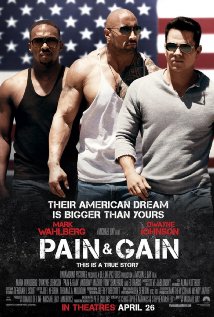
Pain & Gain

The trailer for Pain & Gain looked like my kind of movie, just the type of exciting, cool flick that cinephiles can expect this time of year as we gear up for the action-packed summer blockbusters.  I’m a fan of Mark Wahlberg, who is no stranger to playing the badass antihero (see The Departed and Contraband), and I liked the premise.  It promised to tell the true-life tale of an ambitious young bodybuilder who went from rags to riches, breaking a few laws along the way.   I was entertained at various times throughout the movie, but by the time the credits rolled I had an underwhelmed feeling.

Wahlberg stars as Daniel Lugo, a convicted murderer who took the lives of two innocent people in 1995 during a botched robbery.  The movie opens by introducing us to Lugo, an ambitious meathead with a voracious appetite for his version of the American Dream.  Lugo was inspired by the fictional exploits of the likes of Tony Montana and Michael Corleone, and (stupidly) aspired to be like them.  One would think that Scarface in particular would be a cautionary tale, considering that he ended up laying dead in a fountain looking like a piece of Swiss cheese – but don’t tell that to Daniel Lugo.

Lugo worked at a Florida gym, where he perfected his body and his designs on untold riches.  Accompanying him was friend Adrian (Anthony Mackie, Gangster Squad), a fellow bodybuilder with similar ambitions of greatness.  Eventually Lugo hatches a plan to kidnap and extort Victor Kershaw (Tony Shalhoub, Hemingway & Gellhorn), a wealthy client for whom he acts as personal trainer.  Kershaw has several assets that Lugo can liquidate if he compels Victor to turn them over.  Daniel and Adrian recruit a third man for their plot, a convict named Paul Doyle (Dwayne “The Rock” Johnson) who has served time in federal prison.  Doyle is a humorously devout Christian who found Jesus in jail.  Perversely ironic, he has no problem jibing his Christian ideals with a criminal lifestyle.  Once the three stooges have the plan in motion, they bungle their way through, eventually getting their hands on millions of dollars.  Eventually things begin to go south with Kershaw and the gang decides they need to do another job.  Their greed eventually gets the best of them, leading them to the robbery and murder of a wealthy couple that belonged to their gym.

The movie began to lose me about a third of the way through, when I couldn’t tell if it was taking itself seriously or not.  There were several implausible scenes, including one where Kershaw seems to be invincible.  I did research after the fact, and it turns out that these farfetched things actually happened.  I can’t fault director Michael Bay (Transformers) for telling it like it is, but I can fault him for the way he chose to depict these real-life events.  The three principal characters were portrayed as funny and likeable, and so I liked them.  But by the time the movie concludes, the viewer realizes that these funny guys did a horrible thing.  Because they were depicted so comically initially, I’m not sure that the severity of their actions adequately resonated with viewers.  I enjoyed the laughs, and Wahlberg was his usual cool, badass self – but I was left with too many conflicting elements, from an emotional perspective.  I don’t attribute this to any particular depth of storytelling, but rather to a muddled approach by director Michael Bay.

Grade: C+

This article first appeared at Poptimal and was reprinted with permission.

The Place Beyond the Pines

I adore Ryan Gosling.  I think his choices are shrewd and artful, and the camera loves him.  I can rattle off several of his movies that I think are truly superb, and now you can add one more to the list. In The Place Beyond the Pines, Gosling gives a stirring performance that permeates quietly before a shocking culmination.

The movie begins with an introduction to Luke Glanton (Gosling, Gangster Squad), a motorcycle stunt rider who performs in a traveling carnival.  Director Derek Cianfrance (Blue Valentine) immediately drew the audience in with a taut opening sequence, as Luke performs a dangerous three-man stunt in a steel cage without batting an eyelash.  We see immediately that he is a thrilling character, dangerous and effortlessly cool.  I was reminded of Gosling’s turn in Drive, which also began with a riveting introduction to the main character in his element.  Before he leaves for his next city, he is visited by Romina (Eva Mendes, The Other Guys), an old flame.  Ro wears a pained expression, and their interaction is cautious and awkward as he drives her home.  He tells Ro that he will be leaving town soon, but he later stops by spontaneously one last time before hitting the road.  Ro isn’t home, but her mother answers the door holding an infant, which turns out to be his son Jason.

Luke is upset that Ro didn’t tell him about his son, although he hadn’t kept in contact with her since his last visit.  He immediately feels a sense of responsibility and decides to stick around town, quitting the carnival.  He shifts gears and wants to be a provider, though he is totally unequipped and unprepared for fatherhood.  The fact that Ro is in a relationship with a new man (Mahershala Ali, House of Cards) and surrogate father to Jason only adds to Luke’s feelings of inadequacy and emasculation.  Soon he meets Robin, a friendly swindler who easily convinces him to knock off a bank for a quick, small score.  In a brazen daytime robbery, Luke rides his motorcycle up to the bank door and surprises unsuspecting tellers in a daring heist.  He makes his exit quickly, zipping through traffic at a harrowing clip to rendezvous with Robin.  These moments when Gosling (or his stunt double) weaved his way through traffic and the pine trees of the forest on his motorcycle were amazing.

Eventually Luke crosses paths with Avery Cross (Bradley Cooper, Silver Linings Playbook) an ambitious Schenectady cop who is privy to larger corruption within the department.  The movie shifts at the midway point, and we begin to see life through Avery’s eyes.  Despite the varied perspectives, the film never felt unfocused.  As we examine the aftermath of their interaction, a parallel storyline emerges, as Luke’s fate and that of his infant son become inextricably tied to Avery Cross, who also has a baby boy.  As the movie unfolds, a haunting context emerges, giving more resonance to Gosling’s character, even when he is not on screen.

From Blue Valentine to Drive, Gosling always strikes the right note and draws the viewer in to his characters’ emotions.  His portrayal was authentic, and I never doubted the performance.  There was a fateful air of sadness that hung over the movie, and Luke was a sympathetic character despite his criminal leanings.  Luke’s energy was palpable, and Gosling was magnetic in every scene.  The Place Beyond the Pines was a poignant, electrifying movie that explored the themes of fatherhood and manhood in a stirring and powerful way.  The camera loves Ryan Gosling, and you will too. Grade: A.

42

A few days ago I had the pleasure of watching 42, the historical account of Jackie Robinson’s integration of major league baseball in 1947.  Robinson is a central figure in Black History, but he was an American hero whose story can be championed by all.

The movie starts without a single opening credit, with director Brian Helgeland (The Order) providing an account of the historical context of American life in 1947 and by extension, baseball.  Segregation was the law of the land, but Brooklyn Dodger president Branch Rickey (Harrison Ford, Cowboys & Aliens) had the progressive inclination to add a Negro player to the team.  Robinson (played by newcomer Chadwick Boseman) possessed a blend of athleticism, youth and pedigree that made him the clear choice over other talented Negro League players, like Satchel Paige.  Although Robinson is a legend, it took a visionary like Rickey to provide the platform for change.

Robinson faced profound and insidious discrimination.  When he stepped up to home plate he was jeered by fans as well as opposing teams.  Opposing pitchers threw at his head, and while playing first base during his first year an opponent intentionally speared him with his cleats.  Throughout this abuse, Robinson maintained his dignity and composure.  One couldn’t even say that a lesser man would have retaliated, because any man would have.  Rickey carefully explained to Robinson that he would never be able to react to the abuse or else the “experiment” would fail.  He bravely served as baseball’s test case to end segregation, enduring ceaseless racism at every turn.

Despite my overwhelmingly positive thoughts about the film, I do have a few minor criticisms.  Harrison Ford’s portrayal of Branch Rickey was very blustery.  He could have pulled back a little bit; but maybe that’s how Rickey really behaved.  If so, I should give him credit.  But if that was Ford’s own interpretation; I found it annoying.  Another minor quibble is that the filmmakers started the movie with a recitation that some may find boring.  I was interested, but it did come across as something you’d see on PBS or some other educational channel.  I do think it was important to set the appropriate historical context for the movie, but it felt like a perfunctory start.

42 balances the ugliness that occasionally marred Robinson’s baseball career with the warmth and purity of the love he shared with his devoted wife Rachel (the talented Nicole Beharie, Shame), a young woman he met while enrolled at UCLA.  Rachel kept Jackie grounded and was a source of peace and solace in an otherwise tumultuous world.  Despite the abuse that Robinson suffered, his time on the diamond was characterized by great triumph as well.  On the most fundamental level, Robinson was an outstanding athlete who wanted to be judged on his merits rather than his skin color.  This simple tenet is the cornerstone of our democracy, but 66 years ago Robinson struggled to receive the most basic allowances that we take for granted now.

Robinson portrayed himself in his own biopic decades ago, but this is the first dramatization to give proper attention and dramatic effect to his story.  Boseman’s big screen debut ostensibly came with lofty expectations, but I think he more than ably captured the humility and quiet strength that Robinson personified.  I think all Americans should see this movie about one of the most transformative figures in our shared history.  Grade: A-


Trance

I think I have a decent working knowledge of recent cinema, but I admit that I had no idea director Danny Boyle (127 Hours) was such a prolific filmmaker.  His name wasn’t on my radar until 2008’s Slumdog Millionaire, which was amazing. I looked at his filmography and realized that there are a few more of his movies that I’d seen, including 28 Days Later and The Beach.  I enjoy his work because he has no discernible niche, and his repertoire reflects a unique versatility.

His latest offering is Trance, a reality-bending thriller starring James McAvoy (X-Men: First Class), Vincent Cassel (Black Swan), and Rosario Dawson (Unstoppable). McAvoy leads as Simon, a young auctioneer who sells valuable paintings off for a Sotheby’s-like company. The movie begins with Simon as narrator, describing his duties as auctioneer, including a detailed description of their robbery protocol.  Robberies used to happen with greater frequency in decades past, as thugs would simply storm into the auction with guns drawn, taking the precious art by force. When Vincent Cassel’s character Frank and his cohorts conspire to steal a valuable Goya painting, they display an intimate knowledge of the robbery protocol that could have only resulted from inside information, which implicates Simon.  When their brilliant heist goes awry, Simon is the only one who can provide answers. The stolen Goya has been lost, and only he knows its whereabouts.  Unfortunately, during the botched heist he suffered an amnesia-causing injury.

Complicating matters is Dr. Elizabeth Lamb (Dawson), a hypno-therapist who believes she can unlock Simon’s memory through co-operative therapy.  She places him in a trance, a mental state where he is highly susceptible to suggestion.  Elizabeth helps Simon navigate the deepest recesses of his mind and he begins to recall certain events.  But are these memories real or false? The lines between doctor and patient and reality and fantasy all become blurred, giving the film a surreal, moody quality.  There was foreshadowing throughout, which only added to the mystery and atmospheric intrigue that Boyle so deftly created.

Vincent Cassel was very effective as Frank, giving the character an unexpected depth.  One minute he seems like Simon’s tormentor; the next minute he is a concerned friend.  Rosario Dawson literally bared it all, boldly appearing nude from head to toe more than once.  I couldn’t believe she showed everything…even the “honeypot!”  I respect her dedication to the role, because although a close up of her hoo-haa may seem gratuitous, it actually made sense for her character to expose herself in such fashion.  James McAvoy ably exhibited Simon’s downward spiral, beginning the film upbeat and confident and ending it in a very dark place as he questions all around him.

The camera angles and cinematography were superb, as some scenes resembled the famous paintings that were featured in the movie.  Boyle’s use of color and overhead camera shots elevated the film to another level.  The writing and performances were nearly flawless, and the script was so cleverly written that Trance bears repeated viewings to be fully understood.  I found it confusing at times, but I attribute this muddling to my own lack of understanding rather than a flaw in Boyle’s writing.  Again, a second viewing is advisable.  If you appreciate suspense, you will not be disappointed. Grade: A-

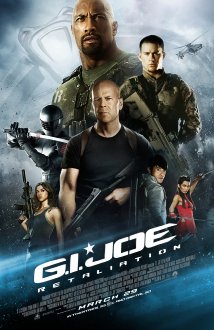
G.I. Joe: Retaliation

Once again I have to start this review with my fanboy disclaimer: I am not a GI Joe “buff,” and you shouldn’t have to be to see this movie.  I watched the cartoons as a child, but I’m approaching this review as an average moviegoer and not an enthusiast.  At any rate, I enjoyed the first edition and was looking forward to the sequel.  It was entertaining, and it opened up at number 1 at the box office – but it wasn’t quite all it was cracked up to be.

We begin with Duke (Channing Tatum, Side Effects) and Roadblock (Dwayne “The Rock” Johnson, Snitch) as the movie opens with a glimpse into their affable friendship.  Tatum and Johnson have an easy rapport, and it’s always interesting to see these iconic cartoon/comic book characters brought to life.  Lady Jaye is portrayed by Adrianne Palicki (Red Dawn), who you may recognize from Friday Night Lights, while DJ Cotrona of Detroit 187 appears as Flint.  Duke is the clear leader, but his position is threatened when the Joes are ambushed by COBRA while on assignment.  It turns out the President is actually a disguised Zartan, who ultimately wants to free Cobra Commander from his prison and destroy the Joes in the process.  The ambush results in severe casualties, and nuclear warheads are stolen. The President (Zartan) blames the Joes and paints them as traitors, disavowing them.  Disgraced and betrayed, the surviving Joes band together to figure out who’s responsible and recover the warheads.

I’ll be succinct and quite simply tell you what worked and what didn’t.  We’ll start with the positive.  I thought the casting was effective and the lineup made sense.  Additionally, there were quite a few cool scenes and plenty of entertaining action sequences, including a memorable scene involving Snake Eyes (Ray Park, X-Men) and Jinx (Elodie Yung, The Girl With the Dragon Tattoo) battling ninjas on the side of a snow-capped mountain.  Bruce Willis (Red) makes a cameo as a seasoned Joe who lends a hand, and he’s a sentimental favorite of mine.   I think he’s gonna try to do the action thing until he’s collecting Social Security (if he’s not already), and you know what? He can still pull it off.

Unfortunately, the movie wasn’t without its flaws.  The 3D aspect was negligible, which is becoming all too common nowadays.  Secondly, the writing was not very impressive.  The movie faltered when it drifted away from action.  The dialogue was corny and the plot confusing at times, beginning with the appearance of RZA as a wise old martial arts master who has a history with Storm Shadow (Byung-hun-Lee, I Saw the Devil).  I thought I was watching The Man With the Iron Fists for a second.  I like RZA, but I couldn’t take him seriously. I think if you grew up watching the cartoons, you might want to see this off GP, and I can dig it.  But if you’re totally neutral about it, perhaps you should forego the experience.  It wasn’t bad.  It just wasn’t THAT good.  Grade: B-

Olympus Has Fallen

It’s been a while since we’ve had a “straight up” action movie.  I don’t mean a superhero joint with good special effects.  I’m talking about a movie where a disastrous situation occurs and there’s only “one man for the job.”  In his latest effort, director Antoine Fuqua (Training Day, Brooklyn’s Finest) harkens back to the 80s, a decade proliferated with Schwarzenegger/Stallone/Willis movies featuring a one man wrecking crew.

Fuqua pulls together several notable names in Olympus Has Fallen, an action-packed movie about a secret service agent who tries to save the White House (code name Olympus) after it is besieged by North Korean terrorists.  Gerard Butler (Playing For Keeps) stars as Mike Banning, an accomplished Secret Service agent who was recently reassigned from a prestigious position on the President’s detail to a much less exciting position at the Treasury Department.  The President is ably portrayed by Aaron Eckhart (The Rum Diary), even though there is no way he looks like a president.  In real life, a President has never appeared so young, fit, and handsome – no offense to JFK or President Obama.  Morgan Freeman (The Dark Knight Rises) and Angela Bassett (This Means War) round out the cast as the Speaker of the House and Secret Service Director, respectively.

The movie begins with a flashback to the incident that led to Banning’s reassignment.  I’ve always thought it was extremely important to begin and finish a movie on a strong note.  I think audiences are more tolerant of a lull in the middle of a movie if they feel invested up to that point.  Don’t let Butler’s recent romantic comedy leanings fool you.  Remember that he was King Leonidas in 300, and playing the tough guy hero is totally in his wheelhouse.  The actual White House takeover scene was breathtaking to watch, for a number of reasons.  Even if you’re not the patriotic type, there is something unnerving about seeing the White House obliterated.  I’m not xenophobic, but when I saw those North Koreans make Swiss cheese out of 1600 Pennsylvania Avenue, my blood began to boil.  Go America!

The concept of the White House being taken over is a little far-fetched, but if it could ever conceivably happen I think Fuqua did a good job of showing us how it would transpire.  That being said, I don’t think the CIA is too concerned with anyone getting ideas after seeing this movie.  I’m not sure if the weapons technology depicted really exits, but the special effects were amazing.  Excessive killing in movies can be gratuitous, but here it was essential to the plot.  Freeman and Bassett didn’t break any new ground with their roles, but they served their purpose. As long as Butler was convincing as Banning, the movie worked.  Just as John McLane’s sole objective was to reclaim the Nakatomi Building, Mike Banning will stop at nothing to reclaim The White House.  If you like action, this throwback movie won’t disappoint.  Grade: B+

The Incredible Burt Wonderstone

Steve Carell has been pretty consistent with his comedic performances, save for 2010’s horrid Dinner for Schmucks.  He’s shown the ability to deliver laughs as well as heartfelt, dramatic performances, as found in Crazy, Stupid, Love and Dan in Real Life.  In his latest movie he joins Jim Carrey (Mr. Popper’s Penguins) and Steve Buscemi (Boardwalk Empire) in The Incredible Burt Wonderstone, a silly flick about dueling magicians.

Carell is Burt Wonderstone, an egotistical Vegas magician who performs a running act alongside his best friend and fellow magician Anton Marvelton (Buscemi).  They resemble Siegfried and Roy, and it’s especially funny to see Buscemi out of his element in such a ridiculous part.  They are joined by their able assistant Jane (Olivia Wilde, In Time), a gifted magician in her own right.  Although he performs for hordes of adoring fans each night, Burt was not always so popular.  His childhood was miserable until he received a magic set for his birthday and found his passion through the love of magic.

Fast forward to the present day and there is a new kid on the block in Steve Gray (Carrey), a character that is best described as a cross between Chris Angeland David Blaine.  Gray is capturing the public’s attention through his magic tricks that more closely resemble publicity stunts.  Some of his “tricks” include holding his urine for over a week and not blinking for days at a time.  His antics are intentionally absurd, but it wasn’t too far removed from some of the ridiculous feats attempted by David Blaine.  Magic is an easy subject to lampoon, so the storyline was ripe for laughs.  For starters, all three magicians take their craft very seriously, approaching their performances with a laughable level of intensity.

When Anton and Burt have a falling out after a failed magic trick, Anton finally stands up for himself and quits.  Burt tries to maintain the show, but it fails miserably.  His boss at the casino (James Gandolfini, Killing Me Softly) gives him one last chance to recapture the old magic if he can best rival Gray and come up with an unbelievable magic trick to beat all others.  The remainder of the movie pits Burt and Gray against one another, with pretty funny results.  Jim Carrey’s humor isn’t for everyone, but I’ve always been a fan of his quirky brand of physical humor.  He reminded me of his old performances on In Living Color and I thought he played well off Steve Carell.  Olivia Wilde was a good sport in her role and ably complimented the more experienced funnymen.

The Incredible Burt Wonderstone was more ridiculous than funny, which isn’t necessarily a bad thing.  The three lead actors didn’t take themselves too seriously, and that was the only requirement here.  It was not highbrow humor, but I enjoyed myself despite the silly premise.  Jim Carrey fans won’t be disappointed, although it won’t rank highly among his funnier solo efforts.  Similarly, Steve Carrell has also had smarter, funnier material to work with.  However, I can’t judge the movie too harshly.  It’s a movie about dueling magicians for goodness’ sake, what did you expect?

Grade: B

This article first appeared at Poptimal and was reprinted with permission.

My Personal Top 10 of All Time

I’m not saying these are the greatest movies ever made, but they are MY favorites

1. The Godfather

A timeless classic. It’s not a movie about crime or violence, it’s a movie about family, loyalty, and how a sense of duty and responsibility can reveal never before seen characteristics, like innate wisdom, courage, and leadership (Michael Corleone).

2. The Usual Suspects

A brilliantly written and acted film with a very accomplished cast, including at least 2 Oscar Winners and an Oscar Nominee. Bryan Singer directed an intricate masterpiece that was enthralling from the first frame. Who is Keyser Soze? The person you least expected. One of the best “twist” endings in memory.

3. The Sixth Sense

Which leads me to another movie with one of the best endings EVER. This movie has been parodied endlessly but when it was released and I saw it as a college sophomore, my jaw dropped. It was a groundbreaking movie and remains M. Night Shymalan’s best. He’s never been able to recapture lightning in a bottle, but I give him credit for this gem. Held together by the strength of Haley Joel Osment and Bruce Willis’ performances, this movie is a classic.

4. School Daze

I was surprised to see this movie catch some flack recently. People, it was a commentary about negative things on Black college campuses (misogyny, the “color complex”) not an endorsement of them. Spike Lee aptly portrayed the myriad of personalities that occupy the microcosm that is a college campus. Entertaining, funny, and poignant. One of my favorites from Spike. And here is another, at number 5.

5. The 25th Hour

Don’t try to put my man Spike in a box. He doesn’t just do “Black” movies, although if he did there is certainly nothing wrong with that. My point is that he can tell more than one story. He didn’t write the screenplay, so I can’t give him credit for that – but the vision was his. Edward Norton is one of the better younger actors of our generation, and I wish his catalogue were more prolific. Nevertheless, he was superb as Monty Brogan, a man on borrowed time.  Phillip Seymour Hoffman and Barry Pepper are no slouches either. This film just resonated with me for some reason. The last scene in particular, is wonderful. A great movie about friendship and most of all: regret.

6. The Girl With the Dragon Tattoo (original Swedish version)

This is the most recent addition to a list that was firmly set in place. An absolutely visceral, dark and mind-blowing tale of intrigue and suspense.  This is one of the most riveting movies I’ve ever seen. Words don’t do it justice. Layer upon layer of mystery and suspense. Disturbing, violent, and powerful.

7. Pulp Fiction

Tarantino is a genius. It took me forever to see this movie and when I did, all the fuss was justified. A non-linear work of art. Nobody was making movies like this in ’94.

8. The Dark Knight

This was not a corny movie like one of the Spiderman sequels or the old school Superman movies. I’m not knocking those movies, because they have their own place. But The Dark Knight was MORE than just a comic book movie. Don’t call it that, it’s an insult. This was a cinematic masterpiece. Director Christopher Nolan is The Shiz, check his resume. Heath Ledger gave a tour de force performance.  The nuances he brought to The Joker were nothing short of brilliant. Aaron Eckhart nearly stole the show as Two Face. What I loved most about the movie were the psychological dilemmas it raised. Do tragic circumstances force us into becoming something we never thought we could be, or do they reveal what always was inside us? One question of many.

9. No Country For Old Men

I wasn’t ready for this one. I didn’t know what to expect, but the Coen Bros rarely misfire. This movie was a lesson in the art of storytelling with a central figure so evil and compelling, I thought my heart would thump out of my chest in the theater. Like The Girl With the Dragon Tattoo, it’s not for the faint of heart. If you have the guts to follow a stone cold killer and madman, this is a hell of a movie.

10. Jackie Brown

This is just a personal favorite. I like movies with ensemble casts, and I like “caper” movies. Tarantino is a master of dialogue and there are some gems in this one. Check the scene between Chris Tucker’s character and Sam Jack’s character. Priceless. When Robert Deniro has a throwaway role, you know a movie is awesome. Pam Grier and Sam Jack are the definition of cool. I love it.

Snitch

I think there can be many ingredients to a successful movie, and there are a variety of ways to end up with an entertaining film.  A movie with a hackneyed plot can still be salvaged with good performances from a gifted cast.  Similarly, a highbrow concept can compensate for trite dialogue.  In Snitch, director Ric Roman Waugh presents a direct but effective story of a man who will exhaust all measures to protect his son. I don’t think Waugh had any great artistic aspirations with this movie, but it was enjoyable in its simplicity and straightforwardness.

Dwayne “The Rock” Johnson(Fast Five) stars as John Matthews, a recently divorced father of two.  His teenaged son Jason lives with his mother (Melina Kanakaredes, CSI: NY) while John resides with his second wife and their young daughter on a large estate.  A small business owner, John’s job occupies him most of the time.  Perhaps it is this inattention from his father that leads Jason to a very poor decision to get involved with illegal drugs.  He foolishly agrees to allow a friend to mail him ecstasy pills, with the understanding that the friend will pick them up later.  The package is intercepted from Jason’s friend, who agrees to implicate Jason for a reduced penalty.  Ultimately Jason is arrested after he accepts the package, devastating his parents and jeopardizing his promising future.

Jason’s crime subjects him to mandatory minimum laws that require a mandatory sentence for a particular crime, even if it’s the accused’s first offense.  Thus, Jason will be sentenced to 10 years in federal prison, unless he cooperates with the authorities and “snitches” on one of his friends in order to reduce his sentence.  Refusing to betray one of his friends, Jason remains silent, with no hope of release.  With Jason’s refusal to cooperate, John offers to stand in his son’s place and act as an informant for the U.S. Attorney (Susan Sarandon, Cloud Atlas).  If he can help them ensnare someone higher up the “food chain,” Jason’s sentence will be reduced to 6 months.  Snitch is inspired by true events, but this part of the story seemed implausible to me.  I’ll overlook its dubiousness, since I know it is just a vehicle by which to set up the major premise of the movie.

After John gets the green light from the Feds, he enlists the help of one of his employees (Jon Bernthal The Walking Dead), an ex-con who can provide the entre into the underworld that he needs.  The bulk of the movie follows John as he moves closer to landing a major cartel player in order to save his son.  The movie was action-packed and tense, and Johnson’s portrayal of a devoted father was convincing.  He showed a subtle tenderness in a few scenes, displaying the right mix of intensity and restraint in the role.

However, there was virtually no character development.  The movie was very linear, and it reminded me of the old “B movies” of the 1980s.  Despite being straightforward, I appreciated its commentary on the criminal justice system.  Waugh closes with an astonishing statistic that mandatory minimum laws often result in greater sentencing for drugs than rape and murder.  The movie humanized the war on drugs in a thoughtful, simple way.  The only other observation I’d make is that I was surprised by the quality of the cast.  In addition to Susan Sarandon, Barry Pepper (Broken City) and Benjamin Bratt also make appearances, and I thought Waugh was lucky to have them in such ordinary roles.  Simple yet illuminating, Snitch was a fairly good way to spend an afternoon at the movies.  Grade: B

This article first appeared at Poptimal and was reprinted with permission