Author: T_Dot_Lane

The Girl on the Train

Before I see a film, there’s an occasional bit of trepidation. There’s always the risk that the results will not live up to the expectation, especially if the studio includes the best moments in the trailer. Good editing and well-placed scenes can leave you duped. Such was the case with The Girl on the Train, a film that teased mystery and suspense, but failed to deliver on both. I was expecting something in the vein of Gone Girl but was left with something much more forgettable.

Emily Blunt (Sicario) stars as Rachel, a troubled divorcee who hasn’t gotten over her ex-husband Tom (Justin Theroux, Zoolander 2), despite the fact that he’s moved on by starting a family with his former mistress. Rachel is battling demons, struggling with addiction, living day to day with the loneliness and betrayal of her failed marriage. She commutes to Manhattan on the train every day, often gazing out at the sprawling homes dotting the train’s path. One home in particular draws her attention, a charming white abode occupied by an enchanting young couple. The woman, a carefree blonde, is everything Rachel wishes she were: vibrant, hopeful, in love. Her husband appears devoted and loving. Rachel crafts a narrative for the couple in her mind, spinning fanciful tales from weeks of brief observations.

When the young woman Rachel’s been observing goes missing, she comes even more unhinged. Claiming to have witnessed her abduction, she tells the authorities – who are reluctant to believe her, given her fragile emotional state. Things get even more complicated when it’s revealed that the missing woman was also Tom’s nanny. The characters are intertwined in a way that isn’t abundantly clear – and here’s where I hoped the film could’ve been more suspenseful. For a substantial portion of the film we watch Rachel stumble through her pathetic life in a lonely haze, but instead of empathizing with the character, I was mostly apathetic.

Furthermore, the story felt disjointed, as writer Erin Cressida Wilson (Men, Women & Children) used flashbacks, frequently shifting back and forth from different perspectives and points in the recent past. Perhaps this device was employed in the book from which the film was adapted, and maybe it was more effective in that medium, but it faltered here. The pacing was slow and uneven, and I didn’t feel emotionally connected to the characters. The film didn’t become worthwhile until its final act, which was overwhelmingly predictable. I feel catfished by this movie. Take it from me and save your money. Grade: D+

Don’t Breathe

I don’t typically watch horror movies at all, let alone at the movie theater. However, there was something interesting about Don’t Breathe, the story of a would-be victim who turns the tables on some trespassers in his home. The film begins by introducing us to the main characters and their motivation. If we were to feel any sympathy for what they shall endure, it would help to establish an emotional connection with the characters first.

Friends Rocky, Alex, and “Money” are looking to make an easy score. They’ve had luck hitting a few homes, but now they need one more job before packing up and moving to California. Rocky (Jane Levy, Suburgatory) wants to provide a better life for her little sister, Alex (Dylan Minnette, Prisoners) is smitten by Rocky and would do anything to please her, and Money (Daniel Zovatto, It Follows) is just your typical criminal opportunist. Money tells the other two about a prime target, a blind veteran who lives alone in a largely abandoned neighborhood. He has $300,000 somewhere inside, and the trio of miscreants feel only a brief twinge of guilt at the notion of robbing a blind man blind.

It’s said that when a person loses one of their senses, the remaining four senses overcompensate for the loss by becoming more heightened. Alex, Rocky and Money have bitten off more than they can chew, preying upon a seemingly vulnerable target without realizing they are the ones entering the lion’s den. The blind man knows his house like the back of his hand, and he is uniquely advantaged compared to his intruders, despite his apparent handicap. After he gains the upper hand, I’m torn in my emotional allegiance. Do I feel sorry for these kids, or did they bring this on themselves? I was on the edge of my seat the entire time, and the tension was heart stopping. It was fascinating to watch them scramble like caged animals, unable to make a sound as the blind man moved just inches away.

Don’t Breathe is aptly titled, as you will find yourself holding your breath in terror throughout this frightful film. The premise is a good, realistic one, and I liked the moral questions posed by the anti-heroes’ own greed. If you enjoy the genre, you will definitely be pleased. Grade: A.

Hell or High Water

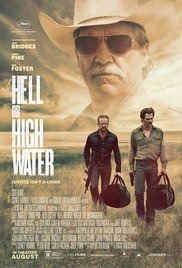
When we think about interesting movie settings, we might think of some exotic locale, perhaps a far off land – maybe a jungle or the base of a volcano. But great cinematic landscapes don’t have to be on the other side of the world. Sometimes an effective movie setting is one that is rarely depicted, but not so far away. Such was the case for Hell or High Water, an enthralling film capturing a slice of southwestern America. The Texas setting lent itself surprisingly well to the story of two brothers who chart a dangerous course through the Bible Belt.

When we meet brothers Toby (Chris Pine, Star Trek Beyond) and Tanner Howard (Ben Foster, The Finest Hours) they are brazenly robbing a small bank. Inexperienced but resourceful, the pair is bumbling in their execution but genius in their foresight. Tanner is fiery and violent, while Toby is sympathetic and measured, each the perfect foil. Inevitably, the siblings soon draw the ire of Marcus Hamilton (Jeff Bridges, True Grit), a small town sheriff near retirement (a familiar trope, I know). He and his partner begin tracking the duo, mapping their likely targets, surmising that they are stealing small amounts to reach a modest, specific goal. If they can determine the motive, perhaps they can narrow in on a suspect.

Director David Mackenzie (Starred Up) and writer Taylor Sheridan (Sicario) weave an atmospheric tale permeating with desperate energy. Toby and Tanner are just a half step ahead of the law, and it could all come crumbling down at any moment. As their motivation for the robberies is revealed, we feel the weight of their burden. A sense of foreboding hangs like a cloud over the film, hinting that the pair is on borrowed time. Many viewers will probably relate to the movie’s themes, particularly the brothers’ sense of frustration at the seemingly short hand life has dealt them, always a day late and a dollar short. Blue-collar, working class, somewhat marginalized and essentially impoverished.

The film was reminiscent of the Coen Brothers’ work, with cinematography and setting similar to both No Country For Old Men and Blood Simple. I could also see Sheridan’s hand reflected in the story, which bore cinematic similarity to his work in Sicario. The Texas landscape was grimy and hot, and their desperation was palpable. Perhaps I shouldn’t have rooted for them, but I did – which is a testament to the film’s story and two leads. Foster and Pine gave textured performances, evincing wide-ranging emotion. While there has been praise from critics, the average moviegoer may be reluctant to see this film – but don’t be one of those people. Hell or High Water has been one of the better films of 2016, so far. Grade: A

War Dogs

People often say that money is the root of all evil. False. The love of money is the root of all evil. I actually enjoy the tales of the wealthy, if for nothing more than the aspirational motivation I get from seeing a world I normally couldn’t witness. Whether it’s Wall Street or The Big Short, tales of the perils of wealth and excess fascinate me, and I love the story of a good “come up.” When I saw the trailer for War Dogs, which was inspired by true events, I was instantly hooked and wanted to learn how these upstarts cornered the market on international arms dealing.

Miles Teller (Fantastic Four) and Jonah Hill (Sausage Party) star as best friends David Packouz and Efraim Diveroli. The year is roughly 2006, and David is disenchanted with life. He can’t hold a steady job and is eking out a living as a masseuse. When he reconnects with Efraim, his old friend hasn’t changed a bit. He’s as obnoxious as ever, but seems to be doing well for himself. He started out buying seized illegal firearms from law enforcement and reselling them online. He’s moved on to small government contracts, selling weapons and ammunition to the U.S. government. One would think the world’s greatest military wouldn’t need to resort to buying small amounts of weaponry from individual gun purveyors, but blame the cronyism of the Bush Administration. Amidst allegations of nepotism against Dick Cheyney, Congress introduced legislation requiring the government to entertain offers from small companies. War is big business, and Efraim is cashing in.

He offers David a role in his company, and the pair embarks on a new course beset by dangerous greed. They attack the gun-running business with tenacious fervor, undeterred in the pursuit of lucrative government contracts. Efraim doesn’t mind playing fast and loose with the law if it keeps the money flowing, and David acquiesces. When trade legislation threatens a deal to export beretta handguns from Italy to the Middle East, the “war dogs” drive the guns through hostile territory themselves. Hill is superb as the brash, rotund Diveroli, delivering a performance reminiscent of his role in The Wolf of Wall Street. Efraim is the loveable asshole, and Hill infused his interpretation with quirks that made the character feel real.

Teller is serviceable as Packouz, though not as impressive as his co-star. I find his performances somewhat uneven, but his work in films such as Whiplash evinces great ability. Darker characters tend to be more nuanced and complex, and so Jonah Hill had more to work with, in many respects. His character’s duplicity allowed for a more layered performance, compared to Teller’s. Nevertheless, both actors had an abundance of chemistry and played to each other’s strengths. Director Todd Phillips (The Hangover) is a master at capturing the fraternal dynamic between friends, and that ability is on display here. You can’t help but root for David and Efraim, yet that feeling is tempered by the clear white male American privilege from which they both benefitted, all while nearly running afoul of the law. War Dogs was insightful and entertaining, due in large part to an entertaining, compelling story and an anchoring turn from Jonah Hill. Grade: A-


Sausage Party

Do you smoke weed? Seth Rogen clearly does. How else could he concoct a story like Sausage Party? I’ll bet he was toking up one day, and after one especially gnarly bong rip, he got the munchies. As he stared down at his bag of chips, perhaps he thought – what if they were alive? Thus Sausage Party was born. And in case the R rating didn’t clue you in, let me caution any parents out there: this animated flick is NOT for children.

Shopwell’s Grocery Store is filled to the brim with food items, from hot dog buns to lemonade. Well, imagine that all of these items are alive. Sausage Party gives distinct personalities to common food items, with the grocery store serving as its own little world. Each food item, from the snacks to the meat, desires to be chosen by a human shopper, taken to what is known as “the great beyond” – the world outside of the store. Some esteemed actors lent their voices to the project, from Edward Norton (Birdman) to Salma Hayek (Grown Ups 2), but the movie stars Seth Rogen (The Night Before) and Kristen Wiig (Ghostbusters), as Frank the hot dog and his sweetie pie Brenda the bun. Frank and Brenda long to travel to The Great Beyond and are overjoyed when they are finally tossed in a shopping cart just before red, white, and blue day (Independence Day).

Frank’s joy is short-lived when he finally discovers the truth about The Great Beyond. Honey Mustard (Danny McBride, Rock the Kasbah) made it there, only to be returned to the grocery store, where he warns his food brethren. He tells them that The Great Beyond is hell, and they will all be murdered. Of course this is true, as we boil, burn, fry, steam, cut, and (at the very least) chew our food! The whole plot was silly, but I got a kick out of it. Frank is the only one persuaded by Honey Mustard’s tales of horror, and he is determined to get the proof he needs to convince the others. He sets out on a quest to find Firewater (Bill Hader, Trainwreck), a wise old bottle of liquor who can verify Honey Mustard’s claims. Frank must traverse the grocery store while steering clear of Douche (Nick Kroll, The League), the supermarket bully who blames Frank for not making it to The Great Beyond.

Sausage Party was a fun movie, and what you see is what you get. I was surprised at the modest but sizeable matinée crowd in my theater. I judged everyone as either a stoner or a person with an immature sense of humor – but we all had a good time, that’s for sure. The dialogue was funny and raunchy, and I think Rogen delivered. The last five minutes will make you blush, so if I haven’t stressed this enough: don’t take your kids! This movie is meant for a specific audience, and I think you know who you are. So spark up and enjoy! Grade: B.

Suicide Squad

It’s become trendy on social media, and on Twitter especially, to refer to any and everything as “trash” if you dislike it. When word spread online that Suicide Squad was “trash,” I was disappointed that the highly anticipated DC Comics film hadn’t lived up to expectations – but I needed to see for myself. And I’m glad that I didn’t heed the naysayers. Although the movie was not without its flaws, it was far from the disaster everyone described.

The movie is built on an intriguing premise: What if Superman were bad? Who would stop him? This essential question is what drives Amanda Waller (Viola Davis, Lila & Eve), a high-level national security advisor who ascribes to the old adage that you fight fire with fire. She assembles a team of badass miscreants to keep on standby for any kamikaze mission, should the need arise. If things go south, this band of ragtag criminals and “meta-humans” will be easy to disavow. The Suicide Squad is comprised of Deadshot (Will Smith, Concussion), Harley Quinn (Margot Robbie, The Legend of Tarzan), Killer Croc (Adewale Akinnuoye-Agbaje, Concussion), Boomerang (Jai Courtney, Insurgent), Diablo (Jay Hernandez, Bad Moms), and Slipknot (Adam Beach, Diablo).

Dr. Harley Quinn was a psychiatrist at Arkham Asylum, where she treated The Joker (Jared Leto, Dallas Buyers Club). She fell in love with the charming psychopath, and the pair unleashed a reign of terror across Gotham until Batman (Ben Affleck, Batman v. Superman) nabbed her, splitting the demented couple apart. Batman also reeled in Deadshot, an assassin whose pinpoint accuracy netted top dollar amongst underworld figures. Harley, Deadshot, Croc and Diablo share a prison, while Boomerang and Slipshot are apprehended later, rounding out the Squad.

Colonel Rick Flag (Joel Kinnamon, Run All Night) is Amanda Waller’s second in command, tasked with corralling the Squad as they did her bidding. He is in love with Dr. June Moon, an archaeologist whose body and spirit have become inhabited by a witch dubbed Enchantress (Cara Delevingne, Pan). Moon’s altar ego unleashes a sinister force, spurring Waller to call the Suicide Squad into action. I’ll end the plot summation here, as the storyline is perhaps the weakest aspect of the movie. The details of the Squad’s mission were muddled, and writer/director David Ayer (Fury) seemed to take an ad hoc approach to the storyline’s structure. The movie’s strength lies in the chemistry of its titular ensemble cast, namely Harley Quinn and Deadshot.

Robbie and Smith have undeniable chemistry, evidenced by their previous work in last year’s Focus, and again here. Robbie clearly relished the role, embodying the beautifully batty Harley with an endearing air of likability. I watched the Batman cartoon as a kid, and I remember Harley as an adoring nuisance to the Joker, a smitten pest. Here, she was every bit his equal and true love interest. Regarding Joker, there will be inevitable comparisons to Heath Ledger’s portrayal, but I encourage you to let each interpretation stand on its own. Leto did a fine job with the role, putting his own spin on it while maintaining the evil eccentricity we’ve come to expect.

The entire cast was excellent, but Smith and Robbie were the standouts. To put it simply, Deadshot is a bad ass MF. Smith is charismatic enough to carry his own Deadshot movie, and I hope DC is at least considering the notion. Viola Davis couldn’t turn in a bad performance if she tried, and she shone brightly in what could have been an average role. She was formidable in her own right, which was befitting of a character charged with keeping such a group in line. Was this the best comic book movie ever? No. In fact, I can understand why someone wouldn’t love it. But the disdain is totally overblown. Bolstered by the chemistry of its cast and the sheer amount of fun they seemed to be having at every moment, Suicide Squad made for a good time at the movies. Grade: B

Jason Bourne

I try to keep celebrities’ personal lives separate from the way I view their work, but sometimes it’s hard for me to draw a line between the two. Matt Damon (The Martian) was one of my favorite actors, and I thought of him as cool and smart, and he is – but recent comments have lead me to believe that he’s tone deaf at best, and ignorant at worst as it pertains to diversity in Hollywood. As an aspiring screenwriter, this troubles me. I still appreciate his work as an actor, but I can’t divorce myself from his recent statements and opinions. That being said, of COURSE I was going to see Jason Bourne. I own the first three installments in the trilogy on DVD, and I’m a big fan of the franchise.

Jason Bourne promised to reveal the secrets that have always tormented the super spy from the beginning. Who is he? Who can he trust? Has his government betrayed him? Unfortunately, I think the film was long on promises and short on results. It opens with the familiar face of Nicky Parsons (Julia Stiles, 11:55) whom you may recall is one of Bourne’s few allies. She hacks into the CIA database, accessing their black ops files in the hopes of gaining intelligence that might help Bourne piece together his past, including information about his father. Meanwhile, our hero is off the grid, earning a living as a bare-knuckle boxer. When Nicky reconnects with Bourne, she leads The Agency right to him, as they began tracking her as soon as the files were hacked. Headed by Director Dewey (Tommy Lee Jones, Criminal), the CIA dispatches an operative (Vincent Cassel, It’s Only the End of the World) to dispose of both Jason and Nicky.

What follows next is an exotic game of cat and mouse, as Bourne criss-crosses the globe in an attempt to exact revenge upon the CIA for betraying him. He is as formidable as ever, dispatching foes with ruthless efficiency. However, from a viewer’s standpoint, these scenes didn’t excite me. Part of the appeal of the first three Bourne movies was witnessing great hand-to-hand scenes like this one: https://www.youtube.com/watch?v=Yp2mYEKLxcA . If Bourne is knocking people out with one punch, where is the fun in that? Furthermore, the intrigue and mystery just weren’t there for me. The backstory involving his father was never fleshed out in a satisfying manner. The movie just felt like an opportunity for Damon to cash in, though he certainly doesn’t need the money. I thought he had moved on from this franchise? That’s why Jeremy Renner (Captain America: Civil War) stepped in for The Bourne Legacy. Now we have another installment with Damon and instead of rewarding, it’s just disappointing.

The film’s final act was effective, but after two hours of mediocrity, it wasn’t enough for me. And I wanted to like this movie, trust me. This franchise should’ve ended in 2007 and been limited to the true trilogy it once was. Grade: C

The Infiltrator

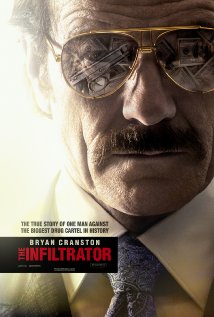
The Medellin drug cartel (helmed by notorious kingpin Pablo Escobar) at its pique flooded the U.S. with approximately half a billion dollars worth of cocaine per week in the mid 1980s, under the approving eye of the American government. This was all very clandestine at the time, but in recent years it has become accepted political history rather than mere fodder for conspiracy theorists. Television shows like Netflix’s Narcos and films like last year’s Kill the Messenger have pulled back the curtain on Escobar’s notorious exploits and the subsequent fallout, respectively. The Infiltrator, starring Bryan Cranston (Breaking Bad), offers a unique glimpse into the American effort to bring down Escobar’s empire.

If you’ve seen The Wire, you will recall that Detective Lester Freamon made a breakthrough in his drug case against Stringer Bell and Avon Barksdale after he stopped following the drugs and started following the money. U.S. Customs Agent Robert Mazur (Cranston) applies the same logic to bringing down Escobar. After his undercover efforts yield middling results, he switches his strategy, making inroads with perimeter players in Escobar’s network, particularly those who launder the ill-gotten proceeds of his trade. He goes undercover using the alias Bob Musella, operating as money launderer between Escobar’s associates and foreign financial institutions.

Fellow agent Amir Abreu (John Leguizamo, Ice Age: Collision Course) makes the appropriate introductions, and soon “Musella” is in. Their circle includes informants, criminals, and assorted lowlifes, and the stakes for Mazur could not be higher. He could’ve opted for retirement, but instead he dives even deeper into the underworld. A devoted family man, he maintains his integrity at the expense of his operation, while his marriage becomes increasingly strained. Slowly, methodically Mazur works his way up the food chain, with each new player getting him closer and closer to Escobar’s principal launderers. Cranston and director Brad Furman (Runner Runner, The Lincoln Lawyer) perfectly capture the tortuous duality of the undercover agent’s double life and its attendant betrayal.

Cranston does an outstanding job, infusing Mazur with dogged tenacity masking an omnipresent air of frustration and guilt. However, the most subtly revelatory performance might have come from John Leguizamo in his supporting role as the cocksure Abreu. I always appreciate the little non-verbal nuances actors bring to their roles, and Leguizamo did not disappoint. Whether a slight flicker in the eyes or a nearly imperceptible shudder, his performance bubbled with realism. Both he and Cranston shone brightest when their humanity conflicted with the tasks at hand, whether it was complicity in a murder or the need to befriend and then betray. I appreciated the film for its excellent performances and original perspective on a familiar story. The Infiltrator does not disappoint. Grade: A-

X-Men: Apocalypse

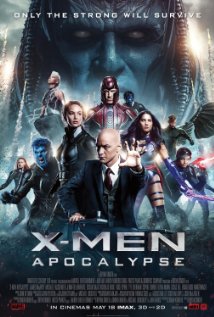
X-Men are among my favorite movie superheroes and always have been. I’ve loved every edition in the series, with the exception of X-Men 2. Director Bryan Singer (The Usual Suspects, X-Men: Days of Future Past) has infused the franchise with fresh energy by adopting a sort of prequel format established in the last two or three movies. By introducing us to a younger Magneto, Mystique, Xavier, and company, Singer cleverly extends the life of the franchise. The only constant character is the perennial Wolverine (Hugh Jackman, Eddie the Eagle). Boasting additional new young iterations of our favorite characters, X-Men: Apocalypse did not disappoint.

The movie begins in ancient times, as the Egyptians engage in religious ritual. Their apparent ruler is a strange behemoth with purplish, leathery skin called En Sabah Nur (Oscar Isaac, Ex Machina). He will eventually come to be known as Apocalypse, and his existence proves mutants were around long before Professor X (James McAvoy, X:Men: Days of Future Past) became aware of them. Apocalypse and his followers attempt a supernatural energy exchange with another person, which is disrupted by dissidents seeking to overthrow his regime. Apocalypse is buried alive, left undisturbed until the Egyptian ground shifts and he is awakened thousands of years later in 1983.

After his epic snooze, Apocalypse awakens to a world dominated by humans. He doesn’t like mutants’ stature and seeks to upset the proverbial apple cart by encouraging them to take their rightful place atop the food chain. He quickly assembles a team, including (a much younger) Storm (Alexandra Shipp, Straight Outta Compton), Magneto (Michael Fassbender, Steve Jobs), and newcomers Angel and Psylocke (Olivia Munn, Zoolander 2). Religious themes ran throughout the movie, with Apocalypse displaying god-like abilities as he actually makes his team of mutants better. He enhances their powers and shows them how to maximize their gifts. For example, we know Magneto controls metal objects. If there’s no metal readily available, one might think he’d be powerless in that moment. However, there are metals and minerals in the ground. Magneto can literally move mountains if he wanted.

Professor X learns of Apocalypse, whose powers are nearly insurmountable. Meanwhile, enrollment at Xavier’s School For Gifted Youngsters increases as Scott Summers/Cyclops (Tye Sheridan, Mud) joins the fray. It was fascinating to see younger versions of the familiar characters we’ve come to know and love. It was particularly cool to see the first meeting between Cyclops and Jean (Sophie Turner, Game of Thrones), who will go on to have quite a love affair, albeit an intermittently one-sided one. I also enjoyed the barrage of 80’s pop culture references, from Thriller jackets to Tab soda. The film establishes the clear ideological dichotomy between mutants that runs throughout (chronologically) later films. Xavier is a pacifist almost to a fault, recognizing the importance of educating his students in a classroom, but leaving them woefully unprepared for battle and unequipped for self-defense. Apocalypse forces him to open his mind to a new approach, turning the tables on the benevolent professor and setting the stage for a showdown between good and evil.

A summer day at the movies should be entertaining, action-packed, and fun. With spot-on casting and a strong yet simple plot, X-Men: Apocalypse was all that and much more. I can’t wait to see what Marvel Studios has in store for us next. Grade: A-


Miles Ahead

Sometimes it seems like an actor was just destined for a role. Think about how inextricably linked Angela Bassett and Tina Turner are after the 1993 classic What’s Love Got to Do With It. Over the last decade or so we’ve seen a host of biopics centering on everyone from James Brown to Steve Jobs. When a biopic covers a musician it must be particularly hard for filmmakers to nail the depiction, because they have the added task of accurately capturing the subject’s artistry and creative process in addition to just an impersonation or exercise in mimicry. Don Cheadle (Captain America: Civil War) looks perfect in the role of Miles Davis, and his involvement with the film on a cellular level reflects the passion and commitment he brought to portraying this legend and musical genius.

The film opens in the ‘present’ year of 1979, as Miles is being interviewed. His record label is hounding him to hand over tapes from a recent recording session, while Miles demands to be compensated first. He lives reclusively, his large brownstone a lonely, haphazard jumble of papers and clutter. Enter Rolling Stone reporter Dave Brill (Ewan McGregor, Star Wars: Episode VII: – The Force Awakens), an intrepid nuisance determined to pen the Miles Davis comeback story. Through Miles’ conversations with Dave we are taken via flashback to the 1950s, when Davis first rose to prominence on a national stage. He is particularly haunted by memories of his first wife Frances (Emayatzy Corinealdi, The Invitation), a vibrant and lovely woman whom Miles stifles in his demand that she give up her love of dancing to be his doting wife.

Cheadle was the uncanny embodiment of Miles Davis, from his signature rasp to his seemingly affable, accessible demeanor. He captured an interesting duality, showing that Miles was very aware of his own greatness, yet he had an approachable, selfless air about him. The epitome of cool. Most importantly, he provided a glimpse into Miles’ creative process, as we see him work on studio arrangements with other composers and delightfully improvise at home with Frances, during some of their more tender, intimate moments. Not that he needed it, but Cheadle humanized Davis, even in some of his darker moments. The film never demonized Davis, even as it exposed drug abuse and womanizing infidelity.

What an interesting, artful film. I don’t have any real criticism, only a few observations. Cheadle obviously selected a very narrow slice of Davis’ life to explore, rather than an extensive chronology of his childhood, musical beginnings, or other lovers (I had no idea he dated Cicely Tyson – she’s not referenced at all). I felt that the film presupposes a basic familiarity with Davis, and I guess that’s ok. I applaud Cheadle for his unique approach. Not every biopic is going to read like a step-by-step biography. The film was filled with musicality and warmth, yet left an air of mystery around the legendary jazzman. Cheadle did a masterful job on and off screen, and I hope he is rewarded for his performance. This was an emotionally gratifying portrayal and I recommend it to anyone looking for something a bit different at the theater. Grade: A