2012 Movies

Wrath of the Titans

Sam Worthington (Man on a Ledge) definitely has my attention.  He’s not the most handsome, and he’s not the best actor, but I like him.  I think Clash of the Titans is what did it for me.  Too bad the much-anticipated sequel was not as effective.  When we first met Perseus, he was totally unaware of his godly heritage.  Clash worked because it gave us a hero who was called to save humanity while realizing his true destiny.  It’s literally the stuff stories are made of.  I enjoyed the depiction of the iconic Greek gods, and the story was a good one.  Unfortunately, I can’t say the same about Wrath of the Titans.  It wasn’t a bad movie, but it was not as good as the first.

This time around, the gods of Mt. Olympus are in dire straits.  They derive some of their power and strength from humanity, through prayer and adulation.  Maybe things are going pretty well for mankind, because people haven’t been calling on the gods much lately.  Thus, they are getting weaker and vulnerable to attack.  You’ll recall from the first movie that god of the underworld Hades has a beef with his brothers Zeus and Poseidon.  I’d be pissed if my siblings ruled the heavens and the sea while I was sent to hell too.  Anyway, Hades is still ticked off.  Now that the gods are getting weaker, they’re ripe for the taking.  Hades, with the help of Zeus’ son Ares, god of war, is plotting to unleash the titans from their prison so they will destroy their traitorous offspring.  The titans gave rise to the gods, who in turn defeated them. Confusing stuff if you don’t remember the mythology, and my memory is a little rusty.  Anyway, Hades kidnaps Zeus and takes him to the underworld to drain his remaining power and release the titans.  His godly brethren are useless, so Zeus must once again call on Perseus, the demi-god and reluctant hero.  Now with a boy of his own, Perseus is adored by his countrymen but lives the simple life of a fisherman.  He must once again summon his inner greatness and rise to the occasion, with the help of his trusty steed Pegasus.

I’ll start with the good.  The movie was exciting and entertaining. I saw it in 3D, which was cool.  I’m kinda over the whole 3D thing though.  Unless it’s a dope ass epic movie like Avatar, I’m usually underwhelmed by it.  Unfortunately, Wrath of the Titans failed to live up to its predecessor because it lacked a compelling storyline and was comprised of weak characters.  Perseus is often told that being only half god is not a bad thing.  He is told that he possesses all the best of humanity and the gods.  My issue with his character was that this is not his first time at the rodeo.  That was the last movie.  Perseus, you don’t know what you’re doing yet? You saved the world before; you released the MF kraken – and you’re still afraid?  That just didn’t work for me.  Perseus should just be more…special.  I also found aspects of the storyline to be implausible, whether it was a timely reconciliation here, or a transparent betrayal there. *yawn*.  Anyone who saw Clash of the Titans probably liked it and would be amenable to the sequel.  Be forewarned, you may be mildly disappointed.  Wait for Netflix.  Grade: C+

The Hunger Games

I didn’t read the book, ok? Hopefully you still find my thoughts on The Hunger Games relevant.  I’m not one of those people that must read the book before I see the movie. Movies are my passion, and I haven’t been a voracious reader since adolescence. I think all of this higher education dulled my ability to read for pleasure, and I’m working on getting that desire back.  But who cares, let’s talk about The Hunger Games.  When I was a kid I read a short story called “The Most Dangerous Game,” about a man who was hunted like an animal by another man.  It was a fascinating look into man’s most sadistic urges.  The Hunger Games promised to touch on a similar theme of self-preservation, and it presented an interesting portrait of a bleak future – a striking cultural dichotomy.

In a fictional future, the country has been fractured by civil war.  The rebellion was quelled, but now instead of states, American territory is divided into twelve districts.  As penalty for their uprising, the citizenry must offer a periodic sacrifice, or “tribute.”  Each district must randomly select one boy and one girl between the ages of 12-18 to compete in The Hunger Games, a televised battle pitting the 24 contestants against each other in a fight to the death. Katniss Everdeen (Jessica Lawrence, X-Men: First Class) lives in District 12, and here’s the dichotomy I was talking about.  Although the movie depicts a futuristic world, District 12 looks like it’s straight out of The Great Depression.  Known for coal mining, the residents of District 12 are covered in soot, both downtrodden and hungry.  Food is a precious commodity, doled out in parsimonious fashion.  People barter for food by agreeing to submit their name into The Hunger Games lottery.  If you’re starving and don’t have any currency, you bargain with your livelihood.  At least that’s what I managed to glean from the cinematic version.  If you literary enthusiasts need to correct me on that point, feel free.  Katniss has an adorable little sister named Primrose, who at the age of 12 is newly eligible for the Games.  She’s understandably petrified at the prospect of the competition, but Katniss reassures her that the chances of her being selected the first time are slim.  Turns out the odds are not in young Primrose’s favor, and her name is pulled for The Hunger Games.  Fiercely protective of her sibling, Katniss offers herself as tribute in Primrose’s place.  The male contestant randomly selected is Peeta Mellark (Josh Hutcherson, The Kids Are All Right), Katniss’ childhood friend.

That’s the basic gist of the plot, which you probably already knew. Most of the movie takes place in a faux wilderness of sorts, the setting for The Hunger Games.  The contestants compete in a controlled environment, manipulated by the producers of the show.  Katniss is a skilled huntress, deft with a bow and arrow.  She uses this to her advantage in the savage game, one that allows for the possibility of a twelve year old girl fighting an eighteen year old boy to the death.  Talk about the deck being stacked against you.  Recently the movie has come under fire from the omnipresent vocal minority of racist idiots that call the internet home.  Again, I haven’t read the book, but one of the characters named Rue (Amandla Stenberg, Colombiana), has been criticized for not living up to the lily white image some viewers were expecting.  I thought she was adorable, and I’m not going to entertain any criticism of her performance, which was flawless.  The nubile Ms. Lawrence was equally impressive in her role, both stoic and compassionate as the reluctant warrior.

The film was a provocative exploration of the human desire for bloodlust.  It’s just a movie though, right? We’d never have something like The Hunger Games in real life…or would we?  I think the idea of a random drawing goes against the very cornerstone of American freedom, but don’t tell me there isn’t a deep dark part of human beings that loves blood sport.  Gladiators used to battle in a Coliseum while people laughed and pointed and had a grand old time.  And how many people love MMA fighting?  Oh sure, it’s not quite the same, but you get my point.  Google Faces of Death.  People got quite a kick out of that.  The Hunger Games was rather intense for the average little kid, and I wouldn’t take my first grader (if I had one).  Otherwise, I thought it was a treat, and a definite must-see movie.  Grade: A-.

A Thousand Words

Eddie Murphy is a curious case. In his heyday he pioneered the buddy cop genre and was a fixture in some classic 80s movies like Harlem Nights and Coming to America. A few years ago he even won an Academy Award for a supporting role in Dreamgirls. In many respects, Murphy is an accomplished actor. But in other respects he’s responsible for some of the worst movies of the past decade. I present Exhibit A and B. Murphy’s resume is so spotty that I don’t know what to expect from his movies. I had low expectations for A Thousand Words, but it wasn’t as bad as some of his more recent duds. A tepid endorsement for sure, so I wouldn’t rush out to see this one.

Murphy stars as Jack McCall, a fast-talking literary agent who isn’t above bending the truth to get what he wants. His latest target is a new age self-help guru named Dr. Sinja, a fictionalized Deepak Chopra who looks like he raided the Dalai Lama’s closet. Sinja’s philosophy involves finding inner peace by shutting out the noise of the world and looking inward. Jack lives a life polar opposite from Sinja’s, but he is impressed by his massive following and wants to translate Sinja’s popularity into riches. He lies about his motivations, and gets Sinja to sign a book deal. During his spiel to Sinja while visiting his compound, Jack encounters a mystical tree in his garden. It is supposed to be a source of peaceful reflection, but Jack leans against it while lying to Sinja and cuts his hand on the bark, leaving behind some blood. The next day Jack and his wife Caroline (Kerry Washington, For Colored Girls) are shocked to see the massive tree sprout up in their backyard. As he talks, the tree loses leaves. When all the leaves have fallen from the tree it will die, and so will Jack. By the time Jack notices what’s going on, there are about a thousand leaves left on the tree. Jack has a thousand remaining words to speak and is forced to find other ways to communicate. He is also forced to listen to his inner voice since he can’t use his outer one. Unable to BS his way through life anymore, he tries the introspection he should have attempted long ago, but will he learn his lesson before it’s too late?

A Thousand Words wasn’t the most original movie concept. It reminded me of two Jim Carrey movies, Liar Liar and Yes Man. In both movies, Carrey’s ability to communicate was severely hampered so that he could learn a bigger life lesson. He couldn’t lie in Liar Liar and he couldn’t say no in Yes Man. In A Thousand Words, Eddie Murphy can’t talk at all. This lead to a lot of comedic, physical acting and Murphy gave a capable performance. I felt his character’s frustration and his sincerity as he tried to communicate without speaking. There are those who will take a glance at this movie and dismiss it as Murphy’s usual tripe, but I think that would be a bit unfair. The movie may have taken itself too seriously at times, but at least it tried. Despite being largely forgettable, it featured some talented actresses, including Ruby Dee (American Gangster) and Allison Janney (The Help), in addition to the aforementioned Kerry Washington. Though it probably won’t fare well at the box office, I thought A Thousand Words wasn’t nearly as shameful as some of Murphy’s recent offerings. It made for a passable day at the movies, but there are more exciting choices currently in theaters. I give it an A for effort.

This article first appeared at http://poptimal.com/2012/03/a-thousand-words-review-a-for-effort/ and was reprinted with permission.

This Means War

I’m proud to be an American, but the quickest way to turn me off from something is to dub it “America’s fill-in-the-blank.”  For example, “America’s Team” would be the Dallas Cowboys.  Or maybe the New England Patriots.  Either way – I ain’t with it.  Similarly, we’re fond of calling people “America’s Sweetheart.”  I’m not a fan of the expression or what it represents.  Take “America’s Sweetheart,” Julia Roberts.  I’m over her; she doesn’t get a pass for mediocre movies or that obnoxious toothy laugh.  However, there is one notable exception to my disdain for all things patriotic.  Reese Witherspoon – one of America’s Sweethearts who doesn’t annoy me.  Plus she played Tracy Flick in Election, so she can’t be that much of a goody two shoes.  Check that one out on DVD if you haven’t seen it, especially if you’re a fan of black comedy.

I was curious about her latest movie, an entrant into the relatively unique action rom-com genre.  If you don’t know what an action romantic comedy is, think Mr. & Mrs. Smith.   I digress.  Witherspoon (Water for Elephants) stars alongside Chris Pine (Unstoppable) and Tom Hardy (Warrior) in This Means War, a spy vs. spy movie that ended up being pretty entertaining.  Best friends Tuck and FDR are CIA agents who discover that they are casually dating the same woman; a cute thirty-something named Lauren who is none the wiser.  Being the competitive chaps that they are, Tuck and FDR refuse to back off and defer to each other.  They lay down some ground rules, and the game is on.   As secret agents they bring all of their espionage talents to bear, complete with high-tech gadgetry.  Unbeknownst to their boss (played by the wonderful Angela Bassett), they use Agency resources to take cock blocking to unprecedented levels, complete with surveillance and wiretaps.  Lauren genuinely is interested in both guys for different reasons.  Tuck is nice, humble and sweet, while FDR is brash and cocky.  Advising Lauren every step of the way is her sister Trish, played by the hilarious Chelsea Handler in her big screen debut.

Witherspoon’s character was relatable and endearing.  Lauren needed to be capable of making two guys battle each other tooth and nail for a shot with her.  Considering that most men hate to lose, it wasn’t a far-fetched idea.  Tom Hardy continues to impress me with the wide range of roles he accepts.  He’s quite versatile, capable of being both a romantic leading man and a diabolical villain (check him out in the upcoming The Dark Knight Rises).  Chris Pine doesn’t really do it for me, but I understood his character’s appeal.  Everyone had good chemistry with each other, both comedic and romantic (not the two guys, obviously).  The movie doesn’t sacrifice Tuck and FDR’s friendship either, supporting the old adage of bros before garden tools.  To sum it up, this was a great date movie.  It has a little something for men and women alike.  Grade: B

Act of Valor

Navy SEALS are among the most elite of our American military.  To say that their training regimen is rigorous would be an understatement.  These men have unmatched dedication to country and they reject accolades and recognition.  On the contrary, the selfless nature of their service and the demands placed upon them require absolute anonymity.  Recently the SEALS have garnered more attention due to their successful elimination of Osama Bin Laden last year.  Last night I viewed Act of Valor, a movie that has been marketed as action-packed and groundbreaking due to its inclusion of real life active duty Navy SEALS.  The concept of the movie is amazing, and I was mesmerized watching the SEALS in action, but I was unimpressed with Act of Valor as a whole.

The movie centers on the mission of a particular group of SEALS who are tasked with recovering a kidnapped CIA agent.  The agent is Lisa Morales (Roselyn Sanchez, Without a Trace), who had been posing as a doctor while gathering intelligence on an arms smuggler and drug dealer named Christo (Alex Vedov, We Own the Night).  Christo is suspected of conspiring with Abu Shabal, a Ukranian terrorist and former childhood friend who is plotting an attack on American soil.  Morales was monitoring their relationship and when she got too close she was abducted.  The movie focused primarily on her rescue mission and its fallout as well as the backstory of two SEALS, one of whom is an expectant first-time father.  The SEALS are portrayed as a band of brothers whose focus on family and country is paramount.  They are salt-of-the earth people who live by a basic, unwavering code of bravery and sacrifice.  I’m sure this aspect of the story will resonate with many people in America’s heartland, a place where these attributes are similarly revered.

Welp, it’s my job to critique the movie, and despite the overwhelming surge of patriotism Act of Valor may inspire, it was not without its flaws.  There are plenty of excellent documentaries on the Navy SEALS and other elite branches of the military, such as the Army Rangers.  I’d suggest watching one of those if you want insight into what a day in their life would be like.  The dramatization provided by Act of Valor was very intense and exciting, and there were some hear-stopping battle scenes, but those scenes were not enough to hold the movie together.  An entire movie is the sum of its parts.  There was little character development, and that may have been to underscore the idea that no one SEAL is above his team.  I thought maybe the filmmakers wanted to de-emphasize their individuality, much as a SEAL might do in real life.  But there is a moment in the film where clearly I as a member of the audience am expected to sympathize with a character and be moved by their sacrifice.  Perhaps if his character were developed beyond cursory expository dialogue, I would have been moved.

That wasn’t the only issue I had with the movie, and I’m going to choose my next words carefully.  As an American whose freedoms are protected every day by our servicemen and women, I can’t express my gratitude enough.  The two principal characters, who I assume are real SEALS – should be commended for their service.  Unfortunately, the acting in this move was not as praiseworthy.  I feel bad for even saying that, but I have to give an honest assessment of any acting performance.  I thought a lot of the dialogue between the SEALS was hokey and poorly delivered.  I don’t mean to be overly critical, and I’m sure the filmmakers have made even more Americans appreciative of our soldiers with the creation of this film.  But as a cinematic offering, I think it faltered in certain places.  The movie excelled when it focused on the SEAL’s duties and their field operations, not their personal lives, which highlighted the deficiencies in the main characters’ acting abilities.  This is just one person’s opinion.  Please don’t revoke my American citizenship!

This article first appeared at http://www.poptimal.com and was reprinted with permission.

The Grey

I like Liam Neeson (Unknown) a lot.  He was under my radar for a while, and the only thing I remembered him for was Schindler’s List, which is old as hell.  Recently he’s been featured in roles that show him as heroic and resourceful, and I think he displays an understated strength on screen.  It’s actually quite attractive.  Ever since Taken he has proven capable of taking roles that challenge his character and test his resilience.  And he’s pretty hot for an old(er) guy.

The Grey is the story of a group of oil drillers who survive an airplane crash, leaving them stranded in the Alaskan wilderness.  Neeson is featured as Ottway, a solitary man whose job it is to protect the drillers from wolves while they work.  The drillers have a thankless job, working in bone-chilling whether, completely isolated from everyone but each other.  Ottway is very lonely, and we learn through dreamy flashbacks that he has lost a woman he loved.  His cold environment does nothing to warm his heart, and he even contemplates suicide.  Well, obviously we know he’s not going to pull the trigger or else The Grey would have only lasted about 30 minutes.  I thought his aborted suicide attempt was perhaps a bit of foreshadowing, since I knew from the trailer that their plane was going to crash.  Maybe Ottway is resilient, and this fortitude will serve him well later.  When their plane goes down, he quickly emerges as natural leader of the small band of survivors.

The majority of the movie shows Ottway and six other survivors as they traverse the bleak landscape, trying desperately to evade a large pack of predatory wolves.  The wolves quickly claimed their first victim shortly after the plane went down, and Ottway determines that they cannot remain near the wreckage.  Thus begins their arduous journey over the frozen tundra.  Not only must they navigate the frigid terrain, they must harness their competing egos and stick together if they hope to survive.

Neeson gave a good performance, and he was believable as the resourceful hero.  Unfortunately, I don’t have anything else good to say about this movie.  I thought it would be an action-packed tale of survival and triumph, as the men (or most of them) emerged victorious after learning to appreciate their lives and finding true purpose.  Instead, The Grey was a bleak, meandering tale riddled with implausible scenarios and befuddling behavior.  There’s one scene that is just fu**ing impossible.  I won’t spoil it for you – not that you’d care.  There is nothing triumphant about this movie.  I’ve been told that if you stick around for the credits (I did not), you’ll have an extra scene.  Yeah, let’s save cool features like that for good movies, not tripe like this.  I heard about the scene, and even if I would’ve stuck around for it I don’t think my opinion would be any different.  This one would be a waste of money folks.   Good thing I snuck in.

Safe House

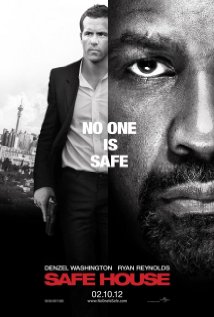
Denzel Washington (Unstoppable) has built an immensely successful career that is both prolific and praiseworthy.  His body of work includes biopics, period pieces, action movies, and dramas alike.  He’s an award winning A-list actor that has managed to retain some degree of realism and accessibility, despite the well-deserved fame.  However, Washington is not immune from being pigeonholed like any other actor who routinely chooses similar roles.  That’s not necessarily a bad thing, because he does it well.  I’m just saying, whether it’s The Taking of Pelham 123, Déjà Vu, Man on Fire, or the aforementioned Unstoppable  – we’ve seen it before: Washington saves the day.  Safe House features Washington in a departure from his customary heroic roles, though he winds up an unlikely protagonist by the time the credits roll.

Washington stars as Tobin Frost, a rogue CIA agent who has been off the grid for years.   He resurfaces seeking amnesty at a U.S. consulate after a deal goes wrong and his criminal counterparts begin deadly pursuit.  Next he is transported to a government safe house manned by novice agent Matt Weston (Ryan Reynolds, The Change-Up).  Frost was once an elite operative, trained in psychological manipulation and interrogation.  Now he is public enemy no. 1, a criminal so elusive that it seems the only way he could be caught is if he surrendered.  Frost is in possession of a data chip containing valuable classified info, and there are several factions who will stop at nothing to get it; but now he is in the custody of the CIA equivalent of the mailroom guy.  When the safe house is ambushed, Weston is faced with some tough choices.  He must secure the high level asset without getting himself killed.  Meanwhile Frost is yammering the whole time, planting little seeds of doubt in Weston’s head about the Agency, causing him to question the circumstances surrounding their fortuitous coup of the nation’s top traitor.

Safe House featured Washington at his charismatic best.  There was one early scene where he practically radiated off the screen, eyes twinkling, head cocked to the side.  “Don’t I look good?” he asks another character.  “Yes,” says the woman sitting next to me in the theater.  I had to chuckle.  He’s still got “it,” but I’ll admit I found some of the physical scenes a little unrealistic, especially one where he runs from rooftop to rooftop in hard bottom shoes.  Safe House is rightfully marketed as a Denzel Washington flick, as the rest of the cast dwindled by comparison.  Reynolds did a capable job as the wet-behind-the ears newbie, but it’s hard to hold your own next to Washington.  He wasn’t bad, but he just seemed a step behind Denzel, both in terms of character and performance.  Vera Farmiga (Source Code) is always pretty good, but her role was a basic one.

Safe House was an enjoyable movie for me, mainly because of Denzel Washington.  He carried the movie, and he’s the main attraction.  I thought he was worth the price of admission, though the movie itself wasn’t as smart as some of his others.  It was a little formulaic and not very suspenseful.  It’s made clear from the outset that Frost is being set up and who’s responsible.  The movie’s so-called twist hardly qualifies as a surprise, and the plot wasn’t terribly intricate.  Just sit back and bask in the Denzeliness. Grade: B+

Man on a Ledge

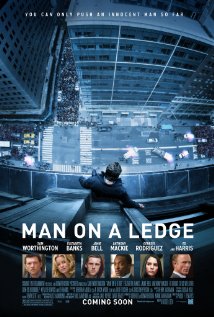
Lots of factors play into my decision whether or not to see a particular movie.  Sometimes the story itself looks intriguing, like Limitless or the recent Chronicle.  Other times, it’s the director that draws me in.  I’ll go see an M. Night Shyamalan movie just off GP, because I’m a fan.  More often than not though, it’s the cast that attracts me.  I like Sam Worthington (Avatar, Clash of the Titans), so when I belatedly heard about Man on a Ledge, I didn’t need much convincing.

Worthington stars as Nick Cassidy, a former police officer wrongly convicted of stealing a priceless gem from Wall Street titan David Englander, played by a scary-looking Ed Harris (Appaloosa).  Englander framed Cassidy, who was disgraced after being sentenced to prison.  After being denied parole, Nick decides to take desperate action to clear his name.  I won’t reveal the elaborate ruse that takes place, but lets just say that he devises a plan to escape from prison and soon he’s a fugitive.  Everything that happens next is all part of a carefully designed plan to exonerate Nick while finding out which other cops on the force helped set him up with Englander.  He enlists the help of Officer Lydia Mercer, (Elizabeth Banks, The Next Three Days) who is called in to talk him off the ledge.  Ah, the ledge.  Why is Nick on the ledge, and how can that help him clear his name?  Well, if I told you all that I’d spoil the movie wouldn’t I?  While Nick is on the ledge he forms a cautious bond with Mercer.  A recent mistake in the course of duty has caused her to lose favor with her peers on the force, just as Nick did when he went to prison.  This bond proves useful, because when the you-know-what hits the fan, Mercer is Nick’s only ally.

I think a lot of people are reluctant to see this movie because it seems familiar, or one note.  It’s a little smarter than that though.  It was relatively suspenseful throughout, and certain elements of the movie made it a solid caper.  Worthington let his natural Australian accent creep in a few times, but other than that he gave an earnest performance as the unlikely villain turned hero.  Anthony Mackie (The Adjustment Bureau) and Edward Burns also make appearances.  I wasn’t blown away by any one particular performance, but this wasn’t that kind of movie.  It was more plot-driven than character-driven, though the cast was more than capable.  I enjoyed the way it all unfolded, and by the time it’s over we see that Nick had a very strategic plan in place, using his law enforcement experience to predict everyone else’s moves.  The movie even offers a slight commentary on society (or at least jaded New Yorkers) by showing the perverse fascination with which passersby watch Nick, rooting for him to jump.  Was this movie deep and twisty like The Usual Suspects or as clever as Inside Man?  Of course not, but sometimes a distant second is good enough.  You won’t be blown away, but you won’t be disappointed either.  Wow. I just read the previous sentence and that was a lukewarm endorsement LOL. I’ll put it in better terms: Grade B

Chronicle

When I saw the trailer for Chronicle, I just thought it looked cool.  Three high school buddies make a discovery that leads to supernatural telekinetic capabilities.  They’re on some Magneto type shit.  The tagline for the movies asks, “What are you capable of?”  Chronicle examines this question as well as the circumstances that teenagers face as they try to navigate the difficult path to adulthood.

Andrew Detmer (Dane DeHaan) is a withdrawn high school senior.  His nights are spent caring for his dying mother while fending off an abusive father, and his days are spent being bullied at school.  The lone bright spot of his day seems to be when his cousin Matt (Alex Russell) picks up him in the morning.  Like Andrew, Matt also rejects the social norms of high school, but their similarities don’t go beyond a shared disdain for the social pecking order.  Andrew lacks the social skills necessary to form meaningful friendships with most of his peers.  This deficit is highlighted by his decision to chronicle his life experiences at home and school.  Originally it seemed that he just wanted to document his father’s abuse, but he ends up taking a video camera to school and filming his peers, which doesn’t always go over well.  Andrew is thoughtful and passive, hardly deserving of the stream of abuse he seems to get from everywhere.  You can’t help but feel sorry for him, and the depiction of his torment is especially relevant in this age of bullying.

Matt tries to get Andrew out of his shell and persuades him to attend a party, where he encounters Steve Montgomery (Michael B. Jordan, Red Tails), the most popular guy in school.  Steve is one of those rare guys that actually is smart, popular, ambitious, and…nice.  Despite his athletic prowess and immense popularity, he is genuine and friendly.  He takes a liking to Andrew even though their paths never cross at school.  I thought this was a little unrealistic, because teenagers aren’t known for their willingness to step outside the box and transcend the clearly defined social roles they occupy.  Keep in mind that the movie is a chronicle of Andrew’s life, and the story is always told through the lens of his camera and his perspective.  Steve tells Andrew that he and Matt have found something cool that might be worth filming.  They take him to an open field near the house party where they see a huge crater that has formed a tunnel beneath the ground’s surface.  Eventually Andrew follows Matt and Steve underground where they encounter an otherworldly source of light and sound.  As they get closer their noses begin to bleed, and eventually they are scared off.

A short time later, the boys realize that their experience has left them with telekinetic powers.  They have the ability to move objects with their minds.  Think Carrie mixed with the aforementioned Magneto.  Initially their powers are weak, but the more that they use them, the stronger they get, and very quickly.  They spend a Saturday practicing their powers by playing pranks on unsuspecting shoppers at the mall.  It’s harmless, but it shows their willingness to screw with people without regard for their feelings.  Matt makes a teddy bear chase a little girl in a toy store, which is not funny – it’s terrifying.  In a bit of foreshadowing, when it is Andrew’s turn for a trick, things take a turn for the worse.  As the guys are driving home, an impatient vehicle begins blowing its horn behind them.  With a small waive of his hand, Andrew sends the vehicle careening off the side of the road into a lake.  The driver survives, but Matt is compelled to lay down some ground rules after the incident.  He doesn’t want them to use their power on other people or in public.  Matt and Steve are content with their existing strength, but Andrew has been victimized his whole life and this new ability is wildly empowering.  Their unique bond solidifies their friendship, but Andrew’s abusive past has left him unequipped to deal with his new powers, with devastating consequences.

I enjoyed Chronicle because it showed how the seduction of power can corrupt even the meekest among us.  It can be difficult to display humanity when your life experiences have not been very humane.  Likewise, the movie also showed the difficult choices that must be made when a friendship becomes toxic.  It captured the angst, uncertainty, foolishness, and blissful naiveté of the teenage years, and posed some very thoughtful questions.  Visually, there was some stunning imagery, including a scene where the boys play football in the clouds.  Good movie.

Red Tails

African-American cinema is a tricky thing.  There is enough diversity within the genre to avoid painting it with a broad brush, but there are certain negative things that come to mind when you say something is a “Black” movie.  Does this mean there will be buffoonery, and is there something wrong with laughing at ourselves, as long as we’re the ones telling the joke?  I think our experiences run the gamut, but unfortunately some of the movies that are most profitable aren’t the most edifying.  Movies like Norbit and any one featuring Madea come to mind as examples of movies  that I tend to avoid.  Every now and then, however – a movie comes along that is worthy of our collective attention.  I think Red Tails was such a movie.  More than just a “Black” movie, it is an American story.

Red Tails is the story of the famed Tuskegee Airmen, an all-black aviation unit that served with distinction in World War II; despite initial reluctance to place the soldiers in combat situations.  Jim Crow’s insidious reach extended to the armed forces, and Black soldiers were deemed inferior due to the bigoted perception that they lacked the mental aptitude and courage for war.  Of course nothing could have been further from the truth, and when the airmen were given their opportunity to serve as bomber escorts, they made the most of their chance.  Comprised largely of the 332nd fighter group, the “Tuskegee Airmen” came to be known as Red Tails due to the unique scarlet markings on the tails of their planes.   Displaying uncommon bravery, the Red Tails proved to be heroic and victorious in their abilities.  Red Tails brings the story of the airmen to a new generation, and it is an important chapter in American history, not just Black history.  Produced by George Lucas, the movie reportedly had a difficult time being made because studios doubted the profitability of telling this story.  I’m happy that Lucas was willing to personally finance its creation, though I wish the movie reflected more of his deft story-telling ability.

Red Tails boasts a young, talented cast whose camaraderie and chemistry radiated off the screen.  Nate Parker (The Great Debaters), Tristan Wilds (The Wire), Terrence Howard (Law & Order: LA), David Oyelowo (The Help), and Cuba Gooding, Jr (The Hit List) were just a few notable cast members.  Parker and Oyelowo had the most screen time and gave the most inspired performances as “Easy” and “Lightning,” respectively.  Easy is the more level-headed and practical leader, while Lightning plays the flashy showboat.  Through it all, they are loyal friends who have each other’s backs in the air and on the ground.  I don’t want to nitpick, but this is a review, right?  Everything wasn’t perfect, and I had an issue with a couple of the casting decisions.  I adore young Tristan Wilds, and I think he’s talented.  However, I thought an older actor would have been better suited for his role of “Junior.”  He looks like he’s about 19, yet his character is supposed to have a wife and child and is told by another soldier that he is the bravest and best he’s ever met.  I guess that is possible, but his character’s backstory seems like it would belong to a more seasoned individual.  Similarly, Cuba Gooding’s role as Major Stance was a little derivative.  We’ve seen the grisly old pipe-chewing commander before.  I could have sworn I’ve seen Gene Hackman or somebody do this already.  Gooding seemed to be over-acting a lot of the time, and it got old.  Terrence Howard wasn’t as irksome as usual, so thank God for small cinematic favors.

I’ve found that you can never underestimate what the younger generation doesn’t know, and I’m pretty sure there are some folks who saw this movie and learned something new.  That alone is reason enough for me to give it my stamp of approval; because this is a story that needed to be told.  HBO made a movie about the Tuskegee Airmen years ago, but it needed a grand stage.  In this day and age our military more accurately reflects the tapestry of American life, but it is nice to have a reminder of our less than glorious past sometimes to appreciate what we have now.  G.I. Joe? No, the Tuskegee Airmen were real American heroes.