2013 Movies

World War Z

The heartthrobs of yesteryear have still got it.  I said it last year about Denzel Washington in Safe House, and I’ll reiterate the point here with Brad Pitt (Killing Them Softly), who scores the highest grossing debut weekend of his career with World War Z.  Although Pitt has aged nicely since he first came on the scene in Thelma & Louise, it’s not really about his looks here.  He’s our leading man, but I think he’s shying away from the types of roles that characterized his earlier career.  The  zombie storyline of World War Z is a familiar one, as television shows like The Walking Dead have become increasingly popular. The movie’s action was immediate and relentless, and I found myself quite literally on the edge of my seat.

The film begins with an introduction to Gerry Lane, a former UN employee who left the organization to spend more time with his wife (Mireille Enos, The Killing, Gangster Squad) and daughters.  Within five minutes of meeting the family, the horror begins on a routine drive to school through downtown Philadelphia.  While sitting in an unusual traffic jam, Gerry and his family notice that there is an unseen commotion swelling behind them.  Something weird is going on.  In this age of terror attacks, one can never be too careful, and this early scene was authentically unsettling.

A passing police officer gives Gerry an ominous warning to remain in his vehicle, and no sooner than he turns to leave, an out of control truck flattens him instantly.  Gerry barely has time to process what has happened before nearby pedestrians begin to run from an unknown horror.  As they flee, he turns to see a man convulsing and contorting his body in ungodly positions.  He has a wild, diseased look in his eyes, and it is clear that this “person” is not of this world.  It’s the zombie apocalypse!

The movie chronicles the zombie outbreak as it affects the entire planet, with each continent facing population extinction.  Torn between remaining with his family and returning to his old job to help figure everything out, Gerry eventually decides that if he wants to help his family, he must resolve to help humanity first.  Apocalyptic tales fascinate me, as they reveal much about the human psyche.  When the constraints of traditional society and civilization are stripped, we see man return to his most base instincts of survival, with Darwinism prevailing.  The immediacy of the zombie threat and the prospect of death created an especially terrifying climate, and the panic and fear were palpable.  Pitt was an ideal protagonist: brave, resourceful and facing some tough odds – everything you’d want in a hero.

If there were any criticism to be had, it would be that things just sort of happened.  There wasn’t a lot of character development, because it simply wasn’t that type of movie.  There is a singular catastrophic event central to the plot, and everything else happens in furtherance of that plot.  I didn’t read the book, so if the movie fell short in its interpretation; I wouldn’t know.  Overall it was very good, and if you’re one of those folks who occasionally doze off during movies, rest assured – it won’t happen here.  Grade: A –

Man of Steel

As other superhero franchises have recently established themselves as powerhouses (Batman, Iron Man), the venerable Superman franchise seemed like an afterthought.  Brandon Routh is somewhere salty as hell.  You’re probably like, who the hell is that?  Exactly.  Routh wore those famous blue tights only once in 2006’s Superman Returns, and now he’s a distant memory.  It seemed like Superman was lost in the iconic days of Christopher Reeve…until now.

Once Christopher Nolan (The Dark Knight Rises) was attached to the project, I think people were amenable to giving it a chance.  Just conjuring images of The Dark Knight franchise gets me excited, and Nolan brought instant credibility to the film.  The addition of director Zac Snyder (300, Sucker Punch) also ensured a fresh departure from the last Superman attempt.  The movie begins on Krypton, with a frantic Lara and Jor-El (Russell Crowe, Broken City) facing the destruction of their planet.  General Zod (Michael Shannon, Mud) has attempted an unsuccessful coup and been subsequently banished to an intergalactic prison.  Krypton and its inhabitants will become extinct as the planet comes to a tumultuous, destructive end.  Anticipating such an apocalypse, Jor-El and Lara planned to send their newborn Kal-El to another planet where he will thrive and ensure the survival of his race.

As the familiar story goes, Kal is given the name Clark and raised by the Kents – the couple who discovered him (and the vessel that brought him) on their farm.  However, after leaving Krypton the movie shifts to Clark’s adult life, as he grapples with finding his place on Earth, given his otherworldly abilities.  Nolan’s influence was apparent, as he offered a non-linear approach to Clark’s story.  Instead of following his upbringing chronologically, the movie flashes back to key events in Clark’s childhood that shaped his current existence.  We’re introduced to him as an adult, a nomadic laborer of sorts who lives in relative obscurity.  Clark consistently struggled with the two distinct messages given to him by both fathers.  Jor-El believed that he was special and could be a symbol of hope to many people.  Conversely Jonathan Kent (Kevin Costner, The Company Men) cautioned his son that people will fear what they don’t understand, and that mankind would reject him.

When General Zod is released from his interstellar prison, he locates Kal on Earth and pursues him there, spelling dire consequences for humanity.  This new development is what forces Clark into action, causing him to confront his obligation, if he even has one.  I’ve purposefully omitted a lot of plot details, because I don’t want to spoil the movie for you, plus I think they are inconsequential to my discussion of the film.  There was an earnest quality to the film, though not quite as dark as the Batman movies for which Nolan is known.  This subtle restraint in storytelling made the interpretation unique, and I can say that Man of Steel was not like The Dark Knight or any of the Iron Man movies.  Whereas Batman seems affected by external forces, Superman’s struggle is largely an internal one – at least in this first edition of the reboot.  The structure of the movie was flawless, and the viewer feels as if he or she really understands Clark’s conflicting duality – revelation vs. obscurity.  Couple that with a lifelong feeling of being the only one of your kind, and it’s easy to see why Clark felt confused and alone.

In addition to the storyline and character development, I thought the casting was also effective.  Henry Cavill (Immortals) is perfect as the new Superman.  He looks the part and he is believable.  Those are big tights to fill, and I’m sure the role is his for a while to come, especially since Man of Steel 2 has already been announced.  The casting of Amy Adams (Trouble With the Curve) as a more intrepid Lois Lane was also successful.  Russell Crowe is incomparable; you already know this.  What more can I say?  The movie was nearly flawless.  In fact, the only criticism I have is minor and probably misplaced.  I’m no expert, but I had a small quibble with the editing.  I thought a few scene transitions were not seamless – but again, what do I know?  The special effects were incredible, and no self-respecting movie buff would go more than a week or two without seeing this movie.  What are you waiting for? Grade: A


The Internship

Movies make us laugh, they make us cry, and they make us angry.  But every now and then a movie surprises us by inspiring an unexpected emotion. We expect to laugh at comedies, but occasionally one touches us in a special way.  It may sound odd, but that’s exactly how I felt about The Internship, a comedy that was both hilarious and heart-warming.

Vince Vaughn (The Watch) and Owen Wilson (The Big Year) team up for the first time since 2005’s Wedding Crashers, starring as Billy and Nick, two best friends and salesmen whose time has passed.  When they attempt to close a big account, they learn they their company is folding.  Their boss (John Goodman, Flight) tells them that they have been rendered obsolete in a changing work environment.  Faced with the limitations of their age, Billy and Nick are left reeling at the prospect of unemployment.

Nick thinks he’ll be stuck selling mattresses for his sister’s boyfriend (Will Ferrell, The Campaign) until Billy comes up with the idea for their next gig.  How often do you Google something?  It’s second nature for me, as it is for many people.  While Googling job possibilities, Billy found himself staring at the computer screen until it hits him.  Why not work at Google?  After fudging a few details on their resumes, Billy lands the pair an interview.  Their lack of traditional IT knowledge is painfully obvious, but the two manage to impress the hiring panel with their unconventional approach.

After beating the odds and landing the internship, the guys arrive in Silicon Valley.  Google’s campus looks like an adult theme park, and the employees are positively delighted to be working there.  Quirky inventions abound, and it looks like the place where creative ideas are birthed.  Billy and Nick are out of their depth, surrounded by college students with high IQs and low social skills.  The interns are divided into teams, and only one team will be announced as winner at the program’s conclusion.  Cementing their ‘reject’ status, Billy and Nick are left with the other undesirables to form a team comprised of the leftovers who weren’t chosen.

Despite their shortcomings, Billy and Nick are natural leaders and bring a sense of realness to their privileged, awkward teammates.  Neha (Tiya Sircar) is surprisingly sassy and outgoing, Yo-Yo is tightly wound thanks to a domineering mother, and Stuart keeps his eyes glued to a smartphone.  Their fearless leader is Lyle, a baby-faced twenty-something whose faux ‘cool guy’ posturing makes him about as hot as a pair of footie pajamas.  The teams must compete in a series of challenges, from creating an app to manning phones in Google’s call center.  In addition to impressing the bosses, the team has to contend with Graham (Max Minghella, The Ides of March), a pretentious douchebag and rival intern.  Every movie needs a villain, and Graham is the fly in the ointment.  Can Billy and Nick rise to the top amidst younger, stiffer competition, or are they severely out of their league?

The Internship was a very enjoyable movie, because it was a story most of us can relate to.  Anyone who’s ever felt stuck in the “rat-race” of life or been unhappy at a BS job will understand Billy and Nick’s frustration.  The movie was funny throughout, and the cameo appearances (Ferrell and Goodman) were well timed and didn’t feel forced.  Besides the laughs there were tender moments as well, particularly as Vince Vaughn’s character played concerned big brother and bonded with the younger interns.  I didn’t expect any heart-warming moments, but surprisingly it all blended perfectly.  The corporate sponsorship of the movie is obvious, but that was unavoidable given the plot.  June looks to be a funny month at the box office, and The Internship is a nice way to get things started.  Grade: A.

This article first appeared at Poptimal and was reprinted with permission.

Fast & Furious 6

If it ain’t broke, don’t fix it.  In fact, milk it for all it’s worth.  That seems to be Universal Studios’ philosophy, considering that they have managed to spin the moderate cult success of the original The Fast and the Furious movie into a full-blown franchise.  Never forget that one of the sequels was literally called “Fast & Furious.”  They simply dropped the word ‘the.’  I couldn’t get past the absurdity of the title and didn’t see that one; but I’d seen all the other editions before this latest one.

Fast & Furious 6 picks up right where Fast 5 left off, as we find our merry misfits enjoying the spoils of their last heist in various exotic locales around the globe.  While Roman (Tyrese Gibson, Transformers: Dark of the Moon) and Tej (Ludacris, New Year’s Eve) live flashy lives, Dom (Vin Diesel) and Brian (Paul Walker, Takers) prefer more humble existences.  Dom is settled with his live-in girlfriend Elena, and Brian and Mia (Jordana Brewster, Fast Five) are expecting a baby.  Han and Giselle are doing their thing, and everyone is living the life.  A hundred million dollars is a pretty nice retirement fund; so there’s not much that would induce the gang to return to their former criminal ways.  Their hiatus comes to a screeching halt when Hobbs (Dwayne “The Rock” Johnson, Pain & Gain) approaches Dom about helping him apprehend a criminal who uses his considerable driving acumen in a new type of “vehicular warfare.”

The man is Owen Shaw (Luke Evans, The Raven), and his skills behind the wheel make him a worthy adversary for Dom and Brian.  Shaw is looking to acquire a processor, a necessary component in a device capable of disabling military communications.  He is in bed with the cartel and the CIA, and it will take a (former) crook to catch a crook.  This is where Dom, Brian, Roman, Tej, Han and Giselle come in.  Hobbs and Dom share a begrudging respect between each other, but there’s no way Dom would be helping the authorities without good reason.  We learned at the very end of Fast 5 that Letty (Michelle Rodriguez, Resident Evil: Retribution) is still alive.  When Hobbs produces a recent photo of her and tells Dom that she’s working with Shaw, that’s all the incentive he needs.

I enjoyed the movie due in large part to the immensely entertaining action sequences.  The fight scenes were plentiful, and both the guys and girls get in on the action.  Eye candy littered the screen, with beautiful people, beautiful cars, and beautiful locations in abundance.  There was never a dull moment in the entire movie, and everyone was a badass.  Unfortunately though, more than one scene was completely implausible.  I think you’re supposed to ignore the fact that there’s no way Vin Diesel can catapult himself from a moving vehicle to catch Michelle Rodriguez in mid air after she too goes hurtling through the air.  But that’s ok, because it was a fun ride.  The ending clearly sets us up for an astounding seventh movie – but I’m not sure we need another one, folks.  On the one hand, they are entertaining, but on the other hand – haven’t we exhausted the possibilities yet?  It’s kinda like making Ocean’s Fourteen.  I’m sure we could, but is that really necessary?  Nevertheless, if you want to be entertained, you can’t go wrong with Fast & Furious 6; a wild ride for sure.  Grade: B+

This article first appeared at Poptimal and was reprinted with permission.

Star Trek Into Darkness

It can be a risky move to reboot an old television franchise.  Occasionally the magic of the original show gets lost in translation when updated.  Sometimes it works (Mission: Impossible, Charlie’s Angels) and sometimes it doesn’t (Dukes of Hazzard).  2009’s Star Trek is another example of a successful TV reboot.  It was fairly entertaining and did pretty well at the box office, so of course Paramount Studios went back to the well again; it’s only right.

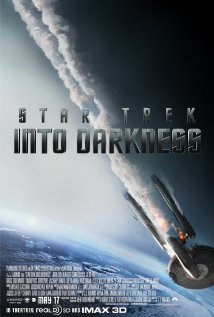
Star Trek Into Darkness finds the cocky young James T. Kirk (Chris Pine, This Means War) back at Starfleet as Captain of the Enterprise.  The movie opens with Kirk and company on a recon mission on a foreign planet.  The natives are “uncivilized,” and the Enterprise has a directive to keep its presence undetected.  There is a volcano on the planet, threatening to erupt and destroy everyone on it, unless Spock can set off a device to prevent it.  Spock plants the device, but is unable to escape the scorching lava.  The only way for Kirk to save Spock is to disobey the directive and save him with the Enterprise, rescuing him from the volcano’s peak.  Spock is emotionless about his impending doom, and he doesn’t mind sacrificing himself to execute the mission.  Kirk is a wild card, and he doesn’t mind breaking the rules, even if it’s a Starfleet directive.  He rescues Spock, and in doing so exposes the highly advanced interplanetary spacecraft to a people who haven’t even invented the wheel yet.

This act of defiance leads to Kirk’s demotion and his ordered return to the Academy, courtesy of his superior officer and mentor Commander Pike (Bruce Greenwood, Flight).  His exile is short-lived though, as emergencies call for reinstatement to the Enterprise.  An act of British terrorism at a Starfleet Records location implicates a treasonous officer named John Harrison.  Harrison takes it a step further with an attack on Starfleet, and now the crew must hunt him down and make him pay.  Their quest to apprehend him takes them throughout the galaxy, to the forbidden planet of Kronos – a planet they dare not visit, as tension with the Klingons is at an all-time high.  The remainder of the movie centers around the battle with Harrison, who is a much greater foe than Kirk and Company anticipated.

JJ Abrams (Super 8) has done it again.  Star Trek Into Darkness was everything you’d want in a summer blockbuster: non-stop action and entertainment, and cool special effects.  I’m starting to hate the entire concept of 3D, because 90% of the movies that are released with this “special feature” are not enhanced by it at all.  The difference is negligible, and audiences should smarten up and stop falling for the trick.  Studios are shameful with this blatant money-grab.  I digress.  Despite the useless 3D aspect, I have no real criticism of the movie.  The plot made sense and it was easy to understand.  I don’t want a plot that’s completely dumbed down, but give audiences something they can wrap their heads around.  I want the plot to make sense; I don’t just want to be entertained by stuff blowing up, although that works for me too.  Chris Pine is a likable leading man, and he’s ably shouldered the load in the few performances I’ve seen from him.  Abrams brought an emotional backstory to the movie, adding an unexpected heft to the movie’s tone.  With him at the helm, Star Trek should be a summer franchise to watch for a few years to come.  Grade: A

Iron Man 3

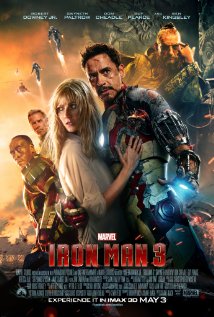
It’s time for the summer movies to start rolling in, the popcorn fare that entertains us during those dog days.  Iron Man 3, the third installment in Marvel’s popular franchise, kicks off what should be a promising season for super hero movies.  This time around we find Tony Stark (Robert Downey Jr., Sherlock Holmes: A Game of Shadows) recuperating from the otherworldly showdown that capped off last year’s Avengers.  He is physically fine, but his shaken mental state leaves him in a reflective mood.

The movie opens with Tony thinking back to a chance encounter on New Year’s Eve 1999.  After attending a glamorous party with then girlfriend Maya Hansen (Rebecca Hall, The Town), Tony runs into a scientist, a developer named Aldrich Killian, who wants to discuss some exciting new ideas for his technology company.  Aldrich (Guy Pearce, Prometheus) appears nerdy and disheveled, not the kind of person who leaves an impression.  Tony snubs the man, unwittingly setting him on a course of scornful retaliation.

Fast-forward to the present day, and Aldrich has reinvented himself.  Gone is the meek intellectual who could barely a muster a sentence. With a new hairdo and some much-needed dental work, he is confident and bold.  His intentions have grown more nefarious since Tony spurned him all those years ago.  He has created Extremis, a chemical that could restore limbs to maimed soldiers returning home from war.

Unfortunately, Extremis can have terrible side effects, including spontaneous combustion, which would sort of defeat the purpose of regenerating a lost limb, wouldn’t it?  These spontaneous explosions are related to a series of terror attacks that have been charged to a radical extremist known as “The Mandarin” (Ben Kingsley, Hugo).  His relationship with Aldrich isn’t immediately clear, but the pair is up to something fishy.  When Aldrich kidnaps the president in a misguided attempt to further their twisted terrorist agenda, Tony and his buddy Colonel James Rhodes (War Machine aka Iron Patriot) (Don Cheadle, Flight) come to the rescue.

Hope I didn’t give away too much; I tried to keep it simple.  Iron Man 3 was exciting and entertaining, and I understand why it opened at number 1, given its format and the time of year.  The special effects were cool; particularly the way the Iron Man suit strategically broke away from Tony and then quickly reattached itself, piece by piece.  The movie was funny, and even though he’s a billionaire, Stark is one of the more accessible superheroes because he doesn’t seem to take himself too seriously.  There were lots of one-liners, and Robert Downey Jr. will be missed if it’s true that this is his last outing.  You know what though?  I was rather underwhelmed.  I actually dozed off for a quick second.  I can’t quite put my finger on it, but maybe I like a darker protagonist.  This was a feel-good movie for all audiences, which is great.  I’m sure I have the minority opinion, but I just didn’t love it.  Good movie, but no big deal. Grade: B+


Gatsby

It’s been a long time since my high school English class, but I remember that The Great Gatsby was one of my favorites.  It’s been dramatized a few times, including a 1974 version starring Robert Redford and Mia Farrow.  That version was a rather dull, literal interpretation of the book that offered little in the way of artistry.  Now, director Baz Luhrmann (Moulin Rouge, Romeo + Juliet) reunites with Leonardo DiCaprio (Django Unchained) in a beautiful adaptation of the Fitzgerald classic.

The movie begins true to form with the introduction of Nick Carraway, played here by Tobey Maguire (Brothers).  Nick is an observer, a spectator in a world to which he doesn’t actually belong, and our gateway to Gatsby.  He lives on Long Island, renting a modest cottage across the sound from his cousin Daisy (Carey Mulligan, Shame) and her husband Tom Buchanan (Joel Edgerton, Zero Dark Thirty).  Their estate dwarfs Nick’s, as the “old money” Buchanans are well established.

The Island is divided into two sections, with Daisy and Tom on East Egg, and Nick on West Egg.  As Nick acclimates himself to his new environment, he begins to hear whispers around town about Jay Gatsby, a mysterious resident of West Egg known for his lavish, opulent parties.  He lives next door to Nick, but the two have never met.  In fact, Gatsby is such a shadowy figure that for the first 20 or so minutes, we don’t even see him, we only hear about him in excited, hushed whispers.  This is particularly true at one of Gatsby’s own parties, to which Nick is invited – but wading through the rumors only adds to Gatsby’s mystique.  Is he a bootlegger? How did he make his fortune? As the speculation reaches a fever pitch, finally Nick meets his enigmatic host.

Gatsby’s noveau riche trappings initially do very little to entice the object of his affection, Daisy Buchanan.  They had a brief dalliance before she married, but circumstances precluded their union.  After returning from war, Gatsby did not have the means to provide for a woman such as Daisy, and this fact both drove and haunted him.  Fast-forward five years to 1922, and Gatsby’s love for Daisy has intensified in its yearning.  She is his motivation for everything: the parties and the decadent monument to capitalism that his mansion represents.  The pair is ill fated, and the revelation of this immutable fact is  beautifully tragic.  I don’t want to say much more about the plot, because I hope you’re already familiar.

Baz Luhrmann is a true artist, and the cinematography was breathtaking.  Certain scenes looked as if they could be paused, printed, framed, and hung on a wall.  When Nick gets drunk for only the second time in his life, it is during a raucous party in the city with Tom Buchanan, Tom’s mistress, and her friends.  Nick is torn between his loyalty to his cousin and friendship with Tom, but eventually casts his inhibitions aside.  Luhrmann creates an unforgettable scene, a beautiful bombardment of color and sound unlike anything you’ve seen.  It was like a Romare Bearden painting come to life.

Much ado has been made about the film’s anachronistic score, provided by Jay-Z.  Luhrmann has employed anachronism in previous work, and I found it mostly effective here.  “Who Gon Stop Me,” “No Church In the Wild,” and “100$ Bill” were completely on point in terms of their placement.  I can’t say enough about this film, and I honestly don’t see what’s to dislike.  Gatsby was a magical movie that juxtaposed the great opulence of a gilded age with the hollowness of hedonism and unrequited love.  The performances were brilliant and haunting, particularly those of DiCaprio and Maguire.  DiCaprio infused Gatsby with the requisite charisma and panache, affecting the aristocratic transatlantic accent of the day with perfection.  This was one of the best movies of 2013, so far.  Grade: A.

Pain & Gain

The trailer for Pain & Gain looked like my kind of movie, just the type of exciting, cool flick that cinephiles can expect this time of year as we gear up for the action-packed summer blockbusters.  I’m a fan of Mark Wahlberg, who is no stranger to playing the badass antihero (see The Departed and Contraband), and I liked the premise.  It promised to tell the true-life tale of an ambitious young bodybuilder who went from rags to riches, breaking a few laws along the way.   I was entertained at various times throughout the movie, but by the time the credits rolled I had an underwhelmed feeling.

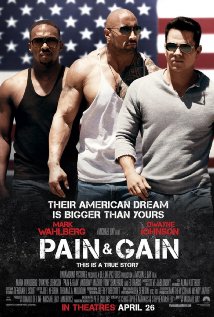
Wahlberg stars as Daniel Lugo, a convicted murderer who took the lives of two innocent people in 1995 during a botched robbery.  The movie opens by introducing us to Lugo, an ambitious meathead with a voracious appetite for his version of the American Dream.  Lugo was inspired by the fictional exploits of the likes of Tony Montana and Michael Corleone, and (stupidly) aspired to be like them.  One would think that Scarface in particular would be a cautionary tale, considering that he ended up laying dead in a fountain looking like a piece of Swiss cheese – but don’t tell that to Daniel Lugo.

Lugo worked at a Florida gym, where he perfected his body and his designs on untold riches.  Accompanying him was friend Adrian (Anthony Mackie, Gangster Squad), a fellow bodybuilder with similar ambitions of greatness.  Eventually Lugo hatches a plan to kidnap and extort Victor Kershaw (Tony Shalhoub, Hemingway & Gellhorn), a wealthy client for whom he acts as personal trainer.  Kershaw has several assets that Lugo can liquidate if he compels Victor to turn them over.  Daniel and Adrian recruit a third man for their plot, a convict named Paul Doyle (Dwayne “The Rock” Johnson) who has served time in federal prison.  Doyle is a humorously devout Christian who found Jesus in jail.  Perversely ironic, he has no problem jibing his Christian ideals with a criminal lifestyle.  Once the three stooges have the plan in motion, they bungle their way through, eventually getting their hands on millions of dollars.  Eventually things begin to go south with Kershaw and the gang decides they need to do another job.  Their greed eventually gets the best of them, leading them to the robbery and murder of a wealthy couple that belonged to their gym.

The movie began to lose me about a third of the way through, when I couldn’t tell if it was taking itself seriously or not.  There were several implausible scenes, including one where Kershaw seems to be invincible.  I did research after the fact, and it turns out that these farfetched things actually happened.  I can’t fault director Michael Bay (Transformers) for telling it like it is, but I can fault him for the way he chose to depict these real-life events.  The three principal characters were portrayed as funny and likeable, and so I liked them.  But by the time the movie concludes, the viewer realizes that these funny guys did a horrible thing.  Because they were depicted so comically initially, I’m not sure that the severity of their actions adequately resonated with viewers.  I enjoyed the laughs, and Wahlberg was his usual cool, badass self – but I was left with too many conflicting elements, from an emotional perspective.  I don’t attribute this to any particular depth of storytelling, but rather to a muddled approach by director Michael Bay.

Grade: C+

This article first appeared at Poptimal and was reprinted with permission.

The Place Beyond the Pines

I adore Ryan Gosling.  I think his choices are shrewd and artful, and the camera loves him.  I can rattle off several of his movies that I think are truly superb, and now you can add one more to the list. In The Place Beyond the Pines, Gosling gives a stirring performance that permeates quietly before a shocking culmination.

The movie begins with an introduction to Luke Glanton (Gosling, Gangster Squad), a motorcycle stunt rider who performs in a traveling carnival.  Director Derek Cianfrance (Blue Valentine) immediately drew the audience in with a taut opening sequence, as Luke performs a dangerous three-man stunt in a steel cage without batting an eyelash.  We see immediately that he is a thrilling character, dangerous and effortlessly cool.  I was reminded of Gosling’s turn in Drive, which also began with a riveting introduction to the main character in his element.  Before he leaves for his next city, he is visited by Romina (Eva Mendes, The Other Guys), an old flame.  Ro wears a pained expression, and their interaction is cautious and awkward as he drives her home.  He tells Ro that he will be leaving town soon, but he later stops by spontaneously one last time before hitting the road.  Ro isn’t home, but her mother answers the door holding an infant, which turns out to be his son Jason.

Luke is upset that Ro didn’t tell him about his son, although he hadn’t kept in contact with her since his last visit.  He immediately feels a sense of responsibility and decides to stick around town, quitting the carnival.  He shifts gears and wants to be a provider, though he is totally unequipped and unprepared for fatherhood.  The fact that Ro is in a relationship with a new man (Mahershala Ali, House of Cards) and surrogate father to Jason only adds to Luke’s feelings of inadequacy and emasculation.  Soon he meets Robin, a friendly swindler who easily convinces him to knock off a bank for a quick, small score.  In a brazen daytime robbery, Luke rides his motorcycle up to the bank door and surprises unsuspecting tellers in a daring heist.  He makes his exit quickly, zipping through traffic at a harrowing clip to rendezvous with Robin.  These moments when Gosling (or his stunt double) weaved his way through traffic and the pine trees of the forest on his motorcycle were amazing.

Eventually Luke crosses paths with Avery Cross (Bradley Cooper, Silver Linings Playbook) an ambitious Schenectady cop who is privy to larger corruption within the department.  The movie shifts at the midway point, and we begin to see life through Avery’s eyes.  Despite the varied perspectives, the film never felt unfocused.  As we examine the aftermath of their interaction, a parallel storyline emerges, as Luke’s fate and that of his infant son become inextricably tied to Avery Cross, who also has a baby boy.  As the movie unfolds, a haunting context emerges, giving more resonance to Gosling’s character, even when he is not on screen.

From Blue Valentine to Drive, Gosling always strikes the right note and draws the viewer in to his characters’ emotions.  His portrayal was authentic, and I never doubted the performance.  There was a fateful air of sadness that hung over the movie, and Luke was a sympathetic character despite his criminal leanings.  Luke’s energy was palpable, and Gosling was magnetic in every scene.  The Place Beyond the Pines was a poignant, electrifying movie that explored the themes of fatherhood and manhood in a stirring and powerful way.  The camera loves Ryan Gosling, and you will too. Grade: A.

42

A few days ago I had the pleasure of watching 42, the historical account of Jackie Robinson’s integration of major league baseball in 1947.  Robinson is a central figure in Black History, but he was an American hero whose story can be championed by all.

The movie starts without a single opening credit, with director Brian Helgeland (The Order) providing an account of the historical context of American life in 1947 and by extension, baseball.  Segregation was the law of the land, but Brooklyn Dodger president Branch Rickey (Harrison Ford, Cowboys & Aliens) had the progressive inclination to add a Negro player to the team.  Robinson (played by newcomer Chadwick Boseman) possessed a blend of athleticism, youth and pedigree that made him the clear choice over other talented Negro League players, like Satchel Paige.  Although Robinson is a legend, it took a visionary like Rickey to provide the platform for change.

Robinson faced profound and insidious discrimination.  When he stepped up to home plate he was jeered by fans as well as opposing teams.  Opposing pitchers threw at his head, and while playing first base during his first year an opponent intentionally speared him with his cleats.  Throughout this abuse, Robinson maintained his dignity and composure.  One couldn’t even say that a lesser man would have retaliated, because any man would have.  Rickey carefully explained to Robinson that he would never be able to react to the abuse or else the “experiment” would fail.  He bravely served as baseball’s test case to end segregation, enduring ceaseless racism at every turn.

Despite my overwhelmingly positive thoughts about the film, I do have a few minor criticisms.  Harrison Ford’s portrayal of Branch Rickey was very blustery.  He could have pulled back a little bit; but maybe that’s how Rickey really behaved.  If so, I should give him credit.  But if that was Ford’s own interpretation; I found it annoying.  Another minor quibble is that the filmmakers started the movie with a recitation that some may find boring.  I was interested, but it did come across as something you’d see on PBS or some other educational channel.  I do think it was important to set the appropriate historical context for the movie, but it felt like a perfunctory start.

42 balances the ugliness that occasionally marred Robinson’s baseball career with the warmth and purity of the love he shared with his devoted wife Rachel (the talented Nicole Beharie, Shame), a young woman he met while enrolled at UCLA.  Rachel kept Jackie grounded and was a source of peace and solace in an otherwise tumultuous world.  Despite the abuse that Robinson suffered, his time on the diamond was characterized by great triumph as well.  On the most fundamental level, Robinson was an outstanding athlete who wanted to be judged on his merits rather than his skin color.  This simple tenet is the cornerstone of our democracy, but 66 years ago Robinson struggled to receive the most basic allowances that we take for granted now.

Robinson portrayed himself in his own biopic decades ago, but this is the first dramatization to give proper attention and dramatic effect to his story.  Boseman’s big screen debut ostensibly came with lofty expectations, but I think he more than ably captured the humility and quiet strength that Robinson personified.  I think all Americans should see this movie about one of the most transformative figures in our shared history.  Grade: A-