2013 Movies

Trance

I think I have a decent working knowledge of recent cinema, but I admit that I had no idea director Danny Boyle (127 Hours) was such a prolific filmmaker.  His name wasn’t on my radar until 2008’s Slumdog Millionaire, which was amazing. I looked at his filmography and realized that there are a few more of his movies that I’d seen, including 28 Days Later and The Beach.  I enjoy his work because he has no discernible niche, and his repertoire reflects a unique versatility.

His latest offering is Trance, a reality-bending thriller starring James McAvoy (X-Men: First Class), Vincent Cassel (Black Swan), and Rosario Dawson (Unstoppable). McAvoy leads as Simon, a young auctioneer who sells valuable paintings off for a Sotheby’s-like company. The movie begins with Simon as narrator, describing his duties as auctioneer, including a detailed description of their robbery protocol.  Robberies used to happen with greater frequency in decades past, as thugs would simply storm into the auction with guns drawn, taking the precious art by force. When Vincent Cassel’s character Frank and his cohorts conspire to steal a valuable Goya painting, they display an intimate knowledge of the robbery protocol that could have only resulted from inside information, which implicates Simon.  When their brilliant heist goes awry, Simon is the only one who can provide answers. The stolen Goya has been lost, and only he knows its whereabouts.  Unfortunately, during the botched heist he suffered an amnesia-causing injury.

Complicating matters is Dr. Elizabeth Lamb (Dawson), a hypno-therapist who believes she can unlock Simon’s memory through co-operative therapy.  She places him in a trance, a mental state where he is highly susceptible to suggestion.  Elizabeth helps Simon navigate the deepest recesses of his mind and he begins to recall certain events.  But are these memories real or false? The lines between doctor and patient and reality and fantasy all become blurred, giving the film a surreal, moody quality.  There was foreshadowing throughout, which only added to the mystery and atmospheric intrigue that Boyle so deftly created.

Vincent Cassel was very effective as Frank, giving the character an unexpected depth.  One minute he seems like Simon’s tormentor; the next minute he is a concerned friend.  Rosario Dawson literally bared it all, boldly appearing nude from head to toe more than once.  I couldn’t believe she showed everything…even the “honeypot!”  I respect her dedication to the role, because although a close up of her hoo-haa may seem gratuitous, it actually made sense for her character to expose herself in such fashion.  James McAvoy ably exhibited Simon’s downward spiral, beginning the film upbeat and confident and ending it in a very dark place as he questions all around him.

The camera angles and cinematography were superb, as some scenes resembled the famous paintings that were featured in the movie.  Boyle’s use of color and overhead camera shots elevated the film to another level.  The writing and performances were nearly flawless, and the script was so cleverly written that Trance bears repeated viewings to be fully understood.  I found it confusing at times, but I attribute this muddling to my own lack of understanding rather than a flaw in Boyle’s writing.  Again, a second viewing is advisable.  If you appreciate suspense, you will not be disappointed. Grade: A-
G.I. Joe: Retaliation

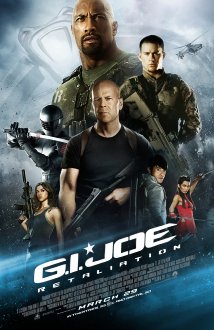
Once again I have to start this review with my fanboy disclaimer: I am not a GI Joe “buff,” and you shouldn’t have to be to see this movie.  I watched the cartoons as a child, but I’m approaching this review as an average moviegoer and not an enthusiast.  At any rate, I enjoyed the first edition and was looking forward to the sequel.  It was entertaining, and it opened up at number 1 at the box office – but it wasn’t quite all it was cracked up to be.

We begin with Duke (Channing Tatum, Side Effects) and Roadblock (Dwayne “The Rock” Johnson, Snitch) as the movie opens with a glimpse into their affable friendship.  Tatum and Johnson have an easy rapport, and it’s always interesting to see these iconic cartoon/comic book characters brought to life.  Lady Jaye is portrayed by Adrianne Palicki (Red Dawn), who you may recognize from Friday Night Lights, while DJ Cotrona of Detroit 187 appears as Flint.  Duke is the clear leader, but his position is threatened when the Joes are ambushed by COBRA while on assignment.  It turns out the President is actually a disguised Zartan, who ultimately wants to free Cobra Commander from his prison and destroy the Joes in the process.  The ambush results in severe casualties, and nuclear warheads are stolen. The President (Zartan) blames the Joes and paints them as traitors, disavowing them.  Disgraced and betrayed, the surviving Joes band together to figure out who’s responsible and recover the warheads.

I’ll be succinct and quite simply tell you what worked and what didn’t.  We’ll start with the positive.  I thought the casting was effective and the lineup made sense.  Additionally, there were quite a few cool scenes and plenty of entertaining action sequences, including a memorable scene involving Snake Eyes (Ray Park, X-Men) and Jinx (Elodie Yung, The Girl With the Dragon Tattoo) battling ninjas on the side of a snow-capped mountain.  Bruce Willis (Red) makes a cameo as a seasoned Joe who lends a hand, and he’s a sentimental favorite of mine.   I think he’s gonna try to do the action thing until he’s collecting Social Security (if he’s not already), and you know what? He can still pull it off.

Unfortunately, the movie wasn’t without its flaws.  The 3D aspect was negligible, which is becoming all too common nowadays.  Secondly, the writing was not very impressive.  The movie faltered when it drifted away from action.  The dialogue was corny and the plot confusing at times, beginning with the appearance of RZA as a wise old martial arts master who has a history with Storm Shadow (Byung-hun-Lee, I Saw the Devil).  I thought I was watching The Man With the Iron Fists for a second.  I like RZA, but I couldn’t take him seriously. I think if you grew up watching the cartoons, you might want to see this off GP, and I can dig it.  But if you’re totally neutral about it, perhaps you should forego the experience.  It wasn’t bad.  It just wasn’t THAT good.  Grade: B-

Olympus Has Fallen

It’s been a while since we’ve had a “straight up” action movie.  I don’t mean a superhero joint with good special effects.  I’m talking about a movie where a disastrous situation occurs and there’s only “one man for the job.”  In his latest effort, director Antoine Fuqua (Training Day, Brooklyn’s Finest) harkens back to the 80s, a decade proliferated with Schwarzenegger/Stallone/Willis movies featuring a one man wrecking crew.

Fuqua pulls together several notable names in Olympus Has Fallen, an action-packed movie about a secret service agent who tries to save the White House (code name Olympus) after it is besieged by North Korean terrorists.  Gerard Butler (Playing For Keeps) stars as Mike Banning, an accomplished Secret Service agent who was recently reassigned from a prestigious position on the President’s detail to a much less exciting position at the Treasury Department.  The President is ably portrayed by Aaron Eckhart (The Rum Diary), even though there is no way he looks like a president.  In real life, a President has never appeared so young, fit, and handsome – no offense to JFK or President Obama.  Morgan Freeman (The Dark Knight Rises) and Angela Bassett (This Means War) round out the cast as the Speaker of the House and Secret Service Director, respectively.

The movie begins with a flashback to the incident that led to Banning’s reassignment.  I’ve always thought it was extremely important to begin and finish a movie on a strong note.  I think audiences are more tolerant of a lull in the middle of a movie if they feel invested up to that point.  Don’t let Butler’s recent romantic comedy leanings fool you.  Remember that he was King Leonidas in 300, and playing the tough guy hero is totally in his wheelhouse.  The actual White House takeover scene was breathtaking to watch, for a number of reasons.  Even if you’re not the patriotic type, there is something unnerving about seeing the White House obliterated.  I’m not xenophobic, but when I saw those North Koreans make Swiss cheese out of 1600 Pennsylvania Avenue, my blood began to boil.  Go America!

The concept of the White House being taken over is a little far-fetched, but if it could ever conceivably happen I think Fuqua did a good job of showing us how it would transpire.  That being said, I don’t think the CIA is too concerned with anyone getting ideas after seeing this movie.  I’m not sure if the weapons technology depicted really exits, but the special effects were amazing.  Excessive killing in movies can be gratuitous, but here it was essential to the plot.  Freeman and Bassett didn’t break any new ground with their roles, but they served their purpose. As long as Butler was convincing as Banning, the movie worked.  Just as John McLane’s sole objective was to reclaim the Nakatomi Building, Mike Banning will stop at nothing to reclaim The White House.  If you like action, this throwback movie won’t disappoint.  Grade: B+

The Incredible Burt Wonderstone

Steve Carell has been pretty consistent with his comedic performances, save for 2010’s horrid Dinner for Schmucks.  He’s shown the ability to deliver laughs as well as heartfelt, dramatic performances, as found in Crazy, Stupid, Love and Dan in Real Life.  In his latest movie he joins Jim Carrey (Mr. Popper’s Penguins) and Steve Buscemi (Boardwalk Empire) in The Incredible Burt Wonderstone, a silly flick about dueling magicians.

Carell is Burt Wonderstone, an egotistical Vegas magician who performs a running act alongside his best friend and fellow magician Anton Marvelton (Buscemi).  They resemble Siegfried and Roy, and it’s especially funny to see Buscemi out of his element in such a ridiculous part.  They are joined by their able assistant Jane (Olivia Wilde, In Time), a gifted magician in her own right.  Although he performs for hordes of adoring fans each night, Burt was not always so popular.  His childhood was miserable until he received a magic set for his birthday and found his passion through the love of magic.

Fast forward to the present day and there is a new kid on the block in Steve Gray (Carrey), a character that is best described as a cross between Chris Angeland David Blaine.  Gray is capturing the public’s attention through his magic tricks that more closely resemble publicity stunts.  Some of his “tricks” include holding his urine for over a week and not blinking for days at a time.  His antics are intentionally absurd, but it wasn’t too far removed from some of the ridiculous feats attempted by David Blaine.  Magic is an easy subject to lampoon, so the storyline was ripe for laughs.  For starters, all three magicians take their craft very seriously, approaching their performances with a laughable level of intensity.

When Anton and Burt have a falling out after a failed magic trick, Anton finally stands up for himself and quits.  Burt tries to maintain the show, but it fails miserably.  His boss at the casino (James Gandolfini, Killing Me Softly) gives him one last chance to recapture the old magic if he can best rival Gray and come up with an unbelievable magic trick to beat all others.  The remainder of the movie pits Burt and Gray against one another, with pretty funny results.  Jim Carrey’s humor isn’t for everyone, but I’ve always been a fan of his quirky brand of physical humor.  He reminded me of his old performances on In Living Color and I thought he played well off Steve Carell.  Olivia Wilde was a good sport in her role and ably complimented the more experienced funnymen.

The Incredible Burt Wonderstone was more ridiculous than funny, which isn’t necessarily a bad thing.  The three lead actors didn’t take themselves too seriously, and that was the only requirement here.  It was not highbrow humor, but I enjoyed myself despite the silly premise.  Jim Carrey fans won’t be disappointed, although it won’t rank highly among his funnier solo efforts.  Similarly, Steve Carrell has also had smarter, funnier material to work with.  However, I can’t judge the movie too harshly.  It’s a movie about dueling magicians for goodness’ sake, what did you expect?

Grade: B

This article first appeared at Poptimal and was reprinted with permission.

Snitch

I think there can be many ingredients to a successful movie, and there are a variety of ways to end up with an entertaining film.  A movie with a hackneyed plot can still be salvaged with good performances from a gifted cast.  Similarly, a highbrow concept can compensate for trite dialogue.  In Snitch, director Ric Roman Waugh presents a direct but effective story of a man who will exhaust all measures to protect his son. I don’t think Waugh had any great artistic aspirations with this movie, but it was enjoyable in its simplicity and straightforwardness.

Dwayne “The Rock” Johnson(Fast Five) stars as John Matthews, a recently divorced father of two.  His teenaged son Jason lives with his mother (Melina Kanakaredes, CSI: NY) while John resides with his second wife and their young daughter on a large estate.  A small business owner, John’s job occupies him most of the time.  Perhaps it is this inattention from his father that leads Jason to a very poor decision to get involved with illegal drugs.  He foolishly agrees to allow a friend to mail him ecstasy pills, with the understanding that the friend will pick them up later.  The package is intercepted from Jason’s friend, who agrees to implicate Jason for a reduced penalty.  Ultimately Jason is arrested after he accepts the package, devastating his parents and jeopardizing his promising future.

Jason’s crime subjects him to mandatory minimum laws that require a mandatory sentence for a particular crime, even if it’s the accused’s first offense.  Thus, Jason will be sentenced to 10 years in federal prison, unless he cooperates with the authorities and “snitches” on one of his friends in order to reduce his sentence.  Refusing to betray one of his friends, Jason remains silent, with no hope of release.  With Jason’s refusal to cooperate, John offers to stand in his son’s place and act as an informant for the U.S. Attorney (Susan Sarandon, Cloud Atlas).  If he can help them ensnare someone higher up the “food chain,” Jason’s sentence will be reduced to 6 months.  Snitch is inspired by true events, but this part of the story seemed implausible to me.  I’ll overlook its dubiousness, since I know it is just a vehicle by which to set up the major premise of the movie.

After John gets the green light from the Feds, he enlists the help of one of his employees (Jon Bernthal The Walking Dead), an ex-con who can provide the entre into the underworld that he needs.  The bulk of the movie follows John as he moves closer to landing a major cartel player in order to save his son.  The movie was action-packed and tense, and Johnson’s portrayal of a devoted father was convincing.  He showed a subtle tenderness in a few scenes, displaying the right mix of intensity and restraint in the role.

However, there was virtually no character development.  The movie was very linear, and it reminded me of the old “B movies” of the 1980s.  Despite being straightforward, I appreciated its commentary on the criminal justice system.  Waugh closes with an astonishing statistic that mandatory minimum laws often result in greater sentencing for drugs than rape and murder.  The movie humanized the war on drugs in a thoughtful, simple way.  The only other observation I’d make is that I was surprised by the quality of the cast.  In addition to Susan Sarandon, Barry Pepper (Broken City) and Benjamin Bratt also make appearances, and I thought Waugh was lucky to have them in such ordinary roles.  Simple yet illuminating, Snitch was a fairly good way to spend an afternoon at the movies.  Grade: B

This article first appeared at Poptimal and was reprinted with permission

Side Effects

Known as the “master of suspense,” Alfred Hitchcock is considered a true pioneer of the contemporary thriller.  He popularized the idea of the “femme fatale,” a woman whose beguiling attributes rendered men helpless, often with deadly consequences.  So, when someone references Hitchcock or describes a film as “Hitchcockian,” I’m curious to see the supposed hallmarks of one of my favorite directors.  When I heard one of the stars of the new movie Side Effects describe it as reminiscent of Hitchcock – I was convinced to give it a look.

Side Effects is Steven Soderbergh’s (Contagion, Magic Mike) latest addition to a prolific career.  I’m a fan of his slick cinematography and the occasional languid feel of some of his movies, and Side Effects was no exception.  The movie features Channing Tatum (The Vow, Magic Mike) and Rooney Mara (The Girl With the Dragon Tattoo), as Martin and Emily Taylor, a young couple trying to rebuild their lives after Martin’s release from prison for insider trading.  Separated for five years, the couple is eager to reunite, and they seem very loving and loyal to each other.  Emily appears devoted, having stood by Martin during his fall from grace.  However, soon after his release Emily falls into an inexplicable depression.  I suppose some jittery anxiety is normal, as the pair hasn’t been intimate in quite some time.  Yet Emily’s mood doesn’t comport with what should ostensibly be a very happy time in their lives.  After she commits a dangerous act that shall remain nameless (you’re welcome), she comes under the care of Dr. Jonathan Banks (Jude Law, Sherlock Holmes: A Game of Shadows), a psychiatrist who believes she may simply be feeling overwhelmed by Martin’s return.  Eventually he gives her a prescription, but she continues to deteriorate both rapidly and publicly.  She melts down at a black-tie party in front of their friends, and she needs consolation from a co-worker at her job.

Throughout her struggle, Martin remains patient and understanding as Emily listlessly goes through the motions of everyday life.  She tries one prescription pill after another, as nothing seems capable of snapping her out of her funk.  People suggest different medicines to her, and Banks gives her a sample of a drug called Ablixa (http://www.tryablixa.com/) after consulting briefly with her former psychiatrist (Catherine Zeta-Jones, Broken City).  What follows is a series of events that will leave you shocked and scratching your head.  The movie really shifts gears about halfway through, and I understand the Hitchcock comparisons.  There was an intimate, dream-like quality to the film that made it feel mysterious and slightly foreboding, and I appreciated that aspect of the movie.

Despite the intriguing plot and expert cinematography, I found a lot to be desired when it came to performances.  To be fair, it was only Channing Tatum that left me underwhelmed, yet again.  I think he’s very good-looking and charming.  According to some, he’s even the ‘sexiest man alive.’  Unfortunately for Tatum, this was a trait that served him better in Soderbergh’s last film, Magic Mike.  Here I found him serviceable, at best.  There just never seems to be much beneath the surface, with him.  By no means do I think he’s unintelligent, but his performances always strike me as one note, failing to resonate.  Rooney Mara, on the other hand, was convincing as a troubled, unstable young woman.  Perhaps it’s her diminutive stature, but she always seems vulnerable, and I thought her physical make up served her well in the role.  Her character required a duality that she ably conveyed.  Lastly, Jude Law was effective as the well-meaning doctor who genuinely wants to help Emily but is clueless as to what deeper issues may be bubbling under her troubled veneer.  The pacing was a bit slow in certain spots, but this was remedied by the final act.

I’ve tried to reveal as little as possible, but I’ll leave you with a solid recommendation for this tense thriller. Side Effects was sexy, mysterious, and suspenseful.  Amidst a sea of Oscar contenders currently in some theaters, I thought it was a welcomed reprieve.  Grade: B+


This Is 40

During the last few years, Judd Apatow has emerged on the comedic forefront with some very memorable movies.  Before his recent popularity, he began his career writing/directing several episodes of NBC’s critically acclaimed Freaks and Geeks.  His big screen directorial debut came with The 40 year Old Virgin, which I thought was hilarious.  Apatow kept the laughs going with Knocked Up, and This is 40 is the aptly billed “sort-of sequel” to that movie.  Unfortunately, it wasn’t nearly as funny as its predecessor.

Paul Rudd (The Perks of Being a Wallflower) and Apatow’s wife, actress Leslie Mann (The Change-Up) reprise their limited roles from Knocked Up, returning as Pete and Debbie.  They have two adorable daughters named Sadie and Charlotte, and they have a lot for which to be thankful.  However, it seems that Pete is rather bogged down with life’s common stressors, such as the demands of his job and family.  He gets most of his “me time” in the bathroom, before his wife routinely interrupts him and beckons him back to the family.  The movie shows how 40 isn’t “old,” but it definitely comes with a different set of demands and expectations.  Both Pete and Debbie own their own businesses, and each professional endeavor highlights unique feelings of inadequacy for both of them.  Pete has a fledgling record label and featured artist, while Debbie deals with younger employees at her own boutique.

Family is the central theme of the movie, with a focus not just on Sadie and Charlotte, but on their parents as well.  Pete’s father (Albert Brooks, Drive) has repeatedly borrowed money from him for years, to the family’s detriment.  Just as Debbie begins to accept her impending 40th birthday, she finds out that she is pregnant again and makes it clear that they can’t afford to hemorrhage funds to Pops.  She also has a strained relationship with her own father (John Lithgow, The Campaign), who divorced her mother long ago and started a second family.  She feels disconnected from him, as he is a much more visible presence in his second family’s life.  In the movie’s final act, Pete and Debbie try to resolve some long-standing issues with their fathers, with mixed results.

I liked This is 40, but if you are expecting non-stop hilarity you will be disappointed.  This is not one of Apatow’s funnier movies. I think Mann and Rudd are gifted comedic actors, and I enjoyed them in movies like I Love You Man and The Change-Up.  However, This is 40 is not as funny as either of those two movies.  It was more heart-warming and sweet than funny, and I was definitely straight-faced more than once.  The movie focuses on family so much that it became endearing.  That’s fine, but it’s not funny.  Good movie, but not as “laugh out loud” funny as I thought it would be.  Grade: B.

Jack Reacher

Sometimes it’s hard for me to separate the artist from the work.  If I dislike the way an actor conducts themselves outside of their movies, I don’t really look at their movies the same way, if at all.  Clint Eastwood pisses me off now.  I think he’s an ornery old cracker.  His movies are dope, but I just don’t rock with him like that.  Which brings me to Tom Cruise (Rock of Ages), my old favorite up until recently.  I have always liked Cruise, the venerable star whose movies were sure blockbusters.  And then he started to seem like a kooky scientologist.  Granted, I never heard of him doing anything really bad; he just seemed kind of weird.  But dammit, I couldn’t completely give up on him.  I liked him in the last Mission Impossible movie, because he’s still a great action star.  He’s charismatic and capable and seems like he performs his own stunts.  I’m sold on him in these types of roles, so when I saw the trailer for Jack Reacher, it looked worth checking out.

Cruise stars as Jack Reacher, a military investigator who is “off the grid.”  He served honorably, receiving numerous medals of distinction.  He hasn’t been definitively heard from or seen in a couple of years, and only resurfaces after being requested by a domestic terror suspect.  The movie begins with a vivid and terrifying sequence of events where members of the public are seemingly shot at random.  In light of the recent shootings in Connecticut, I’m sure this scene was particularly disturbing for some.  It reminded me of the DC Sniper, as we see the killer hunt his victims as they engaged in routine activity.  First he trained his sight on a woman walking alone, then on a man seated on a bench, and so on and so forth.  At first it seemed that he was bypassing his targets, whimsically sparing each one – but he quickly retraced his steps and picks off each victim in rapid succession.  He makes his getaway quickly, and soon the wrong man is arrested for the heinous crime.  We know this right away, but what we don’t know is why this unsuspecting former soldier named Barr was chosen as the fall guy, or why he wants Reacher to help him.

Rosamund Pike (Wrath of the Titans) and David Oyelowo (Lincoln) round out the cast as Barr’s lawyer Helen and the detective who wants to put him away, respectively.  They were serviceable in their roles, though something about Pike annoys me.  I think I haven’t forgiven her for replacing Gemma Arterton in Wrath of the Titans, which is unfair.  Nevertheless, I was glad that her character and Reacher kept it professional throughout the movie.  I didn’t notice any particular chemistry between the two, which was in keeping with Reacher’s solitary nature.

Reacher was similar to some of Tom Cruise’s past characters, in that he was a skilled antihero, a good guy who isn’t afraid to punish mercilessly when pushed by an adversary.  Despite his toughness, I liked that Reacher was more of a thinker than a bruiser; he only used violence as a last resort.  His mysteriousness only heightens the suspense of the movie, and I thought much of it was smart and well done.  However, after mulling it over with a friend who also saw it – I have to admit that certain scenes were foolish and didn’t quite make sense.  One fight scene between Reacher and two foes looked like something out of the Three Stooges, and it dumbed down an otherwise smart movie.  I’m not sure why the scene played out that way, though writer/director Christopher McQuarrie is brilliant to me, on the strength of The Usual Suspects alone.  I thought the writing was very sharp for the most part, but I was admittedly sucked in from the opening scene, so I may have had blinders on.

Tom Cruise is like a timeless, cryogenic wonder.  He is either genetically blessed, or he has the best plastic surgeon in Hollywood – because he still looks great and is believable.  At the age of 50 he is still convincingly playing the action hero, which is pretty impressive.  I’m not familiar with the series by which the movie was inspired, but I understand there was some backlash from its fans about his casting.  The Reacher of literary note was a blonde behemoth – which clearly does not describe Cruise.  Like I said, I’m not familiar with the books, so I share no such disappointment.  In sum, I thought Jack Reacher was pretty good, but it’s not a must-see.  Grade: B.

Django Unchained

Few filmmakers in recent memory have proven more controversial than Quentin Tarantino (Inglourious Basterds).  From his penchant for violence, to his excessive use of the “n-word,” his movies have sparked discourse amongst critics and fans alike.  He’s one of my favorite directors, so quite naturally I was looking forward to Django Unchained, his highly anticipated antebellum spaghetti western.  Before viewing Django, you’ll need to dispel notions of historical accuracy and political correctness, and that should make the film easier to digest.  Despite the much-ballyhooed use of the n-word, I enjoyed Django largely because of its memorable performances, though I wouldn’t rank it highly among my Tarantino favorites.

The movie begins appropriately with the introduction of the titular Django, (Jamie Foxx, Horrible Bosses) a slave who has been separated from his wife Broomhilda (Kerry Washington, A Thousand Words) and sold to a different plantation.  Slave traders lead Django and several others in a pitiful procession across a desolate Texas landscape, en route to his new plantation home. Eventually they cross paths with an amiable bounty hunter by the name of King Schultz (Christoph Waltz, Water for Elephants), a resourceful and charming man who masquerades as a traveling dentist.  He is in hot pursuit of three outlaw brothers, and Django may know their whereabouts.  Django is willing to help Schultz locate the trio, provided that Schultz agrees to help him find and rescue Broomhilda from her new plantation.  After the not-so-small matter of separating Django from the slave traders is solved, the pair set out on their quest.  Not only does Django locate and dispatch the initial three outlaws with Schultz, he helps him execute other bounties as well.  On the surface Schultz and Django would appear to make strange bedfellows, but the German dentist holds no prejudice, limited only by the rigid, cruel social constructs of the day.

Despite the small victory of the initial bounty, Django knows that he cannot rest until he finds Broomhilda. It is the driving force for everything he does, and Tarantino hammered the point home with flashbacks to Django and Broomhilda on their plantation, including a scene where she was whipped brutally.  Schultz keeps his word to track Broomhilda, and eventually he gets a beat on her.  She is in the possession of one Monsieur Calvin Candie (Leonardo DiCaprio, J. Edgar), a rather debonair slave master with faux Parisian sensibilities. Under an elaborate ruse, Django and Schultz find themselves in a position to rescue Broomhilda from Candie’s clutches, while dispensing a little old-fashioned justice along the way. The motif is one common to Tarantino’s previous work: a singular character with laser-like focus on revenge.

The most satisfying aspects of the movie were its rich performances, particularly those of Foxx, DiCaprio, and Waltz.  Foxx will probably end up being remembered for this role just as much as he was for Ray, and I thought he portrayed Django with a cool, understated fury.  This is the second Tarantino film for Cristoph Waltz, and I hope the trend continues.  He is a wonderful actor and I’ve been impressed with his abilities in every performance.  Lastly, Leonardo DiCaprio was deliciously evil as the cruel Calvin Candie, showing once again there is not much of which he is not capable.  I was a little disappointed with Kerry Washington’s lack of meaningful dialogue or screen time with Jamie Foxx, but the movie was written such that Broomhilda and Django are apart for the majority of the film, and he is its unmistakable star.  It’s not called “Broomhilda Unchained,” so I can live with that.

Django is a complicated film that certainly will not suit everyone.  I enjoyed it, but I’m not going to hop on the Django bandwagon.  Some feel that the movie trivializes and parodies slavery, due to the abundance of humorous elements.  Particularly comical was Samuel L. Jackson’s turn as the quintessential house negro who vies for “Massa’s” attention and approval.  His character’s contentious jealousy of Django is amusing, but unfortunately accurate.  That type of dissension still exists within the Black community today; though I’m not sure Tarantino intended this parallel.  As a matter of fact, I’m not sure Tarantino wanted to do anything with this movie other than entertain his audience; and that’s ok.  He certainly did not thoughtfully explore the underpinnings of slavery, though he did provide an accurate snapshot of its savagery.  I’m not complaining about his depiction, but I can understand the criticism of those who feel that he didn’t portray the subject with the gravity it requires.  To those folks, I would simply say that if you view this movie as a revenge movie set during slavery, you’d be less disappointed.  This is not Roots; this is not Amistad.  I don’t think Tarantino was trying to be profound or accurate at all.  I think he just wanted to make a “cool” movie, and the idea of a slave killing a bunch of white people just sounds badass.

Although I enjoyed the performances, there wasn’t much character development – but maybe that’s just not what this movie aims for.  Revenge movies are more about the accomplishment of the avenging act, not the protagonist’s metamorphosis.  At the end of the day, I think Django Unchained was a good (not great) film that doesn’t quite live up to its staggering expectations.  It’s a worthy addition to Tarantino’s catalogue, but I wouldn’t rank it among his best.

Grade: B+

This article first appeared at Poptimal and was reprinted with permission.