Harrison Ford

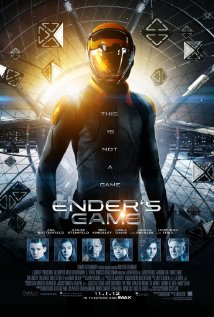
Ender’s Game

Sometimes a movie takes you by surprise.  I had no desire to see Ender’s Game until a friend suggested it.  The science fiction genre isn’t a real draw for me, and neither are kid-themed movies.  That being said, Ender’s Game was darn good.  Based on a novel of the same name, the film chronicles the development of Ender, a young boy who is destined to save Earth.

The movie begins at an unspecified future date, after the planet has narrowly survived an intergalactic battle about 20 years prior.  The military believes that the best defense is a good offense, and looks to the best and brightest children to form the army of tomorrow.  This underlying premise was fascinating to me.  There’s something creepy about viewing children in adult-like settings and situations rather than the protective lens through which they are usually portrayed.  Here, the characters behaved like adults, displaying both callousness and wisdom beyond their years.  Despite their maturity and the responsibilities with which they’re tasked, the viewer never forgets that these are just kids – even if they don’t act like it.

Among the gifted recruits, young Ender Wiggin (Asa Butterfield, Hugo) quickly distinguishes himself.  Colonel Graff (Harrison Ford, Paranoia) and Major Anderson (Viola Davis, Prisoners) of the army identify leadership qualities in Ender.  He is compassionate without being weak, strategic rather than emotional in his decision-making.  When provoked, he will defend himself, but he does not need to intimidate others.  He is gifted but humble, secure that his abilities will speak for themselves – thereby precluding the need to best his classmates.  Ender is the perfect balance of compassion and aggression.

After identifying the best of the best, Colonel Graff and his collection of multi-culti super kids head to space for training.  Ender’s abilities may have Graff and Anderson hooked, but they do nothing to endear him to his peers, who are envious of all the attention he receives.  Eventually he wins over the other recruits by showing that he will stand up for himself and challenge authority.  To put it simply, some people are natural born leaders, and Ender is special.  This was highlighted in a really great scene where Ender masterminds a winning strategy in a critical training exercise.  While Ender goes through his training, Graff and Anderson keep a watchful eye on their prized pupil.

In the movie’s final act, Ender must complete his training successfully before being entrusted with command of the International Army.  The fate of humanity depends on his readiness to protect Earth.  I won’t spoil the movie’s resolution, but hopefully I’ve said enough to entice you.  I enjoyed the psychological elements of the movie; from the way Ender expertly navigated the social pitfalls posed by the other recruits, to the manner in which Graff and Anderson dissected his behavior.  Asa Butterfield was a charismatic leading young man, and he embodied the character well.  I was so taken by the movie that I thought about naming my kid Ender if I ever have a son.  Yeah, I’m buggin’.

Grade: B+

42

A few days ago I had the pleasure of watching 42, the historical account of Jackie Robinson’s integration of major league baseball in 1947.  Robinson is a central figure in Black History, but he was an American hero whose story can be championed by all.

The movie starts without a single opening credit, with director Brian Helgeland (The Order) providing an account of the historical context of American life in 1947 and by extension, baseball.  Segregation was the law of the land, but Brooklyn Dodger president Branch Rickey (Harrison Ford, Cowboys & Aliens) had the progressive inclination to add a Negro player to the team.  Robinson (played by newcomer Chadwick Boseman) possessed a blend of athleticism, youth and pedigree that made him the clear choice over other talented Negro League players, like Satchel Paige.  Although Robinson is a legend, it took a visionary like Rickey to provide the platform for change.

Robinson faced profound and insidious discrimination.  When he stepped up to home plate he was jeered by fans as well as opposing teams.  Opposing pitchers threw at his head, and while playing first base during his first year an opponent intentionally speared him with his cleats.  Throughout this abuse, Robinson maintained his dignity and composure.  One couldn’t even say that a lesser man would have retaliated, because any man would have.  Rickey carefully explained to Robinson that he would never be able to react to the abuse or else the “experiment” would fail.  He bravely served as baseball’s test case to end segregation, enduring ceaseless racism at every turn.

Despite my overwhelmingly positive thoughts about the film, I do have a few minor criticisms.  Harrison Ford’s portrayal of Branch Rickey was very blustery.  He could have pulled back a little bit; but maybe that’s how Rickey really behaved.  If so, I should give him credit.  But if that was Ford’s own interpretation; I found it annoying.  Another minor quibble is that the filmmakers started the movie with a recitation that some may find boring.  I was interested, but it did come across as something you’d see on PBS or some other educational channel.  I do think it was important to set the appropriate historical context for the movie, but it felt like a perfunctory start.

42 balances the ugliness that occasionally marred Robinson’s baseball career with the warmth and purity of the love he shared with his devoted wife Rachel (the talented Nicole Beharie, Shame), a young woman he met while enrolled at UCLA.  Rachel kept Jackie grounded and was a source of peace and solace in an otherwise tumultuous world.  Despite the abuse that Robinson suffered, his time on the diamond was characterized by great triumph as well.  On the most fundamental level, Robinson was an outstanding athlete who wanted to be judged on his merits rather than his skin color.  This simple tenet is the cornerstone of our democracy, but 66 years ago Robinson struggled to receive the most basic allowances that we take for granted now.

Robinson portrayed himself in his own biopic decades ago, but this is the first dramatization to give proper attention and dramatic effect to his story.  Boseman’s big screen debut ostensibly came with lofty expectations, but I think he more than ably captured the humility and quiet strength that Robinson personified.  I think all Americans should see this movie about one of the most transformative figures in our shared history.  Grade: A-