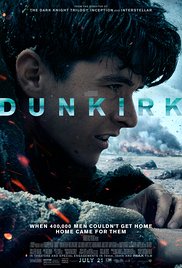
Christopher Nolan (Interstellar) is approaching rarefied air, that upper echelon of filmmaking where greatness is expected. With no obvious missteps in his impressive repertoire, his subject matter has been varied yet consistent. When extolling the virtues of film, I often cite its ability to educate and inform rather than merely entertain. In Dunkirk, Nolan masterfully brings to screen a significant but relatively unknown (at least to me) World War II battle. The quintessential auteur, Nolan has given us a beautiful film, both in spirit and aesthetic.
It’s the dawn of World War II and German forces have driven the British (and a few French allies) to the outskirts of Dunkirk, France, pressing them towards the beach along the northern coastline. Approximately 300,000 soldiers are stranded, making easy prey for passing bomber planes or foes approaching by sea. Just as 300 introduced me to the Battle of Thermopylae, Dunkirk educated me on the similarly harrowing Battle of France. That battle would eventually become a rescue and evacuation mission code-named Operation Dynamo. It may seem antithetical to describe a war film as beautiful, but the visual elements of the film were stunning. Nolan’s austere backdrop was captured perfectly on 70 mm film, the wider format adding an extra layer of realism while immersing the viewer.
The film is told from three distinct perspectives, beginning with Tommy (Fionn Whitehead), a young British soldier who finds himself stranded at Dunkirk after narrowly escaping from behind enemy lines. The second perspective belongs to civilian Mr. Dawson (Mark Rylance, Bridge of Spies) and his sons George and Peter, private citizens courageously responding to their country’s call to action. The third viewpoint is shown from the perspective of two fighter pilots, Farrier (Tom Hardy, The Revenant) and Collins (Jack Lowden, England is Mine), who don’t hesitate to enter the fray despite being low on fuel, changing course to head into what seems like sure disaster.
War films represent a diverse genre that I’ve come to appreciate over the years. From Saving Private Ryan to Platoon, the genre has consistently raised questions of morality and explored the psychological consequences of warfare, from the grief at losing a comrade to the ethical questions faced when atrocities are committed in the name of patriotism. Some war films focus on battle where others delve into the impact of war on the human psyche. Dunkirk was unique in its brilliant bifurcation of the narrative, fleshing out each character’s emotional motivation as they converged on the beach in successive heart-stopping intervals. War films often show strength in the form of violence or brute force, but there is tremendous quiet strength in just surviving. The ability to simply endure is as human a quality as there is, and Nolan captured this beautifully through Tommy and his dogged will live to live.
Nolan is sort of the anti-Tarantino here, utilizing sparse dialogue and relying more on atmosphere and the attendant action of an epic narrative. He showed two sides of the human spirit: one characterized by hope, resilience and valor, the other fraught with a sense of futility and resignation to an inevitable fate. Each act of survival was a minor miracle, and the emotional resonance of the film cannot be denied. Dunkirk was amazing in its portrayal of the human spirit and in its understated visual simplicity. Buoyed by strong performances (including newcomer Harry Styles), deft direction, and incredibly inspiring source material, Dunkirk lives up to the hype and further solidifies Christopher Nolan as one of best filmmakers to emerge in recent memory. Grade: A

 Fast Lane Film