Author: T_Dot_Lane

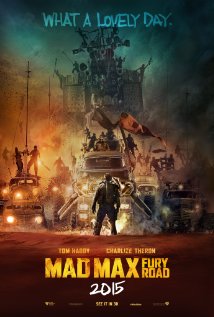
Mad Max: Fury Road

Wow. I saw Mad Max: Fury Road about a week ago and as time passes I like it more and more. The trailer mildly intrigued me with its eye-popping cinematography, bolstered by the promise of Tom Hardy (The Drop) and Charlize Theron (A Million Ways To Die in the West), both of whom have been impressive in action-packed roles. I was just a little shorty doo-wop when the 1985 iteration of Mad Max was released, so I’d never seen the post-apocalyptic desert tale. Sci-Fi is not my favorite genre, but it felt lazy to just dismiss Fury Road as being similar to the explosive tripe we’ve come to expect from Michael Bay recently –although there was no shortage of explosions. Undoubtedly this movie won’t be for everyone, but it was a weirdly awesome treat, a beautiful, minimalist non-stop ride.

Mad Max was unique in that there was little dialogue and not much overt plot development. A few early, key scenes clued me in to the overall plot, and the rest of the movie just flowed naturally from its initial premise. Hardy stars as the titular Max, while Theron is Imperator Furiosa, aligned with the evil Immortan Joe, a ruler who emerged after an apocalypse decimated the earth leaving only sand behind. Fuel and water are at a premium, and Joe lords the precious commodities over the poverty-stricken lower class. Joe enslaves the people he rules and even those he holds closer, having a harem of young women with whom he procreates.

When Max escapes Joe’s clutches, he sends his gang of minions out to retrieve him. Furiosa has been dispatched, but inexplicably veers off course. The rogue Furiosa and desperate Max become unexpected allies, both railing against crippling oppression. Furiosa has Joe’s harem in tow, liberating the young women while searching for her homeland, a utopia known as the Green Place, where water and life abound. The movie is largely one big pursuit, as Max and Furiosa traverse a vast stretch of desert, beautiful while reflecting the barrenness of the times.

Mad Max was intense, characterized by the stark punk rocker imagery of the characters and their desperate, survivalist behavior. It was a visceral experience with nary a moment of calm. There were no lulls in the movie, and my senses were assaulted for nearly two hours. Director George Miller masterfully depicted futuristic warfare while employing modern twists on traditional elements of the battlefield. During the Revolutionary War, colonial soldiers may have marched forward while sounding a war drum or bugle. Here, Immortan Joe employs a rocker affixed to the front of his vehicle, shredding away on a blaring electric guitar. Awesome.

Here, the landscape was just as much of a character as Max and Furiosa. The setting was one of the most stunning aspects of the film, and there was a weird paradox at play. The desert shows no sign of vitality. Yet it’s coppery beauty was something to behold, utterly mesmerizing. If you think weird is good, this is the movie for you. There was literally never a dull moment, and I felt like I got my money’s worth. It was a visual treat not to be missed. Grade: A

The Avengers: Age of Ultron

This is my favorite time for movies, even more so than the so-called Oscar season. Summer blockbusters might not be the most critically acclaimed movies, but they sure are entertaining, and with me that counts for a lot.

Marvel has proven successful in bringing the iconic heroes of comic book lore to the big screen. The Avengers franchise combines some of the most individually popular characters for one collective ensemble of awesome star power. 2012’s The Avengers was wildly successful, leaving little doubt that a sequel would be forthcoming. Last weekend I got to check out the highly anticipated sequel The Avengers: Age of Ultron, the first blockbuster of the season.

The sequel finds our heroes more comfortable with each other, as their shared chemistry reveals an amiable familiarity and easy rapport. Iron Man (Robert Downey, Jr.), Thor (Chris Hemsworth), the Hulk (Mark Ruffalo), Hawkeye (Jeremy Renner), Captain America (Chris Evans), and Black Widow (Scarlett Johansson) complement each other perfectly, and the opening scene highlights their collective strength. The movie begins with the Avengers attempting to infiltrate a base controlled by Hyrdra, the rogue sub-agency within SHIELD. Despite the aforementioned chemistry, the Avengers face a new challenge as they encounter two uniquely worthy foes. Hydra has trained a pair of orphaned twins to counter the Avengers. They are gifted with super speed and telepathy, respectively – and their initial salvo against the Avengers deals the crew a crippling early blow.

The opening scene was successful, because it was action-packed and wasted no time giving us what we wanted. However, the convoluted plot is introduced in the first fifteen minutes, and I found myself struggling to piece it all together. I’ll try to recount it for you, giving only the most pertinent details. Tony Stark and Bruce Banner had been working on new technology in the form of Ultron, an elite global peacekeeper with enhanced capabilities on par with the Avengers. When combined with an element from Thor’s home planet, Ultron comes to life ahead of schedule, but he has been corrupted with evil. He is not a peacekeeper, rather he seeks to destroy the planet – and the Avengers are no match for him. Ultron disables Tony’s trusted cyber soldier Jarvis, and he is hell-bent on going from a computer program to a physical being. The bulk of the movie follows the Avengers as they try to thwart his efforts and save the world.

Age of Ultron strives to give us a deeper insight into the insecurities and personal lives of the Avengers. Natasha has a thing for the good Dr. Banner. Hawkeye actually has a family, and perhaps Tony is the most layered of all. He feels guilty about having created Ultron, but his ego won’t allow him to completely abandon the technology or the ambition that allowed him to create it. The team becomes fractured, as vulnerabilities are revealed. For example, it’s not often that Captain America and Thor get their asses kicked, but the twins and Ultron prove too difficult for them, and even the Hulk. If they want to defeat their enemies, they will have to work together and trust each other.

The film’s first act simply captivated me with the action-packed fight sequences, but the plot details quickly became muddled. Admittedly, plot is secondary in movies like this – but it was confounding nevertheless. At first I thought it was dope, but by the time the credits rolled I thought the movie was just pretty good. The storyline was deficient, but the action and chemistry amongst the cast mostly made up for it. Of the recent Marvel entrants, I thought Thor 2 and Iron Man 3 were among the worst. Avengers: Age of Ultron is definitely better than those, and I put it on par with Captain America: The Winter Soldier. It’s worth checking out. Grade: B+


Focus

Will Smith (After Earth) is becoming uniquely polarizing. In the beginning of his career, I would’ve wagered that almost everyone loved his affable personality and charming one-liners. Now, it’s hit or miss. Some think he tends to overact or rely on a certain “schtick” in his movies; but I’m still a fan. I appreciate his charismatic humor, and I knew what to expect from his latest movie Focus, a slick caper co-starring Margot Robbie (The Wolf of Wall Street).

The movie begins with a happenstance meeting between Robbie’s character Jess and Smith’s Nicky. Jess is a budding hustler, but quickly meets her match in the seasoned Nicky. After her amateurish attempt to con him, Nicky agrees to show her a few tricks of the trade. From grifter to pickpocket, Nicky has the hustler’s full repertoire and takes Jess under his wing, bringing her in on his latest hustle in New Orleans. Equal parts gambler, swindler, and magician – the silver-tongued Nicky approaches his craft with keen precision.

The second act of the film finds Nicky and Jess honing in separately on the same mark, but for very different reasons. They’re used to playing dangerous games, but the easiest way to get yourself killed is to steal from the wrong person – and one wrong move could make this con their last. Neither is willing to back down from a potential score, but for once is Nicky out of his league? His scheme goes awry when Jess is added to the mix, and their feelings for each other compromise their judgment. Sometimes you have to know when to just walk away.

While Focus was largely entertaining, I can’t say it was completely original. Of course Nicky and Jess have smoldering chemistry from the start. Just look at them. While their sexy banter made sense, it was almost too obvious. The two became an item nearly immediately, which didn’t leave much room for the characters to develop romantically. Admittedly I was surprised when Nicky abruptly ended their brief criminal courtship early on, but it was only a matter of time before they crossed paths again.

I enjoyed Focus, but it’s largely a forgettable movie. It was entertaining, and the plot twist caught me off guard, so I’d say it surpassed my meager expectations. It ranks solidly in the middle of Smith’s catalogue, but that’s not necessarily a bad thing. Robbie and Smith have undeniable chemistry, and the pair is rumored to reunite in the upcoming Suicide Squad. That film should reinforce Smith as the action hero we’ve come to love, and propel Robbie’s ascending star even further. In the meantime we have Focus, which won’t set the world on fire but was definitely worth watching. Grade: B

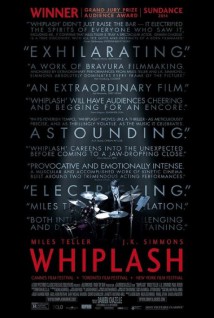
Whiplash

One of the greatest things about film is its ability to transport you to another world. Whether it’s the ravages of war, the inside of a television network, or the world of boxing – you can be a fly on the wall of another realm. Even the most mundane, seemingly uninteresting subjects can become fascinating if one is allowed a glimpse of its inner workings. Such was the case in Whiplash, a fascinating film that examines the relationship between a hard-driving music instructor (J.K. Simmons, Labor Day) and his gifted pupil (Miles Teller, That Awkward Moment). Writer/director Damien Chazelle (The Last Exorcism Part II) gives an unflinching look at the competitive backstage world of a top tier music conservatory, crafting a surprisingly tense film.

Teller stars as Andrew, a sophomore at fictional Shaffer Music Conservatory in New York. A jazz drummer, he spends most of his time playing or listening to jazz, perfecting his craft in seclusion. Eventually he crosses paths with Fletcher, an instructor who typically works with the more talented upperclassmen. Fletcher operates with impunity, berating and insulting his students, exacting every ounce of sweat and ability until only a shell remains. He parsimoniously withholds praise to the point of cruelty, but one could argue the merits of his approach – as the Shaffer jazz band routinely fares well whenever it competes against other ensembles. Having been raised by a single father and with few friends, Andrew pours himself into his work and longs for Fletcher’s approval and validation.

Whiplash was a compelling psychological study. So named for an oft-played piece of music from the film, the title serves as a jarring harbinger of things to come. I’ve seen war movies with some of the most intimidating drill sergeants imaginable – yet they pale in comparison to Fletcher, who never has a kind word for young Andrew – even when he drums his fingers into bloody oblivion. Teller was brilliant in the role, both technically and artistically. He filmed most of the drumming scenes himself and prepared tirelessly for the part. Simmons is probably most known for supporting roles, but showed he has the chops to take center stage. Fletcher was cruel and menacing, but also a richly complex character. He revealed rare compassion in one scene as he mourned the death of a former student, a startling moment of humanity punctuating the onslaught of abuse.

I enjoy jazz music and loved the film’s musicality, but if jazz isn’t your thing you may grow tired of the behind-the-scenes angle. Black Swan showed us that drive, intensity and competitiveness aren’t reserved for athletic pursuits. Whiplash isn’t as complex or beautiful as that film, but I enjoyed it. There aren’t many surprises or character growth leading to resolution, though the ending leaves this up for interpretation. It was a well-done film, and though its subject matter may not excite all viewers, I’d highly recommend it. Grade: B+

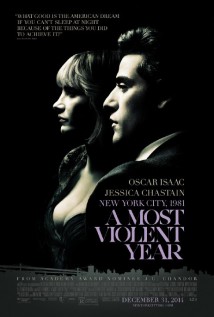
A Most Violent Year

The 80s were an interesting time. If you ask people what they most remember about the decadent decade, they will probably mention Reagan, inflation, the dawn of MTV, or defining moments in American culture like the Challenger explosion, Reagan’s assassination attempt, or the Iran Contra scandal. The 80s were also a violent time, even before the crack epidemic created a new class of criminal. The early 80s were especially dangerous in major cities like New York, with 1981 being one of the most violent years on record, at the time. Writer/director J.C. Chandor (All Is Lost) explores this tumultuous period in his atmospheric film A Most Violent Year, starring Oscar Isaac (Inside Lewyn Davis) and Jessica Chastain (Interstellar).

Isaac stars as Abel Morales, the bootstrapping, self-made owner of a profitable heating and oil company. He’s looking to expand his business, attempting to broker a real estate deal with some powerful Jewish members of the community that will grant him direct access to the city’s ports. Things get complicated when his oil truck drivers begin getting carjacked and Abel loses one truck after the other. The thieves’ brazen lawlessness leaves Abel’s drivers vulnerable and threatens his real estate venture. Rather than arm his drivers with guns to defend themselves, Abel tries to quietly investigate – much to the chagrin of his fiery wife Anna (Chastain). Chandor hints throughout the movie that Abel is involved in some shady business dealings, and this seed is planted further when a district attorney named Lawrence (David Oyelowo, Selma) threatens indictment for a slew of offenses ranging from fraud to bribery. The course of the film follows Abel as he tries to find the culprit behind the robberies and stave off indictment while preserving his real estate negotiations.

A Most Violent Year seemed promising based on its trailer and cast, namely Oyelowo and Chastain. Featuring the soulful sounds of Marvin Gaye’s classic “Inner City Blues,” the trailer hinted at a gritty, atmospheric tale, and that same earthy melody played over the opening credits. What song better captures the harsh realities of an unforgiving metropolis? However, despite its moody cinematography and intriguing premise, there were parts of the film that just didn’t excite me. The film smoldered throughout, but it never ignited in the way I thought it would. For example, Abel seemed to bury his head in the sand in the wake of the truck robberies. How is it believable that someone so seemingly passive in one facet of his life could be so shrewd and ambitious in other aspects? I understand wanting to leave a certain lifestyle behind, but how did you ascend to current heights if you never stood up for yourself? In a way, the film never lived up to its provocative title.

Another thing I disliked about the film was the disjointed nature of certain scenes within the context of the larger plot. When Abel finally finds out who is behind the truck heists the revelation is very unsatisfying and just doesn’t make sense, in my opinion. It simply doesn’t fit with the picture Chandor painted earlier in the movie. For some reason (and maybe this is my fault), I thought the movie would be in the vein of Carlito’s Way, but it wasn’t nearly as exciting. I’m not saying a movie has to resort to cheap thrills to hold my attention – but I was rather underwhelmed. However, the aforementioned criticism must be balanced by the positive aspects, which should not be understated. First, the cinematography was excellent. The movie looked like 1981 in every way; it looked like it came out of a vault. The sepia undertones were haunting and almost beautiful. The tone of the film was perfect, and it was superbly acted. For those reasons, I can’t say it was a bad film. It just wasn’t what I expected. Grade: B

Selma

I can’t begin to know the struggle of a filmmaker. I’m only attempting to be a screenwriter and thus far have found the process very challenging. It must be difficult to craft a film from start to finish, finding a way to hold the viewer’s attention while delivering a compelling a story. Now imagine how much more demanding your task would be if your film centered on a heroic, legendary fixture in American and global history. Such was the task before director Ava DuVernay in her depiction of Martin Luther King, Jr.

Selma isn’t the first film about Martin Luther King, but it does offer a unique perspective behind the man and the movement. Rather than craft a comprehensive biopic spanning his lifetime, DuVernay focused on an all-important slice of his life, the pivotal time in which he spearheaded passage of the 1965 Voting Rights Act. By narrowing the scope, DuVernay provided a fresh insight that hadn’t been previously offered. Moreover, she captured a more personal, intimate side of a larger than life public figure. Given the recent spate of incidents of police brutality against young Black men, the timeliness of the film cannot be overstated, and one couldn’t help notice the parallel between the scenes of civil unrest and protest in the movie and recent images in the news. Moreover, with more and more states enacting local laws restricting the right to vote, Selma rings true today.

The film begins powerfully, first highlighting the absurdly unjust hurdles Black Americans were forced to overcome in order to vote. DuVernay then left the viewer with no doubt about the racial climate by depicting the infamous bombing of four little girls in a Birmingham church. For younger viewers these images may have been jarring, as I can’t assume what people do and don’t know about their history. And when I say “their” history, I mean all young people, regardless of race – because Selma is a portrayal of events in American history, not just Black history.

DuVernay juxtaposed the historical accuracies with a uniquely intimate dramatization of King’s personal life. We’re introduced to him not at the pulpit delivering a fiery speech, but rather in a warm, private moment with his wife Coretta. As he prepares to accept the Nobel Prize for peace, he complains to Coretta about his ostentatious attire. She soothingly reassures him, as only a wife can. Small touches like this may go unnoticed amidst the more powerful, violent images that punctuate the film – but I was struck by the manner in which DuVernay made the legend more accessible.

The film operates within the strategic confines of King’s calculated plan for Selma. His aim was to focus on Selma and protests there so that he could bring national attention to the violent and unconstitutional manner in which Blacks were being denied their right to vote. Then-President Johnson was politically reticent about sweeping change, so King had to apply pressure by keeping the violent images plastered on the front page of the newspapers that littered America’s collective doorstep. His plan was effective, and ultimately Johnson enacted the single most significant piece of legislation of the Civil Rights Movement.

Selma humanized King in a way that brought him down one step from his pedestal without besmirching his legacy. We see that he was a man, with fears and flaws. He and Coretta had problems like any married couple. He had moments of doubt and insecurity, yet he was brilliant in his strategy to the point of shrewdness. I didn’t feel like the movie deified him, though the glorious nature of his character was undeniable. That is due in large part to the gravitas David Oyelowo (Interstellar) brought to the role, though the Academy has overlooked his contribution this year. Both he and Carmen Ejogo (The Purge: Anarchy) were mesmerizing on screen, coloring their scenes with restrained chemistry.

The subject matter alone would make this film a must-see, but it’s technically sound as well. The cinematography and storytelling were nearly perfect, and performances from the likes of Tom Wilkinson (The Grand Budapest Hotel), Tim Roth (Arbitrage) and Oprah Winfrey (The Butler) in a brief but powerful cameo only strengthened the final product. If you weren’t well versed on the history of the Voting Rights Act or Civil Rights Movement then obviously this movie is one you should see. If you were, it’s a reminder of how far we’ve come, although we still have some work ahead of us. Grade: A

American Sniper

I don’t have the highest opinion of Clint Eastwood (Trouble With the Curve) when it comes to his political leanings, but I cannot deny that his legendary status in Hollywood was cemented long ago. His illustrious body of work includes seminal roles in some of the most iconic films in modern American cinema, but in the second half of his career he has proven to be even more skilled behind the camera, giving us a horde of Academy Award winning films from Million Dollar Baby to Mystic River. In American Sniper he paints a harrowing picture of the devastating effects of war, offering an unflinching glimpse into one man’s heroic service.

Bradley Cooper (American Hustle) gives a tour-de-force performance as Chris Kyle, the deadliest sniper in American military history. Like fellow S.E.A.L. Marcus Luttrell (portrayed by Mark Wahlberg in last year’s Lone Survivor) Kyle’s exploits have become the stuff of lore, and both have been subsequently immortalized in film. We are introduced to Kyle as a typical salt of the earth Texan. Spurred to enlist after 9/11, Kyle undergoes grueling boot camp preparation before being deployed to Iraq for the first of four tours.

Two of the most heart-stopping scenes in the film perfectly captured the split second judgment calls he had to make as a sniper. In the first, a mother and son are alternately carrying a missile, and he is forced to eliminate them both. The boy couldn’t have been older than 8, and Kyle took his life with little hesitation. The other scene also involved a child and a weapon, but this time the outcome was different. One is left with the startling realization that Kyle could accept either scenario with no compunction. Kyle was fearless and resolute in battle, but like many soldiers, he found stateside re-acclimation challenging. His relationship with his wife Taya (Sienna Miller, Foxcatcher) was strained because he was often absent, leaving her to raise their two children alone. Taya felt that he’d prefer the company of his comrades to his own family, a notion that Kyle did little to dispel – particularly after returning for a third and fourth tour of duty.

I realize that whether or not you lionize or demonize a particular sniper probably depends on what side he’s fighting for. As the title indicates, American Sniper is heavy on American notions of valor and patriotism. I personally don’t buy into the “rah rah America” narrative, and I choose to evaluate the film on its cinematic merits rather than the propaganda it pushes. That aside, I never questioned Kyle’s belief in the task before him, and I commend him for his unwavering service. Some have expressed an opinion that snipers are cowards, but Chris Kyle didn’t just hide behind his rifle – he got his hands dirty too.

Cooper has easily given the performance of his career, equaling his Oscar nominated turn in Silver Linings Playbook, and surpassing his work in American Hustle. He’s shown flashes of greatness throughout his career and has outdone himself here. His physical and emotional transformation was amazing, and he completely embodied Chris Kyle, from the brawny physique to the Texas drawl. His character’s emotions hurtled from one extreme to the next, and Cooper was pitch perfect throughout. His character’s post-traumatic stress was authentic, and we watched him grasp at normalcy upon his return. This type of film can easily become overrated, due to its subject matter. I think it’s a movie people will want to like, but notions of patriotism aside – I thought it was a well-crafted film that relies heavily on its star, whose presence was undeniable. I think 2015 is off to a good start in film. Grade: A-

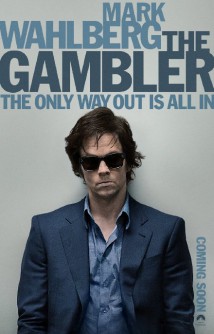
The Gambler

I wouldn’t necessarily list Mark Wahlberg among my favorite actors, yet I find myself enjoying many of his movies. He’s capable of turning in really good performances – whether it’s Lone Survivor or The Fighter. On the other hand, he’s also good for the occasional dud (see Broken City), though not for lack of effort or talent. When I got wind of The Gambler, I thought it might have been a stylish crime movie something like Rounders meets The Drop. The film could have been an effective character study and examination of addiction – but instead it fell flat, leaving me bored and disappointed.

The Gambler is a remake of a 1974 movie of the same name starring James Caan. The newer version keeps the same basic plot, with Wahlberg starring as English professor Jim Bennett, a man with a profound gambling addiction. We’re introduced to his weakening vice immediately, as he impulsively wagers and loses large sums of money on blackjack and roulette in a backdoor casino. He is not a man who will ever quit while he is ahead. Despite his penchant for reckless living, Jim seems to be doing ok for himself. However, every addict faces rock bottom at some point, and it’s only a matter of time before his lifestyle catches up to him.

While gambling at the aforementioned casino, Jim becomes indebted to its owner after losing big and adding to an existing debt. He borrows more money from a loan shark named Baraka (Michael K. Williams, Kill the Messenger), and soon he owes money to at least two people who are threatening to wipe him out in about a week’s time if he doesn’t pay up. Baraka challenges Jim’s moral code when he wants him to involve one of his students in paying the debt. Complicating matters is the strange dynamic he shares with another one of his students, who moonlights as a waitress at the casino. Their relationship is never fully explored, and the subplot remained undeveloped.

The plot was straightforward, and I appreciated its simplicity. However, the movie could have been much more entertaining. As a viewer, I never connected with Wahlberg’s character, even though his dire circumstances lent themselves to empathy. His performance was capable, but something about it felt too restrained. Where was the abject desperation? I never felt sorry for him, despite his obvious pathetic state. One could see that his addiction was crippling and that he was powerless to stop it, but that was the only aspect of the movie that resonated with me. I could see that he was desperate, but he never made me believe it.

The performances were fine, with some notable supporting turns from Jessica Lange (The Vow) as Jim’s wealthy, enabling mother and John Goodman (The Monuments Men) as yet another loan shark with whom Jim makes a high stakes side-bet. But once again, the movie never really went anywhere. Despite a lot of tough talk, the threats from his bookies felt hollow, and I only mildly cared whether or not Jim escaped with his life. The gambling scenes were taut with anticipation, but those moments were sparse.

In sum, The Gambler just didn’t leave much of an impact. The potential for a great story was there, but the movie never seemed to go anywhere. It could have been an exhilarating ride as we watched a man descend into total desperation – but Jim just seemed like a rich brat who never really “got it.” I thought it was just average. Grade: C+

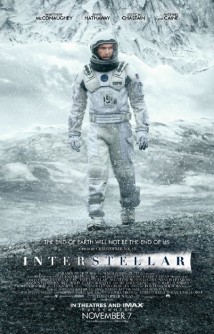
Interstellar

Science Fiction is hit or miss for me. I enjoy the imagery and special effects associated with the genre, but if the plot is mired in the technicalities or minutiae of science, it tends to go over my head. When it came to Interstellar, it was director Christopher Nolan (The Dark Knight Rises) that got my attention. I’m a big fan of his work, so the mere attachment of his name to a project is enough for me to consider checking it out. Moreover, star Matthew McCounaghey (Dallas Buyers Club) made quite the case for the film while making the rounds on its press junket.

The film opens in an unspecified future time, when the world has been ravaged by famine. The entire globe is struggling for resources, and in America corn is the only remaining crop after what appears to be a devastating drought. McCounaghey stars as Cooper, a former pilot and father to a teenaged boy and adolescent daughter. They live in America’s heartland, where an omnipresent layer of thick dust serves as a reminder of lost vegetation. Cooper is a loving, doting father and he staunchly defends his children, particularly his daughter Murphy. “Murph,” as she is affectionately known, has a fiercely independent spirit and idolizes her father. She is curious, and believes their home is being visited by a supernatural force with which she communicates via Morse code. Their future is uncertain, but Cooper has carved out a life for his family, including his late wife’s father Donald (John Lithgow, This Is 40).

One day after communicating with the apparition, Murphy reveals a “message” from the otherworldly visitor. The message leads them to a hidden NASA location, where they are made privy to a master plan for the population’s survival. A scientist named Brand (Michael Caine, Now You See Me) and his daughter (Anne Hathaway, Les Misérables) explain the options to Cooper, whose expertise as a former pilot proves valuable to the scientists and astronauts. Cooper determines that he will execute their mission, traveling to the outer reaches of space in hopes of finding a planet that can sustain human life after Earth becomes uninhabitable.

Well folks, we’ve just about reached the limits of my comprehension, because I couldn’t recount the finer points of the plot if you paid me. I had a very basic understanding, but for me the film’s strength lay in its emotional portrayal of a father who is faced with an unbelievable moral dilemma. Cooper’s decision to travel in space has mammoth repercussions, not the least of which is the temporary abandonment of his family for the greater good of humanity. He has every intention of returning, but the mission is risky and time elapses quite differently in space than it does on Earth.

McCounaghey proves once again that he has the emotional depth to convey the most vulnerable aspects of the human condition. Cooper was courageous, yet frightened, self-interested, but capable of immense sacrifice. My only negative observation of his body of work is that he has yet to ditch his omnipresent Southern twang, though it was not out of place here. He has turned his career around, and there are no discernible signs of regression. Although this was ostensibly a big budget movie, he still chose a vehicle that allowed him to sink his teeth into the emotional elements of his character. Hathaway was also effective, and she too was successful at evoking empathy in the viewer. Finally, Jessica Chastain’s (Mama) performance was worth mentioning. She portrayed Murphy as an adult, and the casting was superb. Although it wavered momentarily, the bond that she shared with her father held the film together, especially when I felt bogged down by the science.

This is another movie that may not be for everyone. The film’s first act focuses on Cooper’s family, and the middle act markedly shifts to another realm. At just under three hours, I had to make an effort to focus on what was happening, particularly when the more nebulous aspects of the storyline emerged. Fortunately, the movie’s emotionality and the talented cast kept me invested. Grade: B+

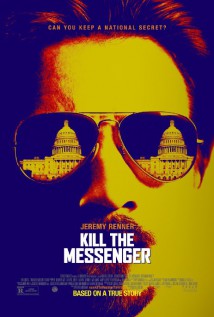
Kill The Messenger

“Blame Reagan for making me into a monster

Blame Oliver North and Iran-Contra

I ran contraband that they sponsored”

-Jay Z, “Blue Magic”
Conspiracy theories are funny. On the one hand, only a fool believes everything their government tells them. On the other hand, if you find a conspiracy behind every corner, your assertions lose credibility. That being said, I know the U.S. government is capable of some appalling behavior. An entity that intentionally infected Black men with syphilis is capable of anything; so the notion that the government facilitated the sale of crack cocaine to its own citizens is not unbelievable to me. Under the Reagan administration, the CIA funded the Nicaraguan Contras by allowing them to export cocaine into Los Angeles (and other American cities) while funneling the profits back to them.

That revelation forms the crux of Kill the Messenger, a film based on true events involving San Jose Mercury News reporter Gary Webb (Jeremy Renner, American Hustle) and his exposure of the CIA’s involvement in what came to be known as a massive crack epidemic. The movie takes place in the mid 90’s, just before the dawn of the information age in which we now live. Although we weren’t in a “24 hour news cycle” back then like we are now, you can imagine the controversial uproar Webb’s articles caused.

The government’s actions were layered and corrupt, as an intricate scheme revealed their use of an informant who doubled as drug middleman. Danilo Blandon was a go-between for the Contras and American dealers like the infamous “Freeway” Ricky Ross, who grossed upwards of a billion dollars by selling drugs to the Blood and Crip street gangs of Los Angeles. Blandon informed on Ross, collapsing his empire while working at the behest of the government. I’d encourage you to read up on this scandal yourselves, as it is quite interesting. These types of events are nearly unbelievable, and lend themselves well to cinematic re-telling.

Webb should’ve been a Pulitzer winner, as he had the courage to risk his life to expose the truth of a corrupt government. However, those who pull back the curtain often fall victim to those they are exposing. Webb’s career was ruined, as the paper began to distance itself from him and his reputation was smeared and character assassinated. In a tragic turn, he was found dead in 2004 of two gunshot wounds to the head, in what was deemed a “suicide.” How one could be capable of shooting himself in the head twice is truly baffling, but after all I’ve told you – are you really surprised?

Jeremy Renner turned in a very good performance, effectively conveying the idealism, passion and doggedness that drove his character. Webb risked his own safety and that of his family in pursuit of what he believed was right. Saddest of all was the realization that his career was ruined. It was cruelly ironic that Webb’s assertions were subsequently confirmed in a government report that went largely unnoticed while the nation was distracted by the Monica Lewinsky scandal. I often talk about the goal or purpose of film. Aside from the obvious emotional effect movies have on us, every now and again the purpose of film is to educate and expose. Kill the Messenger was a nice reminder that you can actually learn a thing or two from the movies. Grade: B+