2013 Movies

Don Jon

Sex comedy.  Like, is that a real thing, a legit genre?  If not, I just made it up – because that’s the best way to describe Don Jon, an entertaining movie that was all at once a farce, satire, romantic comedy, and character study.

I recently found myself zealously defending J. Gordon Levitt (Looper) on Twitter to someone who saw him presenting an award at the MTV VMAs and quipped, isn’t that the guy from Third Rock From the Sun, has he done anything since then?  I replied with Inception, The Dark Knight Rises? Hello?  Levitt is quite the gifted, young actor in my estimation.  He brings a quiet, emotive sensitivity to his roles, and that vulnerability makes his characters more human and relatable.  That sensitivity resonated in movies like 50/50 and 500 Days of Summer, which featured emotionally compelling lead characters.  Well, Don Jon is a departure from those emo, heartwarming flicks for sure – though the ending may surprise you.

Don Jon marks Levitt’s debut as a writer/director, and I think viewers will find his style humorously authentic.  Levitt stars as Jon, a young man who looks like he could’ve been on Jersey Shore.  To my point, the movie is set in New Jersey and Jon is young, Italian, obsessed with his physique and always DTF (down to uh…let’s just say ‘fornicate’).  At first blush Jon is a walking cliché: a young man obsessed with his sexual conquests and women in general.  He and his friends go out prowling, and more often than not Jon is successful, at least in terms of “scoring.”  By any other metric, Jon is lacking, though he is oblivious to his emotional ineptitude.

You see, Jon’s sexual identity and habits are largely shaped by the world of digital porn.  His affinity for porn borders on compulsion.  He’s like a walking boner –  finding visual stimulation in the most innocuous of places, including the check out aisle of the grocery store.  However, lest you think Jon lacks even a modicum of substance – his lifestyle departs from vapidity when we glimpse his love of church and family, which is hilariously juxtaposed with his sexual exploits.

Sometimes it takes a particular experience or person to help us achieve self-actualization in certain aspects of our lives.  For Jon, meeting Barbara (Scarlett Johansson, Hitchcock) inadvertently changes his world.  To say that Barbara is alluring would be an understatement, and her physical appearance draws him in immediately.  Johansson and Levitt had magnetic chemistry, more than any pair I’ve witnessed recently.  Initially Jon is content to bask in Barbara’s sheer hotness, but most relationships that begin with such aesthetic adulation end in disappointment, and Jon begins to question his perceptions about dating and intimacy.  I don’t want to give away too much about the plot, but Julianne Moore (Crazy, Stupid, Love) is featured in a supporting role and perfectly adds to Jon’s character development, contrasting completely with Johansson’s more overt appeal.

I enjoyed Don Jon, because I thought it had a little more substance than people may give it credit for.  Sure, it’s funny and a little raunchy.  But it was also thoughtful, reflecting a depth of character that wasn’t readily apparent.  J. Gordon Levitt has given us a peek at his wheelhouse, and I want to see more.  This movie would make for a great date night, and unlike the typical rom-com: you won’t have to drag your man kicking and screaming.  Grade: B+

Prisoners

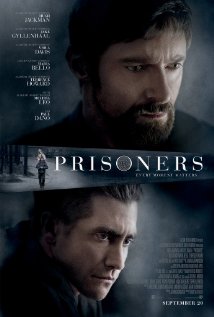
As summer draws to a close, we move away from the popcorn fare that has flooded theaters for the past three months.  I enjoy such movies, but I welcome those that have a little more “meat on the bone.”  Boasting an acclaimed cast and frighteningly realistic plot, Prisoners was such a movie.  Hugh Jackman proves his versatility as a leading man, whether it’s showcasing his vocal ability (Les Miserables) or pushing his body to its physical limits (The Wolverine).  In Prisoners, he gives an emotionally wrought performance as a father amid a devastating tragedy.

The movie begins in a small Pennsylvania community on Thanksgiving.  Keller Dover (Jackman) and his wife Grace (Mario Bello, Grown Ups 2) are joining good friends Franklin (Terrence Howard, Lee Daniels’ The Butler) and Nancy Birch (Viola Davis, Won’t Back Down) for dinner, along with each couples’ two children.  Anna and Joy are 6 and 7, while Ralph and Eliza are in high school.  Thanksgiving is a time when families strengthen the ties that bind, and director Denis Villeneuve struck the perfect familial tone to contrast sharply with what follows.  The four kids go for a brief walk in the neighborhood, where the younger pair happens upon a strange RV.  They climb on it briefly, before their older siblings shoo them away.  An eerie sense of foreboding washes over the viewer here, foreshadowing the crux of the storyline.

After returning home, Anna asks if she and Joy can walk back to her house.  As the lazy day unfolds, Keller notices that Anna and Joy haven’t returned.  Initially the girls’ families are calm and composed, but as the girls remain unaccounted for, a feeling of dreadful panic swells within them.  They frantically search the neighborhood after Ralph mentions the strange camper they’d seen earlier.  When the RV is found in a wooded area hours later, Detective Loki (Jake Gyllenhaal, End of Watch) responds to the call.  Loki finds Alex Jones (Paul Dano, Looper), a teenaged boy with some cognitive deficits.  Alex seems psychologically disturbed, but there’s no real proof that he did anything wrong, which leads to his ultimate release.

Keller’s grief and frustration are ratcheted up to an overwhelming level, and he abducts Alex, holding him prisoner to question him on the girls’ whereabouts.  Don’t worry – I haven’t revealed anything that wasn’t in the trailer.  The movie follows Keller’s desperate actions and Detective Loki’s investigation.  Alex is a viable suspect, but it also seems that Keller could be mistaken.  And if he’s wrong, has his quest to find the monster that took his child turned him into a monster himself?

Prisoners was successful in crafting a disturbing, somber tone that never felt too heavy.  Thrillers like this often run the risk of really bringing you down; but I never felt that way.  The notable cast features an impressive total of four Academy Award nominees and one Golden Globe nominee, and their collective talent shone through.  Jackman, Bello, Howard and Davis gave four unique performances, and I found the distinct coping mechanism of each family interesting and well portrayed.  Although Keller had his perceived culprit in tow, Villeneuve shaped a suspenseful narrative that kept viewers wondering throughout.  If I have a criticism, it’s that the details became briefly muddled.  Red herrings can be an effective tool if used properly, or they can feel insincere if the audience thinks the filmmaker is playing “gotcha” by casting false suspicion on a particular character.  Overall though, I thought the movie was very suspenseful and expertly acted, making it well worth the price of admission.  Grade: B+


This review first appeared at Poptimal and was reprinted with permission.

Riddick

It’s challenging to write a movie review for an excellent film, because there’s so much to say.   There’s so much to digest and analyze.  Conversely, when a movie is bad there isn’t much to break down.  There aren’t complex plot points to discuss; there aren’t subtle nuances in actor performances.  With that being said, I’ll keep my review of Riddick brief!

Vin Diesel (Fast Five) reprises his role as the titular character we first met in 2000’s Pitch Black.   Riddick is a bad ass fugitive, blessed (or cursed) with incredible night vision.  He must wear special glasses to function in the daylight, and that’s just about all I remember.  I’ve seen Pitch Black and The Chronicles of Riddick, but I don’t feel like those movies are required viewing prior to seeing Riddick, because I was still rather lost during the movie.  I just felt like I didn’t really “get it.”  The movie opens with Riddick near death, having barely survived a furious onslaught of some sort.  I think it begins right where The Chronicles of Riddick left off, with Riddick being abandoned and left for dead on a foreign planet.  He hobbles to safety, narrowly avoiding wretched sea creatures and assorted beasts along the way.  His ultimate goal is to return to his home planet, but we never get a clear sense of how he plans to reach his destination.

Meanwhile, he is being pursued by inter-galactic authorities that want to apprehend him for past crimes (which I can’t recall and aren’t fully explained). Eventually his would-be captors track him down and begin a standoff where each tries to draw the other out.  I’ll leave it at that, so I don’t spoil anything about the movie – but really, who cares?  The best part of the movie was the horse-dog-jackal puppy that Riddick saved and raised up as a guard dog and pet.  There were some cool sci-fi elements, and Vin Diesel is always nice to look at, but that’s it – and that latter aspect is not going to draw in the male viewer, who is the target audience anyway.  I don’t know what else to say.  Maybe I’m not the target demographic, so this review isn’t fair to the movie.  I just wasn’t really feelin’ it.  Grade: D+

Jobs

After viewing The Social Network a few years ago, I felt inspired by Mark Zuckerburg’s story and was encouraged to follow my own dreams.  I thought the story of Steve Jobs might similarly inspire me, but after viewing Jobs, I felt no such inspiration.  Perhaps the filmmakers intended to portray Steve Jobs as a complex, charismatic innovator – and to a certain extent, they succeeded.  However, it seems to me that he could also be an asshole, and that was one of the salient aspects of his personality that stuck with me.

The movie begins in 1974 at Reed College, where Steve (Ashton Kutcher, New Year’s Eve) is a former student.  He bums around campus, occasionally sitting in on classes despite being a dropout.  He has close friends and a girlfriend, but his social interaction with others is strange, and his emotional maturity seems stunted.  Very early on he seems unaware of others’ feelings, but displays a keen curiosity that draws others to him.  In some ways he both repels and attracts other human beings, which is an odd feat.

Eventually Steve begins working for Atari.  The superior quality of his work makes him an asset to his supervisor, and he challenges Steve to improve one of their popular arcade games.  Steve enlists his friend, Steve Wozniak (Josh Gad, Love & Other Drugs) to help him with the project.  Steve was promised $5,000 for the successful completion of the task and told his buddy that he’d give him half of the money.  Only Steve told his friend that he’d only been promised $700 for the work; thus giving his friend a paltry $350 for providing invaluable assistance.  This may seem like an insignificant act, but I found it abhorrent and it both underscored and foreshadowed Steve’s social ineptitude.

While Wozniak assisted with the Atari project, Steve observed a rudimentary keyboard at his house one day.  Intrigued, he wanted to know more about this device that would ultimately serve as the prototype for the modern personal computer.  At the time it was only a keyboard that needed to be connected to a monitor, but eventually a local retailer encouraged Steve to provide both the keyboard and monitor for sale as one product.  I credit Jobs with brilliant innovation, but he certainly has others to thank for inspiring groundwork that was laid years ago.

The movie chronicles Apple Computer from its inception, through Steve’s monumentally successful tenure during the early 80s, and through his ousting by the company’s board of directors in 1985.  Though Apple was immensely popular and successful in the early 80s, Steve never seemed motivated by profit, but by creativity.  His work ethic was relentless, and he demanded excellence.  However, his loyalty was virtually nonexistent, and his results-driven approach to business appeared downright callous at times.  This is a man who screwed his friends and denied his child’s existence for the first two years of her life while her mother lived on welfare.

Perhaps these asshole tendencies are an attendant personality trait of genius; I’m not sure.  I just found that the movie didn’t portray Jobs as this likable, interesting man that he actually may have been.  Ashton Kutcher’s performance was uneven and inconsistent.  One minute he perfectly embodied Jobs, and the next minute he seemed to be imitating him, as exemplified by Jobs’ trademark shuffling gait.  I think Kutcher approached the role with the requisite seriousness that a biopic requires, but I can’t quite call his performance a success.  If anything, the movie may encourage people to learn more about this enigmatic visionary.  Unfortunately, I was left wanting more.  Grade: B-


Lee Daniels’ The Butler

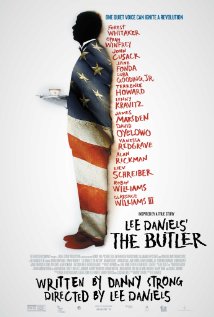
I like what I like, and just because the critics have lauded your work, or it’s popular – that doesn’t mean I will be inclined to join the herd.  Some of director Lee Daniels’ filmography includes movies that I don’t prefer.  That’s no knock on his filmmaking, but rather a commentary on his subject matter. I’ve seen Monster’s Ball, which he produced, and I thought it was an excellent film.  It could not be described as a “feel good” movie, however.  I don’t typically enjoy “heavy” movies that settle over the viewer and linger long after the credits have rolled.  For this reason, I avoided Daniels’ Precious, though I understand that it was a powerful film.  With The Butler, he has decided to do that annoying Tyler Perry thing where he makes sure that his name precedes the movie title,* but I’ll overlook it – because The Butler is quite simply a tour-de-force contribution to contemporary American cinema.  It deserves immediate consideration alongside other American classics with the manner in which it interwove American history seamlessly with wonderful dramatization.  This is arguably the best movie of the summer, and a must-see film.

The Butler is loosely based on the life of Eugene Allen, an African-American butler who served in the White House for 34 years, which is my entire lifetime.  Forest Whitaker (The Last Stand) stars as Cecil Gaines, a fictional version of the titular character inspired by Allen.  The art of being a butler, particularly one at the White House, requires a certain temperament and character.  The movie begins by depicting the circumstances that shaped Cecil’s life and developed his character.  He grew up on a cotton farm in the South, where his father (David Banner, This Christmas) worked as a sharecropper.  Although slavery was long over, the power dynamic remained unchanged in many Southern states.  At an early age, Cecil learned that resistance against the status quo might cost you your life.  As meager compensation for a family tragedy that he witnessed, Cecil was brought in from the field into the house, where he would be trained as a “house nigger,” cultivating a strict attention to detail that would serve him well in his life’s work.

Cecil eventually left the cotton farm and found work as a servant, working under the tutelage of an elder butler (Clarence Williams III, American Gangster) who further refined Cecil’s skillset.  He explained to Cecil that there is one face that you show Whites, and there is your true face that you show everyone else.  I was conflicted in my perception of Cecil’s work at various times throughout the movie.  On the one hand I was put off by the inherent subservience of his tasks, particularly the necessity with which he faded into the background, as if the notice of his mere presence would be an affront to his employer.  On the other hand, there is a quiet dignity in the position, and the attention to detail indicated an impressive work ethic.

Eventually Cecil’s impeccable job performance landed him a position at a posh Washington hotel, which is where a White House employee was so impressed that he notified Cecil when a service position became available at the White House.  Cecil began working at the White House during the Eisenhower Administration and would come to know each President’s eccentricities and disposition.

The film chronicles Cecil’s tenure at the White House as America evolves over the decades and through the various Administrations.  Initially his wife Gloria (Oprah Winfrey, Beloved) is pleased with Cecil’s esteemed new position, which affords him the ability to be sole provider for his family.  However, she eventually begins to feel neglected as he spends more time away from home, enraptured with his job.  He becomes fast friends with fellow employees Carter Wilson (Cuba Gooding Jr., Red Tails) and James Holloway (Lenny Kravitz, The Hunger Games).  Gooding turned in a scene-stealing performance as the crudely affable Carter, while Kravitz added quiet gravitas to his slight role.  The film was rife with notable actors, which I will address later.

The Butler’s strength lies in its artful juxtaposition of Cecil’s life at the White House with the social upheaval of the 50s, 60s and 70s.  While Cecil worked daily in a sterile, sanitized environment, America raged beyond the White House walls, careening to and fro down an historical path.  Cecil’s eldest son Louis (David Oyelowo, Jack Reacher) was at the forefront of these tumultuous times, participating actively in the Civil Rights and Black Power Movements.  One of the more effective scenes in the movie depicted this juxtaposition perfectly, expertly highlighting the divide between father and son.  While Cecil meticulously sets banquet tables for a State Dinner, Louis and his classmates participate in a sit-in, where they are abused and taunted by White patrons.  As the father serves his country literally through servitude, his son rails against his country through active (though peaceful) resistance.  It is not until much later that father and son realize that they are not so different after all.

The Butler is an authentically American movie.  It should be mandatory viewing for anyone who wants a brief synopsis of a critical time period in American history.  Viewers who lived through the Civil Rights Movement and Vietnam War will recall those difficult times, and younger viewers may be startled at a glimpse into an America that is far different from the land we now call home.  Actual events from history were dramatized in startling fashion, and the fear that characters experienced was always underscored by the jarring reality that this in fact did happen.  There was a scene where Louis and his girlfriend Carol (Yaya Alafia, The Kids Are All Right) rode a bus on a “Freedom Ride” through the segregated South.  Their bus was stopped, and a racist mob descended upon them.  Their fear was palpable, and there were factual touches interspersed with the dramatization.  This is a testament to Daniels’ deft hand, and a slew of Oscar nominations should be forthcoming.

The performances in this film were amazing, as the cast includes a virtual who’s who of names, from Robin Williams (The Big Wedding) as Dwight Eisenhower to Jane Fonda (The Newsroom) as Nancy Reagan.  Cecil’s relationship with each president was unique, though he may have been partial to JFK (James Marsden, 2 Guns) due to his influential civil rights legislation and the fact that he brought a unique family dynamic to the White House with his youth and small children who brightened up the place.  The only President for which I noted a hint of disdain was old “Tricky” Dick Nixon, ably though briefly portrayed by John Cusack (The Frozen Ground).  Many characters were important figures in American history (past presidents and cultural icons), but were only minor pieces of the movie, like Martin Luther King, for example.  It is a testament to the film that so many wonderful actors played such small roles.  The film is weighty and substantial in every respect, from casting to direction.  Forest Whitaker embodied Cecil Gaines’ quiet strength, and his servitude belied an understated courage.  Whitaker gave the performance of a lifetime, and he should be in contention for another Academy Award.  Actually, you could tell me that any one of this prolific cast was in consideration for an Academy Award, and I would deem them worthy.

I loathe long-winded reviews, but how could I cut this short? It was a sweeping film that covered an expansive time period in American history, and I wouldn’t do the film justice if I didn’t address the more compelling aspects of the storyline and the attendant performances.  Some movies simply must be seen.  The Color Purple and Forrest Gump come to mind for some reason.  Even if you aren’t crazy about either of those movies – they had to be seen.  Similarly, The Butler is required viewing. Grade: A+

*After writing this review, it came to my attention that Daniels and the movie studio had legal reasons for titling the movie this way, so my comparison to Tyler Perry wasn’t warranted. Still funny though!

Elysium

I love Matt Damon, and if you’ve read my reviews of any of his movies, I usually include that sentiment at some point.  Matt Damon and a big budget summertime action flick seemed like a cant-miss pairing, in my estimation.  That’s why it pains me to say that I was rather underwhelmed by Elysium, his latest film set against a bleak, post-apocalyptic Los Angeles landscape.  Jodie Foster (The Brave One) is also featured, and so quite naturally I thought her inclusion would bolster the movie.  Unfortunately, something about the movie just failed to connect with me, as a viewer.

In the year 2154, the world has been ruined by disease, over-population, and pollution.  Those who could afford it have long since moved to Elyisum, an artificial space station/planet of sorts where disease is a thing of the past.  Citizens of Elysium are afforded body scan technology that eliminates all traces of disease or injury.  The lawns are perfectly manicured, and the sky is always blue.  Picture an entire planet that resembles The Hamptons.  Meanwhile, everyone on Earth looks indigent.  Everyone has dirt under their fingernails, and resources are meager.  The nebulous “powers that be” have relegated humanity to menial low-paying jobs, and everyone appears to be “just getting by.”  Apparently there is no middle class in the future (some would argue that it’s a current myth as well), because you’re either poor on Earth or rich on Elysium.

Damon (We Bought A Zoo) stars as Max, a hard-working ex-con who is scraping by at a shit job just to make ends meet.  After being harassed and assaulted by the robot police on his way to work, he finds himself in the hospital where he runs into Frey (Alice Braga, I Am Legend), a childhood friend now working as a nurse.  Max and Frey lived in the same orphanage as children, and Max pledged his friendship to her while longing for Elysium.  After suffering a horrific accident at work later in the day, it is imperative that Max gets to Elysium so that he can be healed.

Illegal aliens who try to sneak into Elysium are met with force and immediate deportation.  Jodie Foster’s character is Secretary Delacourt, an Elysium government official who is tasked with immigration matters and overall policing.  She refuses to allow her pristine planet to be dirtied by filthy, sick immigrants who will zap her resources.  If Max wants to make it to Elysium, he will have to get through her and Kruger (Sharlto Copley, District 9), an assassin who was dispatched to Earth to ward off any potential illegals seeking to breach Elysium airspace.

Elysium featured an accomplished cast and a provocative storyline.  I don’t know why I felt disconnected from the movie, but I thought it was just ok.  I’ve heard that director Neill Blomkamp (District 9) originally considered Eminem (8 Mile) for the role of Max, and it would have been a much smaller film.  Oddly enough, that may have made it a better movie.   The hallmark of a ‘popcorn’ summer flick is special effects, but those bells and whistles did nothing for me this time.  I love Matt Damon and don’t fault his performance, but something about the movie was hollow, despite its earnest attempt to inspire sympathy within the viewer.  My compadre with whom I saw the movie shared my sentiment.  Grade: B-/C+

2 Guns

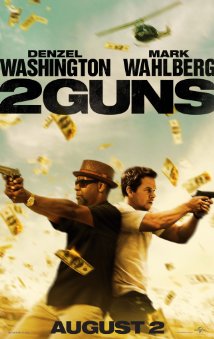
What do movies and sports have in common?  Match-ups.  It’s all about the match-ups baby.  Some cinematic pairings just get us excited, like the prospect of Mark Wahlberg (Pain & Gain) and Denzel Washington (Flight).  Washington is a living legend, and Wahlberg has cemented his place in modern cinema with critically acclaimed turns in films such as The Fighter and The Departed, for which he received Oscar nominations.  The action comedy is on the rise lately, and 2 Guns tantalized moviegoers with the rare opportunity to see Washington bring levity to a performance.  Unfortunately, even charismatic leading men can’t save a goofy script.

Washington and Wahlberg are Bobby Trench and Michael Stigman (Stig), respectively.  When we meet the pair, they are hatching a plot to rob a small bank to swindle a drug lord named Papi Greco (Edward James Olmos) out of his holdings.  They each have distinct reasons for wanting to pull this caper, but each is keeping the real reason a secret.  At first blush we think these two are criminals, after all who else would be robbing a bank?  In actuality they are both “undercover” in their own way, with Bobby being a DEA agent and Stig having firsthand experience with naval intelligence, despite the appearance of being a career criminal.

As each plays fast and loose with the law, the viewer is left wondering if our protagonists are corrupt or just deep undercover.  Bobby tries to convince fellow agent Deb (Paula Patton, Mission:Impossible – Ghost Protocol) that the robbery will serve as a way to nab Papi, while Stig is beholden to corrupt superior officers (James Marsden, Straw Dogs) within the Navy.  Their plan goes awry when they find out Papi’s bank vault yields a much larger heist than expected.  Not only do they need to ascertain the origin of the surplus money, they must ward off several factions who will stop at nothing to retrieve it.  Complicating matters is the fact that Bobby and Stig can’t really trust each other after having lied about their true identities.

I’ll start with the positive.  Washington and Wahlberg have tons of chemistry and good comedic timing.  I don’t have an issue with their performances at all; my issue is with the source material.  The storyline was simply foolish and muddled, and much of the characters behavior was far-fetched.  The screenplay marks the big screen debut for writer Blake Masters, who has previously worked in television.  Maybe his next effort will be more successful, although 2 Guns appears poised to have a solid opening weekend.  Nevertheless, it takes more than two talented leading men to make a successful movie, even if the pairing looks like a “slam dunk.”  Even a dynamic duo like Al Pacino and Robert DeNiro aren’t a sure-fire success if the script is wanting (see Righteous Kill).  If those two legends can team up for a dud, no tandem is above reproach.  The rest of the cast did little to bolster the movie, and it will not be remembered as a summer standout.  I’m not saying it was horrible, just very mediocre – in spite of its two stars.  Grade: C

This article first appeared at Poptimal and was reprinted with permission


Fruitvale Station

Wow.  I don’t even know where to begin.  Nothing could have stopped me from seeing Fruitvale Station, for several reasons.  First, I adore Michael B. Jordan (Chronicle).  Secondly, I support young emerging Black talent.  I admire people who follow their dreams and aspire to greatness, particularly in filmmaking.  The director of this film, Ryan Coogler, is a young man on the rise and I support that.  Lastly, the events that gave rise to this film were a tragedy, and I’m tired of it being ‘open season’ on young Black men in America.  I don’t have a brother, but if I did he might look like Oscar Grant. Or Sean Bell. Or Emmett Till. Or Trayvon Martin.  The list goes on and on, and I’m fucking sick of it.  My soul weeps, and that’s not hyperbole.

In the wee hours of New Year’s Day 2009, a young man named Oscar Grant was a passenger on a BART train heading into Oakland, California.  He had been celebrating the holiday with friends, and they were returning home.  While aboard the train, a fight broke out, prompting a response from transit police.  They detained several passengers, including Grant and his friends.  In the course of this detainment, Grant was shot in the back by one of the officers.  Oscar was unarmed.  The bullet entered through his back and ricocheted back into his body, piercing his lung.  By 10:00 AM on New Year’s Day, Oscar Grant was dead.  The movie begins with the actual footage of this crime, a chilling moment that is not dramatized until the movie’s final act.  Fruitvale Station, so named for that fateful transit stop, examines the last day of Oscar’s life.

You cannot divorce the movie from its larger societal context, particularly in light of George Zimmerman’s recent acquittal.  Other than their skin color, the similarity between Trayvon Martin and Oscar Grant is that they embody the frustration and futility that engulfs so many young Black men in America.  Over the course of the film we see that Oscar is an average young man.  He loves his daughter immensely.  He argues with his girlfriend, and they make up.  He loves his mother and his family, but like many young Black men, he is frustrated with his circumstances.  He has made some mistakes in the past, but he is hopeful and earnest in his desire to change for the better.  Desiring a new start for a new year, he wants to stop selling weed, and we see him make incremental changes in his life to that effect.  It is this flawed ‘everyman’ quality that makes him so relatable.  We are all playing the hand we were dealt, and we’re all trying to get better.

It is particularly poignant to watch his life unfold, only to know that it will be cut short very soon.  There’s an air of dread and foreboding that hangs over the movie, and even the joyful moments are painful, because we know that these moments are fleeting.  His tasks are mundane, but there is something refreshingly authentic about the way Coogler and Jordan brought Oscar to life.  He was immediately humanized, and we see that despite his shortcomings (previous brush with the law, moments of angry frustration), he was a beautiful spirit.  I always say that people are complex.  Good people do bad things, and bad people do good things.  The haunting thing about the movie and about Oscar Grant’s life in general, is that it is a story of promise unfulfilled.

Fruitvale Station won prizes at both the Sundance and Cannes Film Festivals, and it’s easy to see why.  Jordan is a revelation, and continues to impress with both his versatility and a rare ability to endear himself to audiences.  Octavia Spencer (The Help) is featured as Oscar’s mother, and you know this woman.  Either she is your mother, or your aunt or your friend’s mother – but you know this woman.  She carries a quiet and loving demeanor, a firm but gentle hand.  Black women are tasked with raising sons in a world that is at once fascinated by and fearful of that which they don’t understand.  As we see Oscar interact with children, his peers, strangers of different races (some of whom are White), and even a stray animal – we see that his humanity shone through.  It is this same sense of humanity that unites us all, if we could just cut through the bullshit and get to it.

I think Fruitvale Station will prove to be a seminal movie that very much captures a time in American history where we are at a proverbial crossroads.  It’s 2013 now, and the officer that murdered Oscar Grant has been tried, convicted and released, all within a four-year span.  I don’t know whether to laugh mirthlessly at that absurdity or cry about it.  As human beings, we need to figure out what unites us rather than what divides us, and we have to cling to that with every ounce of strength we have left.  What is about young and Black and male that threatens us?  Examination of this question is the difference between life and death for so many people, and the answer has to start to matter to more than just Black people.  It has to matter to all of us.  Grade: A+

The Wolverine

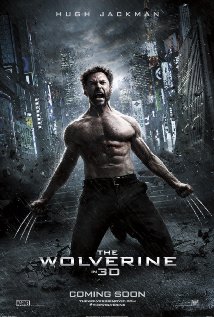
The cream always rises to the top.  The star always gets the spin-off, or leaves the group to go solo.  Movie franchises are no different.  The X-Men are a captivating ensemble, but there are only a couple of them who you’d want to see alone.  I think Wolverine is such a character, and he’s the only one has his own franchise.  As I’ve stated before, I didn’t read the X-Men comic books, but I used to watch the cartoon – and Hugh Jackman (Les Miserables) is the embodiment of the Wolverine.

When we find our long-lost Logan, he’s literally holed away in an isolated mountain cave on the outskirts of a small town.  He’s plagued by nightmares of Jean (Famke Janssen, Taken 2) and flashbacks to the World War II nuclear bombing of Nagasaki.  It was there that Logan saved the life of a Japanese soldier named Yashida, and the two men have never forgotten that fateful day.  Of course Logan hasn’t aged since then, but Yashida is now the elderly CEO of a profitable Japanese company.  Logan’s connection to Yashida is brought to the forefront even more when he encounters a young woman named Yukio (Rila Fukushima).  She intervenes to help Logan in an altercation, but has been dispatched to summon him to Japan.  Yashida is on his deathbed and would like to see his old friend one last time.

Logan reluctantly travels to Japan, where he finds Yashida on death’s door.  He meets Mariko (Tao Okamoto), Yashida’s granddaughter and Yukio’s adopted sister.  She is betrothed to a young Japanese man in a marriage arranged by her father, but everything is turned upside down when it’s revealed that Mariko will inherit her grandfather’s company instead of her father.  Later, she is nearly kidnapped by the Japanese Yakuza, but Logan intervenes and saves her.  Complicating matters is Yashida’s sinister doctor, who seems to have a hidden agenda.

The movie follows Logan and Mariko as they flee her would-be captors and Logan tries to figure out why his healing abilities are unexpectedly diminished.  Yukio has a premonition that Logan will die, and although he is dismissive of her concerns, it certainly seems like a possibility given his suddenly more human condition.  He and Mariko grow closer, especially when he uncovers betrayal within her family.  In the first act of the movie we are shown Logan’s tortured, solitary existence; in the second act he returns to Japan and we are introduced to the movie’s principal conflict; and in the third and final act we see the resolution of that conflict.  I appreciated the straightforward storytelling and found it largely effective.

Director James Mangold (Knight and Day, 3:10 to Yuma) created a dark landscape for Jackman, who is very good as Wolverine.  The role has never been played by anyone else on the big screen, nor should it.  The movie assumes that the viewer is familiar with X-Men and/or has seen the first Wolverine movie, and I won’t quibble with this.  I doubt anyone would go see this movie if they hadn’t seen either of those previous works.  I’ve seen a few tweets criticizing this movie – so I’m not sure what demographic to which it appeals, but I liked it.  Some decried the lack of action; others thought it seemed like a “kiddie” movie.  Bear this in mind, but I wasn’t disappointed at all.  Grade: B.

Red 2

The sequel is a cinematic curiosity.  A good sequel is a logical and relevant continuation of the original movie.  It may flesh out previously established characters or begin a new chapter in the series or franchise.  I think The Godfather II is the best sequel ever made, because it provided a rich backstory while juxtaposing one storyline with another.   I don’t expect the average sequel to come anywhere close to that lofty standard, especially in this age of Hollywood machinery.  Most sequels nowadays are made simply because the studio wants to capitalize off the success of the original movie with a lucrative follow up.  I’m sure that’s what the makers of Red 2 were thinking, but with a cast this impressive – you almost can’t go wrong.

Bruce Willis (Looper) returns as Frank, a retired CIA operative trying to live a quiet life with his girlfriend Sarah (Mary Louise Parker, Weeds).  His peacefulness is short-lived when an old friend and former colleague Marvin (John Malkovich, Transformers: Dark of the Moon), approaches him urgently.  Marvin thinks people are after him and that he and Frank should get out of Dodge, with Sarah in tow.  Sarah is game for a little excitement, but Frank thinks Marvin is being paranoid and brushes him off.  When Marvin turns up dead shortly after, things take an interesting turn.  It turns out the two are suspected of being involved in an old covert mission called “Nightshade,” and some very dangerous people are upset about that supposed involvement.  Frank is taken into custody after Marvin’s funeral, where agents detain and interrogate him.  Inexplicably, another operative breaks into the facility to extract him, killing any agent that gets in his way.

It turns out that Marvin is alive after all, and he and Frank are now on the run.  Nightshade has a lot of people up in arms, and there is a hit out on the pair.  They must find out who’s trying to kill them and why, before it’s too late.  Helen Mirren (Hitchock) returns as Victoria, and she too has been approached to eliminate Frank and Marvin.  Fortunately, her loyalty is true and she forewarns her old friends that the heat is on.  Their escapades take them to Europe, where Frank is reunited with an old flame Katja (Catherine Zeta-Jones, Side Effects), much to Sarah’s chagrin.  Also joining the fray is Han (Byung-hun Lee, GI Joe: Retaliation) another contracted assassin with an impressive skillset – but what side is he really on?

I’ve tried not to reveal too much about the plot, but any further exposition is inconsequential to this review.  The movie basically consists of a lot of spy vs. spy shenanigans, and it’s a fun ride.  Although the plot was very different, Red 2 reminded me of Mr. & Mrs. Smith with its hijinks and effective blend of action and comedy.  John Malkovich, Anthony Hopkins and Helen Mirren are veteran Oscar winning thespians, and it’s good to see them assembled in a light-hearted movie such as this.  Bruce Willis is an ageless wonder, as I’ve stated before.  Most of the cast is eligible for an AARP card, and it’s pretty entertaining to see the old guard still kicking ass.  This made for an enjoyable day at the movies.  Grade: B+