2014 Movies

Godzilla

I was really looking forward to Godzilla after seeing the trailer. Director Gareth Edwards appeared to have crafted an entertaining film in the vein of the old great disaster flicks. Unfortunately, I’m almost ill equipped to pen this review because I dozed off periodically throughout the movie. Make of that what you will, but here goes.

The movie opens with a recent flashback in time from the perspective of married scientists Joe (Bryan Cranston, Cold Comes the Night) and Sandra Brody (Juliette Binoche, Words and Pictures). The pair is conducting research when they become victims of a tragic accident involving an unidentified creature. To be more precise, the creature was a massive, unidentified terrestrial object (MUTO). Cranston adds heft and gravitas to the movie, but after the first 30 minutes or so, I began to lose interest.

We fast forward to the present day, where Joe’s son Ford is all grown up with a family of his own. Ford is estranged from his father, who has never recovered from the tragic and mysterious incident that claimed his wife. Ford has tried to put the memory of his mother behind him, but recognizes that it devastated his father. He is the first call Joe makes after being incarcerated overseas, and Ford vows to help him. The first act focused on this backstory, introducing us to the characters integral in advancing the plot, which eventually becomes secondary to the massive creatures warring with one another. We aren’t introduced to the titular behemoth until well into the movie – but I found the anticipation annoying rather than exciting.

I admit that I’m not as equipped to write this review as I usually am. I fell asleep and wasn’t terribly impressed by what I saw while awake. In an ironic way, doesn’t that prove my point? I simply wasn’t significantly engaged at any time. I wasn’t too entertained by the special effects, or the battle between Godzilla and the MUTO. These are just my thoughts, and if you’re a fan of the sci-fi genre or the iconic large lizard – then by all means go see Godzilla off GP. The guy sitting a few seats down from me in the theater seemed to be having a ball. Judge for yourself, but I was underwhelmed and disappointed. Grade: C
Locke

I believe the hallmark of a good actor is range. Versatility keeps your performances fresh and gives audiences something to look forward to. To that end, I find Tom Hardy (The Dark Knight Rises) one of the most versatile, talented actors around. He’s adept at romantic roles and action movies alike. One minute he is giving Batman hell, the next he’s wooing Reese Witherspoon. I haven’t been disappointed by any of his movies…until now.

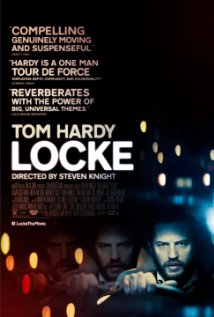
Locke gives us a night in the life of Ivan Locke, a construction planner who is in for a very late, difficult evening. Instead of heading home as planned for a fun night with his wife Katrina and two sons, he is diverted out of town to witness the birth of his illegitimate child. He cheated on his wife the previous year with a co-worker named Bethan, the tryst resulting in a pregnancy. Instead of confessing to his wife, he’s remained silent until now, after Bethan goes into labor earlier than expected. We see Ivan make a series of phone calls to various people, including Katrina and Bethan. He also speaks extensively with a co-worker and with his boss, as his unexpected change of plans threatens to deter an important launch for his company.

It may seem like I’ve revealed a lot about the plot; but this is probably not a movie you’ll be seeing anyway, unless you’re a big fan of Hardy. The entire film consists of Locke in his car, driving to the hospital to see Bethan. The other characters are heard but not pictured. For all but five minutes of the film, we are watching Locke behind the wheel of his BMW, using the vehicle’s hands-free calling. The static environment was confining, and while Hardy’s acting was superb – it’s difficult to watch a character engage in such mundane activity for an hour and a half. Moreover, Hardy is literally the only character we see in the film. We can’t witness him interact with other characters in the traditional sense, which adds to the sense of confinement.

There were some elements of the movie I found effective, namely the fine job by Hardy. His range is impeccable, and he brought a sense of righteousness to the character, despite his abject infidelity. He has the requisite talent to carry a film. Furthermore, the film relies on the strength of verbal and audio performances, as we hear but never see the people with whom Locke is involved. This was not a passive viewing experience, as I found myself oddly engaged yet wanting the movie to be over. It took me about 45 minutes to realize that no climactic event was forthcoming.

Past movies have successfully employed some of the aspects of the film that didn’t quite work here for writer/director Steven Night (Eastern Promises). There have been movies that featured a solitary character (I Am Legend), a static setting (Phone Booth), or have relied heavily on a character’s voice (Her). But those movies either had varied settings or were infinitely more exciting than watching a person talk and drive. I can appreciate subtlety as much as the next person, but only to a point. The concept was interesting, but I thought it would have made a better short film. The plot wore thin pretty quickly. If you’re having trouble sleeping, this movie should do the trick. Grade: C

Captain America: The Winter Soldier

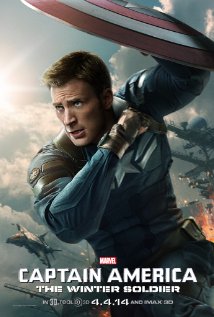
I often lament sequels, because more often than not they are unsatisfying. However, sometimes Hollywood manages to build effectively on an original movie by improving upon the protagonist in the sequel. Superhero movies are in a different realm right now, with The Dark Knight trilogy and Marvel’s The Avengers serving as the standard bearers for the genre. Whereas the Iron Man and Thor sequels have represented a slight decline in quality, I thought Captain America: The Winter Soldier was a marked improvement over its predecessor.

Chris Evans (most recently of Thor: The Dark World) reprises the role he established in 2011, but this time the storyline is significantly more entertaining. Evans has the interesting distinction of playing more than one superhero, having also portrayed Johnny Storm in The Fantastic Four franchise. Steve Rogers/Captain America is a much more compelling character, though his straight-arrow persona lacks the texture of his fellow Avengers. The sequel finds our hero adjusting to life in the 21st century while still feeling like a fish out of water. Recall that he was cryogenically frozen during World War II, only to be thawed out in a completely different era.

The movie opens with a reintroduction to the super soldier Steve Rogers as he undertakes a routine mission for S.H.I.E.LD. It’s established relatively early that Captain America has a simple but unwavering way of doing things.  He likes to deal in facts and strives to be truthful and straightforward in most aspects of life: what you see is what you get.  So when he discovers that S.H.I.E.L.D. director Nick Fury (Samuel L. Jackson, RoboCop) is less than forthright about the mission at hand, he feels slightly betrayed.

Fury’s dishonesty makes Rogers mistrustful of him as well as friend and fellow Avenger Black Widow (Natalia Romanoff) (Scarlett Johansson, Don Jon), who was privy to the deception but doesn’t have the same inflexible “code” as Rogers. This movie differed from the other Marvel entrants in that Fury was featured much more prominently. When he inexplicably becomes the target of assassins, he reveals to Rogers that a splinter group has arisen within S.H.I.E.L.D. That rogue faction is known as Hydra, and they’ve been operating since S.H.I.E.L.D.’s inception. Fury ominously warns Rogers that he can’t trust anyone, and soon he too feels Hydra’s wrath. Robert Redford (All is Lost) is featured as S.H.I.E.L.D. higher-up Alexander Pierce, a questionable character in odd pursuit of Rogers after casting suspicion upon him regarding Director Fury.

The title of this sequel references The Winter Soldier, a soldier every bit as impressive as Captain America. He’s relentless and formidable, complete with a metal arm and seemingly indestructible exterior. His origin is unknown, but Black Widow explains to Captain America that his kills are the stuff of legend. Captain America must expose the Hydra agents within S.H.I.E.L.D., while uncovering their end-game goal. All the while he must contend with The Winter Soldier, a foe against whom he is evenly matched. I’ve tried to describe the movie in a way that is accurate but doesn’t reveal too much – so I’ve been intentionally cryptic about a few details.

I enjoyed the movie because it was entertaining and action-packed. The storyline was more interesting than the first movie, and Rogers’ character was fleshed out more. Additionally, the supporting characters proved to be worthy additions, including Anthony Mackie (Runner Runner) as Falcon, an affable sidekick who fits in nicely alongside Captain America and Black Widow. Men (and some women) will appreciate Scarlett Johansson’s assets, and I thought she more than held her own. All of the Avengers are well cast, and Chris Evans is well suited in the starring role. I don’t go for the “straight-arrow” superhero types, as I like my heroes with a darker side – but he didn’t disappoint. I thought Iron Man 3 and Thor 2 were recent Marvel missteps, but Captain America: The Winter Soldier has the studio back on track and is poised to crush the box office. Grade: A-


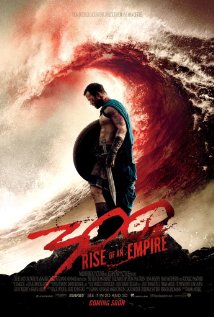
300: Rise of An Empire

I’ve commented numerous times that Hollywood studios love a sequel, whether it’s warranted or not. For example, bad sequels typically involve a re-tread of the original, a la The Hangover 2. Which leads me to 300: Rise of An Empire. 2006’s 300 was an exhilarating depiction of the Battle of Thermopylae, replete with amazing imagery and strong performances. One would think a sequel would logically pick up where the original left off, but the makers of 300: Rise of An Empire had something different in mind, much to my disappointment.

Writer Zack Snyder (Man of Steel) uses this sequel to tell a parallel storyline overlapping the same time period as the original movie. This seems like a cumbersome storytelling technique, but there was potential for it to be interesting. Snyder reveals Xerxes’ (Rodrigo Santoro, The Last Stand)backstory, providing a glimpse of him before he became the ruthless villain who mercilessly defeated Leonidas. Xerxes’ father Darius was king of Persia, decimating Greek troops through relentless warfare. During one fateful battle, he was killed by the bow of Themistocles (Sullivan Stapleton, Gangster Squad), a fearless Athenian determined to unite all of Greece. Upon witnessing his father’s demise, Xerxes became hell-bent on exacting revenge upon Themistocles and any city-state that threatened Persia.

Enter Artemisia (Eva Green, Casino Royale), a fierce Persian warrior who harbors a venomous hatred for Greece. It was Greeks who raped and pillaged her childhood home, viciously marring her childhood and deeply sowing a seed of revenge that would come to define her. Left for dead, she was taken in by an older Persian warrior who trained her in battle. She displayed a natural ferocity and skill, becoming a formidable fighter. By the time she came of age, Artemisia had earned the favor of ill-fated King Darius. She was placed in command of the Persian army, though she served at Xerxes’ pleasure.

The movie is told largely from Themistocles’ perspective, as he tries to defeat Persia with the help of Queen Gorgo (Lena Headey, The Purge), Leonidas’ widow. She is reluctant to provide Spartan soldiers for battle, though Themistocles must amass a sizeable army to compete with the Persians. Eventually she lends the manpower, and Themistocles leads the charge against Persia, not to avenge Leonidas, but to unite Greece in defeat of a common enemy.

I don’t know how or why Zack Snyder allowed such a decline in quality between the original 300 and this sequel, but most aspects of the movie, which I viewed in 3D, disappointed me. The special effects were visually entertaining, but they became trite and felt gimmicky after a while. For example, it’s fine to use slow-mo effects to add emphasis, but overuse of the technique lessens the impact and the device becomes trite. The adversarial positioning of Themistocles and Artemisia was effective from a character standpoint, and they had excellent chemistry. One particular scene where they engaged in a rough romp was awkwardly entertaining, but ultimately the movie was not satisfying. Don’t waste your time. Grade: C

The Monuments Men

The intriguing thing about history is that there is always an untold story.  Against the backdrops of some of the most memorable historical events of our time lie fascinating subplots.  In times of war, for example – the prevailing story will understandably be one that focuses on human casualties.  The artistic or cultural loss of war may not be readily apparent, and most historical narratives don’t explore such considerations.  As a result, actor/director George Clooney (Gravity) found a unique opportunity to highlight a chapter of world history that was previously untold.

During World War II, Hitler instructed the Nazis to seize all works of art, including paintings, sculptures and other precious artifacts.  He supposedly had designs for a museum in his own honor and wanted to fill it with items he’d pilfered along the destructive path he carved through Europe.  In the event that Hitler was killed or captured, he instructed his troops to destroy the stolen art.  President Roosevelt recognized the value in preserving culture and authorized a commission to retrieve the items and return them to their rightful place.  Clooney stars as Lieutenant Frank Stokes, the man tasked with assembling the group that would be known as “The Monuments Men” for their willingness to sacrifice their own lives for the preservation of precious cultural monuments.

You might ask yourself, who cares about a painting when people are being killed? However, Stokes’ character conveys the purpose for The Monuments Men, answering the necessary question of whether or not a piece of art is worth a man’s life.  I’m paraphrasing the quote, but Stokes says that if you burn a man’s house down, he can come back.  But if you destroy his achievements and his history, it’s like he never existed.  That line struck me, and I think The Men’s sacrifice should be celebrated.

The commission is comprised of former military, all of whom have a unique knowledge of art either through study or creation.  Matt Damon (Elysium) co-stars as museum curator Lieutenant James Granger, while Bill Murray (Moonrise Kingdom) and John Goodman (Inside Llewyn Davis) are featured as Sergeants Richard Campbell and Walter Garfield, respectively.  The cast notably includes Cate Blanchett (The Hobbit: The Desolation of Smaug), Hugh Bonneville (Downton Abbey), and Jean Dujardin (The Wolf of Wall Street), with all of the characters filling unique roles that were integral to advancing the storyline.  At the helm both literally and artistically is Clooney, and the men he commands share his passion and commitment to the cause.

The Men contend with Nazi soldiers as well as resistance from Allied troops who don’t share their passion for art, at least not when weighed against the potential risk to American soldiers.  However, I never doubted the validity of their cause, and perhaps that is a testament to Clooney’s storytelling and direction, though I’d be remiss if I didn’t mention that the film is based on a book by authors Robert M. Edsel and Bret Witter.

The Monuments Men was a solid movie, and I found it well made and well acted.  However, it’s not the type of movie that drives foot traffic to the theater, though my show featured high attendance.  This is a quiet movie that you can see with your mom.  You’ll learn something, you’ll chuckle a few times, and you’ll probably be pleased overall.  But this is not the type of movie that will have you talking and telling your friends that they’ve “gotta see it.”  While it was enjoyable, I found myself ready for the credits to roll, despite some good performances and entertaining moments.  This is the kind of movie you’ll stumble across while flipping channels, and you’ll be glad that you did – but it was a bit too understated in its direction for me to give it a ringing endorsement.  Grade: B

This article first appeared at Poptimal and was reprinted with permission.

Lone Survivor

Some of the finest contributions to 20th century film have captured the brutality and complexity of war, showing both its devastating psychological consequences and the savagery of battle.  From Apocalypse Now to Full Metal Jacket to Saving Private Ryan, Hollywood has brought us some incredible showcases of war.  Most of the war movies I’ve seen were set during the Vietnam War, but the Civil War and World Wars 1 and 2 have been represented, among others.  While the jungle of Vietnam is a familiar backdrop, few movies have depicted the mountainous terrain of the more recent war in Afghanistan until now.  Lone Survivor tells the real life account of a group of SEALS who fought courageously in pursuit of high-profile Taliban ally Ahmad Shah in 2005.

Actor/director Peter Berg (Battleship) dramatizes the events of Operation Red Wing, a military action in Afghanistan that claimed the lives of all but one SEAL, lone survivor Marcus Luttrell (Mark Wahlberg, 2 Guns).  Let me preface by saying that any criticism I have is from a purely cinematic perspective; I am thankful for the men and women who serve our country and understand full well the incredible sacrifice that was made in that military operation.  I’m only discussing Berg’s interpretation of what happened, and I found the film mostly effective.  He opens the movie with ostensibly real footage of the grueling preparation endured by all SEALS, revealing the unique fortitude required of the men who carry out some of our most dangerous military operations.

We are introduced to the unit in Afghanistan, and the prevailing mood is one of fraternal camaraderie. Michael Murphy (Taylor Kitsch, Savages), Danny Deitz (Emile Hirsch, Savages), and Matt Axelson (Ben Foster, Contraband) join Luttrell, and the band of brothers couldn’t be any closer.  When they are apprised of the mission, it’s go time.  Luttrell, Murphy, Axe and Deitz are embedded in the mountainous terrain, and soon locate their target Shah.  They are hidden in dry foliage when a local goat herder and two boys stumble upon them.  In a pivotal moment that ultimately determines their fate, Lieutenant Mike Murphy must decide whether they let the party go on their way, detain them, or eliminate them all together.

When Murphy releases the party, they promptly alert Shah and his well-armed band of locals to the soldiers’ presence.  A firefight ensues, followed by an extended and gut-wrenching battle, as the SEALS are outgunned and perilously exposed.  They suffer devastating injuries, including broken legs, shrapnel, and bullet wounds.  It was nearly unbearable to watch, including one scene where they literally hurl themselves over a cliff, tumbling down the mountain as bone meets rock.  The human body and the human spirit weren’t meant to endure such turmoil and trauma, and the viewer is constantly reminded that SEALS are simply cut from a different cloth.

Lone Survivor succeeded in its accuracy, but I can’t help but compare it to the previously mentioned standouts in the genre.  While it was effectively authentic, it was almost too straightforward.  There wasn’t much character or plot development, but I suppose that wasn’t Berg’s intention.  I think the goal of depicting Operation Red Wing was achieved, but I’m not sure this movie is emblematic of an era like the great Vietnam movies were.  However, the casting was excellent, with Wahlberg, Kitsch, and Foster masterfully capturing the bravery, courage and heroism of these real-life fallen soldiers.  Grade: B.

August: Osage County

The family unit is a societal and cultural structure ingrained in most of our lives.  Every family has its quirks, and every family deals with both tragedy and triumph.  Families endure everything from illness and death to incarceration and addiction.  It’s the love and the loss that makes the world go ‘round, and no family is immune from heartache or difficulty.  Moreover, there are common threads found in every family, regardless of class or culture.

For example, even though we love our mothers to death, most people can agree that there are times when you simply want to say,  “Shut up Ma!”  You’d never say it, but mothers have a knack for speaking their minds unabashedly – much to the chagrin of their children.  But we can’t choose our family, and most of us love our relatives for better or worse.  In August: Osage County, director John Wells (The Company Men) explores familial themes through the relationships and trials of the Weston family, a dysfunctional Midwestern clan.

Beverly (Sam Shepard, Mud) and Violet Weston (Meryl Streep, The Iron Lady) are parents to three adult children, though the family unit hasn’t been intact since the girls came of age.  Beverly is a functioning alcoholic, and Violet is a pill-addicted shrew.  She is suffering with Cancer, but her sharp tongue tempers any sympathy.  The eldest daughters Barbara (Julia Roberts, Mirror Mirror) and Karen (Juliette Lewis, Due Date) moved away and haven’t looked back, while youngest daughter Ivy (Julianne Nicholson) remained behind as caretaker.  The opening scene is jarring, with Streep diving headfirst into the role.  It’s so bad it’s good – her character is suffering and it’s uncomfortable to watch, but Streep’s performances always seem like a master class.

When a shocking tragedy reunites everyone, curious family dynamics are revealed.  There’s sibling rivalry, buried secrets, infidelity, sexual taboos – you name it.  It might sound salacious and melodramatic, but realism permeated the film.  The characters’ problems were real, not contrived.  I could relate to the daughters’ frustrations as their mother offered well intentioned but unsolicited advice that went far beyond the pale.

I’ve been making the effort to see most of the Oscar nominees, and August: Osage County has two nominations for Best Actress (Streep) and Best Supporting Actress (Roberts).  The veterans didn’t mail it in here, and I’m sure they are in strong contention in their respective categories.  The entire cast delivered, with Benedict Cumberbatch (The Fifth Estate) and Margo Martindale turning in surprisingly honest performances.  This is the type of movie that doesn’t rely on gimmicks, but strength of script and the dramatic talents of a laudable cast.  I was most struck by the film’s sense of truthfulness.  I almost felt like a fly on the wall, and the realism underscored the film’s effectiveness.  My only minor complaint is that the setting felt static, with most of the movie happening in one environment.  But I’m nitpicking.  Bottom line: an understated but memorable film with strong performances from seasoned veterans and supporting cast alike.  Grade: B+