Author: T_Dot_Lane

Looper

Every self-proclaimed movie buff has a favorite genre and type of movie.  My favorites are suspense thrillers or crime dramas.  I also like movies that feature intersecting storylines.  I think the best movies are “high concept,” meaning that the storyline is uniquely original and it features a refreshing central idea.  Some examples would be Inception, In Time, and Minority Report.  All three of those movies were unlike anything that preceded them.  Looper was such a movie, a high concept tale characterized by an inventive storyline.

J. Gordon Levitt (Inception) has matured into a fine young actor.  He has been impressive in everything I’ve ever seen in him, most notably 500 Days of Summer.  In Looper he stars as Joe, a young criminal in the desolate future of 2044.  30 years from that in 2074, time travel will be possible.  It is ultimately outlawed, used only by criminal organizations in secret as a way of eliminating unwanted offenders.  Joe is a looper, a person who executes people who have been sent back from the future.  Criminals in 2074 send their victim (always another criminal) back in time to 2044, where they are immediately shotgun blasted out of existence by a looper.  There is now virtually no trace of the person ever having existed.  It’s a sad and efficient way of dispensing with an enemy.  Occasionally a crime boss will want to get rid of an employee, even a looper.  When this happens, the looper will make the requisite kill, only to remove the pillowcase from his victim to discover that it’s him or herself (in the future).  This is called “closing your loop,” which means that your future self no longer exists.  The worst thing that a looper could do is fail to close his loop by letting his future self escape.  An open loop means that a future and present version of the looper co-exist in the present.  It also means that they haven’t been removed from the future yet.  It would be like 33-year-old Tanya and 63-year-old Tanya chilling right now in 2012.  Bugged out, right?  Exactly, that’s why it can’t happen.  As crazy as it must seem to put a bullet in your future self, that’s what a looper must do, if necessary.  Joe doesn’t lack the resolve to do it, but he bungles a hit on his future self (Bruce Willis, Red) when the time comes.

Of course, being a looper, Future Joe (Willis) knows exactly what is going to happen when his bosses try to send him back in time.  He prepares for it and outsmarts Present Joe easily, overpowering him and escaping.  I’m just going to refer to Future Joe as Bruce Willis, for simplicity’s sake.  Once his bosses find out that Joe didn’t close his loop, they send a bounty hunter (Jeff Daniels, The Newsroom) back in time to eliminate both Joes – the young one for botching the job and the old one because he was the target in the first place.  Joe himself is also very committed to killing himself, stopping at nothing to track Bruce Willis down.  There is a curious dynamic between Young Joe and Bruce Willis, as their agendas are wildly divergent.  Bruce Willis wants to make sure that his life plays out, as it should, the way he knows it.  He already knows what his version of the future holds, because he’s lived it.  He has a wife that he’ll never meet if Young Joe somehow alters the course of their lives.  Young Joe wants to make his own way in the world and cares nothing for a hypothetical future that he knows nothing about.

Looper was an intriguing movie.  Its high concept premise lured me in, but there were several enjoyable elements.  The casting was great.  Bruce Willis was fitting as the grisly older man who is one step ahead of his younger self.  He really looks like an older version of J. Gordon Levitt, which was especially noticeable in one scene where both actors were shown in profile.  Emily Blunt was also featured, and I think she’s very versatile.  Here she showed a vulnerability and sense of love and compassion that I liked very much.  Her performance was both emotional and convincing.  Levitt always simply does whatever is required of him, and he does it very well.   Looper was nearly flawless, and I hope that Levitt continues to challenge himself with great scripts like this one.  Grade:  A


Lawless

Tom Hardy (The Dark Knight) has recently emerged as the latest “it” guy in Hollywood.  I first viewed him in Guy Ritchie’s gangster drama RocknRolla, and although I found him charming in his supporting role, I was unaware there was such underlying talent.  He’s gone on to star alongside some notable names, and that trend will probably only continue in the future.   His role in the The Dark Knight Rises as super villain Bane cemented his movie star status, and he’s one to watch for me.

Lawless is based on the true story of the infamous Bondurant Brothers, as told in the novel The Wettest County in the World, written by one of the Bondurant descendants.  The brothers were bootleggers in Prohibition Era Virginia, proving to be murderously resilient and nearly indestructible.  Forrest (Hardy) and Howard (Jason Clarke) are the two eldest brothers, fearless and violent.  Jack (Shia LaBeouf, Transformers: Dark Side of the Moon) is the youngest boy and more naïve to the ways of the bootlegging world.  He is sensitive and green to the criminal lifestyle, though he is anxious to earn more responsibility from his brothers in their enterprise.  His days are spent pining away for the local minister’s daughter, played with youthful innocence by Mia Wasikowska (The Kids Are All Right).  A lot of people think Shia is overrated, but I think he does a good job as the well-meaning kid who is in over his head.  It’s a common refrain in his roles, and I think his characters are mostly endearing and relatable.  However, since he conveys the same sentiment in most of his roles – if you disliked him in one you probably disliked him in nearly all of his movies.

Things are rolling along relatively smoothly for the Bondurant Boys, until they run up against a thorny roadblock.  There’s a new sheriff in town (Guy Pearce, Lockout), and he upsets the apple cart by trying to shake them down.  When they refuse to be muscled, the Deputy retaliates against the weakest of the tribe, Jack.  Forrest in particular is not to be trifled with, as the legend of his immortality is so great that he actually believes it himself.  He has survived beatings and several nearly fatal incidents that have convinced the locals that he can’t be killed.  Deputy Rakes wouldn’t dare screw with Forrest just yet, but wants to send a message that he intends to go toe to toe over the spoils of his illegal activity.  Lawless is largely a vehicle for Hardy, and it’s almost like ‘badass’ is in his DNA.  This makes three movies where his character is simply one that is NOT to be fucked with (the first two are Bronson and TDKR if you were wondering).  Despite the aforementioned quality, there is evidence of a softer side, as he ultimately becomes involved with a young woman named Maggie who comes to work for them (Jessica Chastain, The Help).  Forrest is not violent for violence’s sake, but he has no qualms about defending himself by any means necessary.   Maggie appreciates the rugged simplicity that marks his personality, but also reveals a more compassionate side of Forrest.  He is so gentle with her that she even has to make all the moves the first time they sleep together, and his manner with her is sweet without contradicting his ruthless ambition.

Lawless was very entertaining throughout, and it’s pretty awesome that it’s based on a true story.  The story of the Bondurants was ripe for re-telling, though I’ve heard that some of the surviving family members aren’t too happy with their family’s portrayal.  At any rate, Tom Hardy and Shia LaBeouf gave very solid performances, bolstered by strong supporting turns by Waskikowska and Chastain.  Young actor Dane DeHaan (Chronicle) also gave a strong turn as Jack’s best friend Cricket, who becomes caught up in the war between Rakes and the Bondurants.  In short, Tom Hardy’s on a roll, and Lawless is one to see.  Grade: A

End of Watch

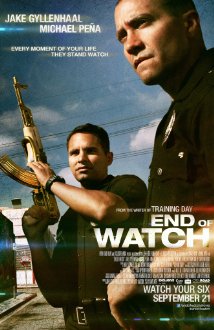
Some filmmakers are known for their keen ability to capture the essence of a particular city, either filtering a landscape through loving eyes or exposing a harsh underbelly as only a native can do.  Spike Lee and Woody Allen have made their careers showcasing New York City, for example.  When I think of L.A. as portrayed in film, Michael Mann comes to mind – most notably for his depiction of the city in Heat and Collateral.  I’ve recently taken note of another filmmaker who has continuously highlighted Los Angeles from both the criminal and law enforcement perspectives, with that line frequently blurred.   Writer/director David Ayer has lent a hand to a few gritty movies set in L.A., including the critically acclaimed Training Day.  He also featured police corruption in Street Kings, an atmospheric tale set amongst a group of dirty Los Angeles cops.  He sticks with familiar territory in his latest effort, End of Watch – with mostly good results.

End of Watch doesn’t aim for much, but what it lacks in originality it compensates for in performance.  The “buddy cop” genre is well worn, but End of Watch takes it a step further by showing a deep and meaningful friendship between two young patrol officers.  Jake Gyllenhaal (Love and Other Drugs) and Michael Pena (Tower Heights) star as Officers Brian Taylor and Mike Zavala, respectively.  On the rough and tumble streets of L.A., they reign supreme.  They don’t exactly do things by the book, but for the most part they act honorably and take their jobs seriously.  Whereas most officers never have occasion to pull their guns in the line of duty (a fact smartly mentioned by Brian as narrator), Brian and Mike flash their iron quite often, seeing more action in a week than the average cop sees in a year.  The movie showed the danger they faced, but also the camaraderie between each other and the rest of the department.  This jovial, fraternal atmosphere has been done a thousand times before, but as long as it’s well executed; I don’t mind a familiar theme.

Ayer is clearly on familiar ground, and I was reminded of Training Day by some of the aspects of the storyline, as well as the cinematography.  Brian and Mike don’t just call it quits after they punch out; they are intertwined in each other’s lives, almost like brothers.  They are commended for their bravery in the line of duty and establish a reputation as fearless officers of the law.  That fearlessness could be construed as foolishness when routine surveillance leads to a huge drug bust one day.  The bust results in seizure of contraband belonging to a Mexican drug cartel, and they don’t take kindly to having their goods intercepted.  Eventually Brian and Mike find out that a hit has been put out on them.  They are undeterred, refusing to take added precautions when on patrol.  After a while things come to a head with the cartel, and the bond between the pair is tested.

I enjoyed End of Watch because of Gyllenhaal and Pena.  They had a natural chemistry and were believable as best friends and partners.  The movie had a good flow and pace, and I felt like a fly on the wall of their lives from the outset.  This was probably because Gyllenhaal’s character was filming a documentary that allowed him to narrate and explain what was happening as it unfolded, a neat trick that drew the viewer into the story.  End of Watch is not without criticism though, and I have to give a tepid endorsement of the movie, based on its ending.  I still think that a movie can be won or lost in the last ten minutes; and the ending didn’t work for me here.  I didn’t like what happened from a narrative point of view, nor did I like an utterly pointless last-minute flashback that served no expository purpose.  Bad endings just leave me flat and disappointed, no matter how effectively a movie started out.  This review isn’t exactly hot-off-the-press, so by now there are other movies I’d see ahead of this one.  All in all, not a bad flick though.  Grade: B.

The Words

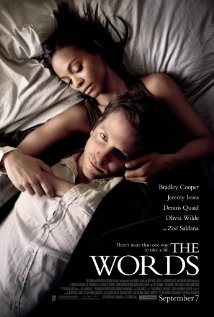
I first noticed Bradley Cooper in The Hangover as the wisecracking but loyal Phil.  It wasn’t too long before Cooper got his chance at top billing, starring alongside Robert De Niro in last year’s Limitless.  He proved in that movie that he could be relatable and endearing, and I knew that I’d be seeing much more of him.  Similar to his role in Limitless, Cooper once again portrays a struggling writer in The Words, a very thoughtful movie from writer Brian Klugman in his directorial debut.

The first thing that struck me about The Words was its interesting and novel structure.  Inception introduced us to the concept of a dream within a dream, within another dream.  Perhaps Klugman was inspired by that format, because The Words featured the unconventional concept of a story within a story within another story.  The movie begins with a narrated look at an ostensibly successful, award-winning author, Rory Jansen (Cooper).  Jansen has penned a critically acclaimed work of fiction called “The Window Tears,” a book that took him from obscure writer to literary sensation.  Rory has an adoring wife Dora, ably portrayed by Zoe Saldana (Colombiana).  When we first meet them they are off to an awards banquet, of which Rory is the guest of honor.  They are a beautiful couple, young and glamorous.  Rory is at the pinnacle of his career on what should be one of the happiest nights of his life, but there is a self-deprecating hint of sadness in his eyes that belies his staggering accomplishments.  It turns out that Rory’s conscience won’t fully allow him to enjoy the spoils of success, because his gains were ill gotten.

Any aspiring writer can tell you that their existence is characterized by a constant battle between their ideal and actual selves.  Am I good enough?  Will I ever be?  These are the perennial questions that plague any artist who struggles with finding inspiration or handling rejection.  Before releasing “The Window Tears,” Rory was beset by doubt and frustration, as the rejection letters mounted.  But his life would be forever changed by his honeymoon in Paris.  While strolling around a Parisian backstreet, Rory and Dora happen upon an antique shop where Rory finds a charming old leather briefcase.  Weeks later he discovers an old manuscript in one of the briefcase pockets and begins to read.  It’s an enthralling tale, and Rory is pained to know that he’d never be capable of producing such a work of art.  Deeply frustrated by his own limitations, he lashes out at Dora.  She believes in him but is wounded by his apparent dissatisfaction with his life, of which she is a huge part.  He begins to transcribe the manuscript verbatim, living vicariously through its anonymous author.  The tale is one of love and loss, set against a post-war Parisian landscape.  At first Rory’s actions seem harmless, but that all changes when he comes home one day to find Dora in tears.  Fearing the worst, he implores her to tell him what’s wrong.  It turns out that she read the manuscript, naturally believing that Rory wrote it.  She’s deeply moved, more than she has ever been by anything he’s written.  She unwittingly sets the stage for an incredible act of cowardice, as Rory takes credit for the story.  Eventually he publishes the manuscript under his own name, calling it “The Window Tears.”

The Words was a unique, emotionally rich movie.  It featured a wonderfully unconventional, non-linear storytelling approach about which I am purposefully not elaborating.  The layered approach made the movie fresh and intriguing, although the concept faltered a bit in the movie’s final act.  Additionally, I would have preferred more concrete resolutions to certain plot points, but these were only minor detractions.  One of the more successful aspects of the movie was its cast, who sucked me into their worlds.  Bradley Cooper was both endearing and compelling as the morally conflicted writer.   His scenes with Zoe Saldana were rife with chemistry, and she was picture perfect as his doting, supportive wife.  Jeremy Irons was wonderful as the Old Man who confronts Rory for stealing his story of love and loss.  He explains in vivid detail the life that inspired such a wonderful tale, each memory a piercing indictment of Rory.  His character was resolute but broken, having been robbed of everything that Rory now enjoys: notoriety, happiness, and true love.  The Words probably won’t make a big splash in theaters, but I thought it was a touching and original drama well worth seeing.  Grade: B+

This article first appeared here at Poptimal and was reprinted with permission.

The Bourne Legacy

I love Matt Damon.  I think he’s extremely talented and versatile.  His turn in The Bourne Identity convinced me that he could do nearly anything.  Prior to that movie I never would have pegged him as an action star or deadly super spy.  He ushered in that franchise and made Jason Bourne a household name.  I couldn’t imagine the series continuing without him, yet any plotline involving his character seemed to have been exhausted with the last installment in the trilogy.  Acknowledging that the Jason Bourne plot had run its course, I was receptive to a new take on the franchise.  Enter Jeremy Renner (MI: 4 Ghost Protocol), who has seen a steady increase in popularity since his award-winning turn in The Hurt Locker.

Renner stars in The Bourne Legacy as Aaron Cross, one of many covert spies working for the same entity that produced Jason Bourne years ago.  I can’t say with certainty whether this entity is a government agency or a private defense company, because I honestly can’t keep up with all the intricate plot details.  When we last saw Jason Bourne in the The Bourne Ultimatum, he was tied up with Blackbriar and Treadstone, with the on-again off-again assistance of Pamela Landy (Joan Allen).  Those covert operations are present once again in The Bourne Legacy, only this time the Powers That Be want to disavow themselves from the program all together.  This means that any agents in the field must be eliminated, as they clean house in advance of a very-much-alive Jason Bourne blowing the whistle.  Bourne knows too much and still poses a threat, especially after the way he was betrayed and hung out to dry when we last saw him.  Once the decision is made to 86 the program, past and present agents are systematically destroyed.  This includes Aaron Cross, who was enduring a hellacious training exercise when his bosses sent a missile to obliterate his wilderness checkpoint, killing a fellow agent.  Cross narrowly escapes, eventually making his way back to civilization.

Like Jason before him, Aaron is extremely resourceful and resilient.  His first order of business is to retrieve some “chems,” pills that he took to sustain himself as he completed the training exercise.  If he doesn’t get another one soon, his body may begin to shut down.  A large pharmaceutical company works with the agency in the development of its internal medicine, and Aaron must travel to the plant where it’s manufactured to retrieve some tablets.  Rachel Weisz (Dream House) features as Dr. Marta Shearing, a chemist who works for the company.  She treats the agents and has treated Aaron previously, though she doesn’t remember him.  He seeks her out in the hopes she can get him a pill, but she explains that they have been transitioning agents off the pills.  Aaron was unaware because he had been completing his training exercise and was in remote locations for several months.  His continued ingestion of the pills has made him a more physically imposing spy.  For some reason that isn’t entirely clear to me, Aaron still wants to obtain some new chems.  From what Shearing explained, it sounds like the chems aren’t necessary for his survival.  Yet Aaron is still determined to go to the plant where they are manufactured in the Philippines and get more.  If it were a life and death situation, I would understand that – but it’s not.  Aaron says something about having witnessed what happens when you go off your meds, and he doesn’t want that to happen to him.  Yeah, ok.  Furthermore, it wasn’t realistic to me that there wasn’t a single pill anywhere in the United States.  Nevertheless, Aaron must get more chems and figure out what’s going on, all while trying to evade his murderous employer.

There were some effective elements of the movie, and some that were less successful.  The aforementioned plot point annoyed me, because it just didn’t make any sense.  It’s important to know what drives your protagonist.  The need for survival is a no-brainer, and I got that.  I also understood his need to protect Dr. Shearing, once they became caught up with one another.  But why is he going to the Philippines if she just told him that he basically doesn’t need the chems anymore?  That seems like a lot of trouble to go through just to avoid withdrawal symptoms.  Aren’t you being hunted?  Shouldn’t you lay low?  Despite that plotline, there were some very good scenes – particularly a workplace shooting that occurred at the pharmaceutical company.  It was a chilling scene that had particular relevance, considering the times in which we live.  At any rate, Jeremy Renner was convincing in his role.  I can’t say that he can fill Matt Damon’s shoes just yet, but he is promising.  He nailed every physical aspect, but I didn’t get a sense of his character’s underlying personality.  Jason Bourne was a more layered, tortured character, and I feel like we only scratched the surface with Aaron Cross.  I’m willing to see what’s in store for the future.  Grade: B.

The Dark Knight Rises

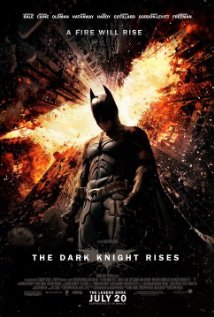
Whenever I review movies that the fan boys love, I have to issue disclaimers.  As I’ve stated before, the only thing I claim to be passionate and knowledgeable about are movies.  If a movie was based on a novel, I may or may not have read that novel. That being said, I didn’t grow up reading comic books.  So I don’t approach The Dark Knight Rises as a person who is checking for accuracy or wants to make sure director Christopher Nolan “gets it right.”  The only measuring stick for me is other movies: other “superhero” movies and the first two Batman movies of Nolan’s trilogy.  I was looking forward to it because The Dark Knight, Nolan’s last edition – was simply outstanding.  It’s one of my favorite movies, and I saw it three times in the theater.  I also think that Christopher Nolan (Memento, Inception) is brilliant, so I’m inclined to see nearly anything he’s attached to (within reason).

When we last saw the Caped Crusader (Christian Bale, The Fighter), he was allowing Harvey Dent to live on in the hearts of Gotham as a hero.  Although Dent devolved into the nefarious Two-Face and held Commissioner Gordon’s son at gunpoint, Batman sacrificed his own reputation rather than shatter the city’s image of its fallen district attorney.  Sacrifice is the recurring theme throughout the trilogy, as Batman selflessly gives his all for Gotham’s residents, though the city doesn’t always appreciate him.  Eight years have elapsed since that fateful night where Dent and Batman swapped destinies, and Bruce Wayne has been a recluse ever since.  Having lost the love of his life and been vilified by many, he has been holed up in his mansion, and Wayne Industries has suffered significant financial losses.  This is where we find our hero, down and quite possibly out for the count.  The time is ripe for any one of the comic’s infamous rogues gallery to emerge and wreak havoc while Gotham is vulnerable.  The city passed The Dent Act, which resulted in the incarceration of many dangerous criminals – but the drop in crime lulls Gotham’s residents into a false sense of security.  That coupled with Batman’s prolonged absence leaves Gotham vulnerable, setting the stage for our latest villain.

Enter Bane (Tom Hardy, This Means War, Inception), successor to The Joker and Two-Face as Gotham’s newest tormentor.  Bane can best be described as a wrecking ball with legs.  He is simply massive, and ably portrayed by Tom Hardy in what is probably his most brutal role since his turn as a notorious British prisoner in Bronson.  Bane escaped from prison and subsequently organized a coup, funded by American businessman John Daggett, a competitor of Bruce Wayne.  Daggett brings Bane to the United States so that he can obtain a clean energy reactor held by Wayne Enterprises and turn it into a nuclear weapon.  Bane’s plan will come to fruition unless the Batman ends his self-imposed exile and more importantly proves himself a worthy adversary of the most physically imposing villain he’s ever faced.

I don’t want to fall into a recitation of the entire plot; nor do I want to give away too much.  There were many plot twists and turns, and several very good performances. The Dark Knight Rises delved deeper into Bruce Wayne’s psyche.  He wasn’t just reacting to things happening around him, rather we see him in a prolonged state of despair, pain, and defeat.  I felt like we journeyed with him as the familiar senses of justice and duty were rekindled within.  This time around we are also treated to Catwoman, played by Anne Hathaway (Love & Other Drugs, The Devil Wears Prada).  Hathaway is a very good actress and I thought she balanced the role perfectly.  Not too campy and corny, strong enough to help Batman instead of merely requiring his rescue.  While I didn’t grow up reading the comic books, I did watch the cartoon series that aired in the 90s.  I remember that Catwoman was a bit “on the fence.”  She wasn’t always Batman’s ally, but she wasn’t out to foil him at every turn, like The Riddler or The Joker.  The same was true of Catwoman in The Dark Knight Rises, as she betrays Batman one minute and saves him the next.  Also featured were strong supporting roles by Joseph Gordon-Levitt (Inception, 500 Days of Summer) and Marion Cotillard (Contagion).  Gordon-Levitt plays an idealistic young police officer that was orphaned as a youth, much like Bruce Wayne.  He instinctively knows Batman’s true identity and gently implores him to help Gotham.  Cotillard was effective as Wayne’s business investor, brief love interest, and…I won’t tell you anything else about her.  You’re welcome.

The best thing about the film was the way Nolan captured the atmosphere of a city on the brink of anarchy.  It always felt like something big was about to happen, at any minute.  But brace yourselves, because this was not “the best movie ever,” as people born in the 1990s might have you believe.  Pump. Those. Brakes.  This wasn’t the best movie made or even the best superhero movie ever made, because it wasn’t superior to The Dark Knight, in my opinion.  How can you be the best movie ever made when you’re not even the best installment of your own trilogy?  The Dark Knight had a more complex villain with a richer backstory and a more layered performance.  I’m not knocking Tom Hardy, and I’m not saying there is anything more that he could or should have done.  Nor am I saying there’s anyone who could have done it better.  I’m just saying it was different, that’s all.  Additionally, The Dark Knight explored deeper psychological themes, and I thought Two-Face nearly stole the show.  Joseph Gordon-Levitt and Tom Hardy came close, but there was no secondary performance that really jumped out at me.  But you know what?  Forget all of that, I can give you a very simple complaint that I had with the film: I couldn’t even understand what Bane was saying the whole time!  I know I’m not the only one who strained to decipher the dialogue when he spoke.  I liked the inflection of Hardy’s voice, and I noticed an almost imperceptible West Indian accent creep through.  When I researched his role after the movie I discovered that he did draw on his Caribbean (who knew?) heritage in the interpretation of the part.  That’s impressive, and it didn’t go unnoticed – but I couldn’t always understand what he was saying!

Of course I think you should go see The Dark Knight Rises, what are you stupid?  Nothing should stop you from seeing it; it will probably be the biggest movie of the year.  Some movies just feel big.  They feel like an experience.  I’m sure it will obliterate existing opening day records, despite the tragic shooting that took place at the midnight screening in Colorado earlier this week.  Now that the trilogy has concluded (Nolan’s not doing any more), I can safely say that it’s probably the greatest trilogy.  But don’t confuse that with me saying that The Dark Knight Rises is the greatest movie.  It’s not, for the aforementioned reasons.  But it was damn good. Grade: A.

Savages

Oliver Stone (W) rose to prominence in the 1980s, with hits like Platoon and Wall Street, cementing his reputation as a heavy-hitter in American cinema.  With the passage of time certain directors fade away, striving to remain relevant in a changing time.  Like a lot of directors, his resume has some duds along with the gems.  Natural Born Killers, anyone?  When I saw the commercial for Savages, I thought it looked like something Tony Scott might do, and it reminded me of Domino for some reason.  At any rate, sex and violence are my cinematic fruits and veggies, and Savages appeared to be my kinda movie.  While some aspects were unrealistic, I think Oliver Stone has shown that he can still elicit some very good performances.

Savages is aptly titled, as almost every character could arguably be characterized as such.  The movie centers on a blissful trio of twenty-somethings who live a hippie-dippy dream in beautiful, sunny California.  The cinematography revealed sun-drenched undertones in every frame, coinciding with amber-haired leading lady Blake Lively (Green Lantern, The Town), as Ophelia, or ‘O.’ As the movie goes on, one wonders if this was a sly reference to the character’s voracious sexuality.  If you went into the theater blind, you found out quickly just what this was all about, as Lively’s legs were spread before the opening credits disappeared.  We’ve seen threesomes before, but O is in an actual relationship with two people, Ben (Aaron Johnson, Kick-Ass) and Chon (Taylor Kitsch, John Carter, Friday Night Lights).  We meet Chon first, as he ravages O in the first few minutes.  She explains that Chon is the love of her life.  A veteran of the war in Afghanistan, he is steely and brooding, the quintessential strong silent type who acts first and thinks later.  We soon meet Ben, O’s other boyfriend who stands in stark contrast to Chon.  Ben is more cerebral, sensitive, and slow to anger.  The yin and yang between the two men make for the perfect triumvirate.  Don’t think for one second that this is a mere twisted love story though.  Ben and Chon share more than a girlfriend, they share a thriving marijuana empire.  Ben studied Botany in college, and Chon came across the best green in the world during his time in Afghanistan.  Forming a partnership seemed like a no-brainer, with Ben as the brains and Chon providing the brawn.  He brought cannabis seeds back from Afghanistan, and Ben used his knowledge to make their strain more potent than any other.  Getting stoned, rolling in the dough, and taking baths with their own blonde beach bunny, what could be better for Ben and Chon?  But nothing good lasts forever.

When Ben and Chon refuse an offer to expand their business with the Mexican cartel, the organization attempts to leverage O against them.  Enter Salma Hayek as Elena, the cunning, ruthless “queenpen,” who is determined to cash in before the political climate in her home country changes, threatening her illegal enterprise.  She dispatches henchman Benecio Del Toro(The Wolfman) to take the one thing from Ben and Chon that they value more than anything, the lovely Ophelia.  She is kidnapped to force their compliance, and they will stop at nothing to get her back.  What transpires next is a harrowing journey of self-discovery and loyalty, as Ben and Chon show exactly what they are capable of when pushed to their limits.

I enjoyed Savages because it assaulted my senses.  There were such carnal displays on screen that I couldn’t help but feel sucked in.  Stone establishes the dynamic between the three lovers quickly, and it actually works, in a perverse way.  On the other hand, it’s hard to believe that three people can be so intimate with one another without becoming posessive.  On an emotional and passionate level, it could work – but otherwise it’s totally impractical.  In fact, Elena explains to a captive O that Ben and Chon will never love her more than they love each other, or else why would they share her?  Moreover, I thought the two leading men were quite good in their roles.  Taylor Kitsch has impressed me from the beginning, since Friday Night Lights.  He is completely believable as the brooding, relentless enforcer who fears nothing.  Aaron Johnson was also effective as the more hesitant, soulful Ben.  In fact, I thought the cast did a great job of overcoming any flaws in the script through their stellar performances, including those of Hayek and Del Toro.

I see that Savages hasn’t fared too well at the box office, coming in at number 4 in its opening weekend.  Some may avoid it because of the obvious violence; others may think that Stone is pandering to a younger, less discerning audience.  I acknowledge that I found certain aspects of the storyline implausible, but isn’t that the nature of movies, in general?  From a visual perspective, my attention never waned.  If you’re up for a wild ride, Savages is worth a look.  Grade: B+.

This article first appeared at Poptimal and was reprinted with permission.

Ted

I saw Ted last week, and so my friend asked my opinion today before taking her son.  I’ll repeat what I told her, “it’s funny – but it’s a talking bear, which is stupid “ – so there’s that.  If you actually make it to the theater to see it, you will probably enjoy.  The hard part is getting past the idea that as an adult, you’re going to see a movie about a talking bear.  Brought to us by the creator of Family Guy, I figured it would be funny.  Quite simply, it’s about a man who must put some separation between himself and his best childhood friend, a talking bear.  My other friend remarked that she thought Mark Wahlberg had turned a corner in his career and would be above such fare.  I reminded her that even Matt Damon (whom I adore) made Stuck on You.

Mark Wahlberg (Contraband) stars as John Bennett, a thirty-five year old man with a middling job and average life.  Average, that is until you look down at his best friend, a talking bear.  When John was a boy, he was bullied and had few friends.  His childhood was a lonely one, and he longed for companionship and a best friend that he could call his own.  When he received a teddy bear for Christmas one year, he finally found a companion.  I’ve never seen a little boy like a teddy bear so much, but ok.  John and Ted do everything together, they are inseparable.  John wishes that Ted would be his best friend forever, and that he was a real friend.  When a shooting star drops from the sky later that night, John’s wish comes true.  When he awakens the next morning, Ted is alive.  John panics momentarily, but Ted reminds him that this was his wish.  There was a hilarious scene where Ted meets John’s parents, who react as I probably would.  Eventually everyone relaxes, and Ted becomes like one of the family.  It’s almost like he’s John’s brother, which is a little weird.  I appreciated the fact that Ted’s identity wasn’t concealed from everyone else.  In fact, Ted becomes a celebrity as word spreads of the sensational talking bear.  Through it all, John is right by his side.

Fast forward to present day and Ted is still right by John’s side, which is sort of the problem.  As our omniscient narrator accurately points out, even if you’re a talking bear, eventually there will come a day when no one gives a shit.  Ted is living a (relatively) normal life with John and his girlfriend of 4 years, Lori (Mila Kunis, Friends With Benefits).  John and Ted live like they are still kids, getting stoned and cracking jokes while vegging out on the sofa.  Lori is fed up with John’s immaturity, and hopes that the next four years of their life together don’t involve the irreverent little bear. John can’t even make it through a thunderstorm without his teddy bear, all because of his childhood promise to be BFFs forever.  Eventually John makes the mature choice, but is able to find the right balance between fun times with Ted and the adult dynamics of a relationship.

A talking bear is obviously a cheap gimmick, but not all humor has to be dry, self-deprecating, or otherwise “smart.”   If you don’t find Family Guy amusing in the least bit, it’s probably best to avoid Ted, since MacFarlane is responsible for both.  I like that type of humor, so it worked for me.  I thought it was hilarious watching Ted do bong rips and fight with John.  On the other hand, it’s a movie. About. A talking bear.  At the end of the day, that simple fact negates a lot.  If you can get past the silly concept, it’s worth a few laughs. Grade: B.

Magic Mike

I don’t prefer male strippers in real life, but as soon as I saw the commercial for Magic Mike, I said, “I’m in.”  What can I say? I appreciate all things aesthetically pleasing, and there was eye candy in abundance.  Unfortunately my girlfriends did not share my enthusiasm, and I could not get anyone to go see it with me.  I don’t discriminate, and there were at least three actors in this movie that I wanted to see.  That would be Joe Manganiello (True Blood), Matthew McConaughey (The Lincoln Lawyer), and Alex Pettyfer (Beastly).  Manganiello stole my heart as werewolf Alcide Herveaux on True Blood, Matthew McConaughey has been fine since A Time to Kill, and Alex Pettyfer got my attention in I Am Number Four.  Now Channing Tatum (The Vow) does nothing for me, so he’s not included in that list.  The fact that Steven Soderbergh (most recently of Haywire) directed it also lent an air of credibility to what otherwise seemed like a fluff movie.

Tatum stars as “Magic” Mike, a hard-working guy in Tampa just trying to make ends meet until he can start his own furniture business.  He’s the kind of guy who does a little bit of this and a little bit of that.  Construction by day, stripping by night.  When he arrives to work at the construction site one day he meets new guy Adam (Pettyfer), a young kid on his first day at the job.  Mike is affable and experienced, and he immediately takes Adam under his wing.  Later that night Adam runs into Mike outside of his second job, a strip club owned by McCounaghey’s character Dallas, one part cowboy, one part surfer dude.  He both owns and “dances” at the club, and if you thought Matty had fallen off, I’m here to tell you he’s still got it.  I mean you could literally wash clothes on the man’s stomach, but I digress.  Mike introduces Adam to Dallas as “the kid,” and at 19, it fits.  Adam watches Mike perform, mesmerized by the effect he has on the crowd of women tearing at his clothes.  Tatum was actually a Florida stripper before making it big, so I’m guessing this was just like old times.  Later when Dallas needs to fill dead air and none of the other guys can go on stage, The Kid is thrust into the spotlight.  He timidly inches out on the stage while the women cheer him on.  He lacks the polish and finesse of the others, but he gets a warm reception and a star is born.  Soon Adam is living a wild new lifestyle, much to the dismay of his protective older sister (Cody Horn) Brooke, with whom he lives.  Complicating things for Mike are the developing feelings he has for Brooke, and a promise that he makes to look out for her little brother – who is dangerously out of his league in the fast lane.

Magic Mike was an odd movie, to me.  Let’s start with what worked.  First of all, it was funny in a cheesy, tongue-in-cheek sort of way.  Matthew McConaughey clearly relished every moment on screen in all his bare-chested glory.  I don’t think Channing Tatum is the best actor in the world, but there is something charming and accessible about him.  His experience was obvious, as he was the only one who could really dance.  Yep, this is the guy from the corny ass Step Up movie folks.  The women in my theater were practically in heat when he and Alex Pettyfer were on screen, audibly yelping and giggling like teenagers.  Despite the eye candy, Magic Mike wasn’t perfect.  The idea of a male strip club is a little far-fetched.  Most male strippers are patronized by gay men.  The idea of a packed house full of clamoring women isn’t very realistic.  And I always say that the way you begin and end a movie are extremely key in the audience’s perception of what they’ve digested.  Magic Mike ended so abruptly that everyone was kind of like, “that’s it?”  The resolution felt rushed, and then boom – roll credits.  I thought that it could have been a little better (it was really corny sometimes), but it managed to live up to the limited expectations I had for it.  I think you either want to see this movie or you don’t, and a word from me won’t really matter.  That’s why I couldn’t convince any of my friends to go with me.  But if you don’t have enough singles for the strip club, maybe you can treat yourself to a Magic Mike movie matinee.  Say that three times fast.  Grade: B.


Prometheus

This ain’t gonna be my best review, cuz I wasn’t feelin’ it. Glad to have that disclaimer outta the way.

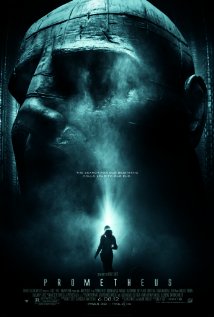
I don’t care about the backstory of Prometheus.  I know it’s the latest effort by the acclaimed Ridley Scott (American Gangster), but other than that I know nothing about it.  I later discovered that it was intended as a prequel to the Alien franchise, Scott’s hit science fiction offering starring Sigourney Weaver as a space traveler who becomes infected/possessed by an alien.  I wasn’t particularly intrigued by the trailer, but the buzz around Prometheus began to swell, so I thought – why not check it out? The cast looked good, if nothing else.  I’m a fan of Noomi Rapace (The Girl With the Dragon Tattoo), Charlize Theron (Hancock), and Idris Elba (Thor).  Michael Fassbender (X-Men: First Class) was another noteworthy addition.

Rapace stars as Elizabeth Shaw, one of a cadre of intergalactic space travelers who are heading across the galaxy in a quest to uncover the secrets of the universe.  She is joined by Charlie Holloway (Logan Marshall-Green, Devil), who shares her rabid curiosity.  In total there are about seven or eight crew members, and their ship is piloted by Elba’s character Janek.  After landing on a foreign planet, two members of the crew discover a mysterious black goo.  They also learn that the human race descended from some early alien species bearing slight resemblance to humans now, only much larger.  Elizabeth is fascinated by the idea of learning about the inception of humanity and wants badly to know who or what created the human race and why.  They think the key to learning this will be instrumental in helping their home planet.  Elizabeth’s curiosity is premised on the idea that we were created by benevolent beings for a meaningful purpose.  This reminded me of the tenets of Christianity, as Christians believe that they were created with love by God in His own image.  However, the crew soon learns that our distant intergalactic ancestors were not so magnanimous in their creation of mankind.  When they encounter one in their exploration, he seems like he doesn’t appreciate being disturbed.  Meanwhile, the two members of the crew that discovered the black substance have been infected by it.  One is dead and the other barely alive.  Charlize Theron’s character is the leader of the crew, and she refuses to let the infected member return to their ship.  Unbeknownst to her, Elizabeth has also been infected, much like Sigourney Weaver was in the previous Aliens movie.  Elizabeth manages to oust the creature from her body, but it is still contained on the ship.

That was a very basic plot synopsis.  I really don’t know what else to say about Prometheus, other than I didn’t care for it.  It was not a bad movie, but it just didn’t do anything for me.  I probably got some of the finer points of the plot incorrect; but it doesn’t really matter, it’s close enough.  I was drawn in the by cast, and I did find them capable – but that was about it.  I asked others what they enjoyed about the film and they mentioned Noomi Rapace’s resilience.  I agree that her character was a strong one, and I do think she is a wonderful actress.  However, it wasn’t enough to say that the movie was ‘good.’  Charlize Theron’s role was almost entirely inconsequential.  No big deal.  Neither was Idris Elba.  His American accent was horrible.  I should have listened to my first instinct and avoided this movie, mainly because Sci-Fi movies are not my preferred genre.  I don’t like the average Sci-Fi movie; I only enjoy the very high concept ones like Inception or Avatar.  I usually give letter grades for movies, but I think I should abstain in this case, because it wasn’t a bad movie; I just didn’t care for it.  Remember those pass/fail classes you took in college, where no letter grade was given, you simply just pass or fail?  Prometheus gets a pass.