2016 Movies

Jason Bourne

I try to keep celebrities’ personal lives separate from the way I view their work, but sometimes it’s hard for me to draw a line between the two. Matt Damon (The Martian) was one of my favorite actors, and I thought of him as cool and smart, and he is – but recent comments have lead me to believe that he’s tone deaf at best, and ignorant at worst as it pertains to diversity in Hollywood. As an aspiring screenwriter, this troubles me. I still appreciate his work as an actor, but I can’t divorce myself from his recent statements and opinions. That being said, of COURSE I was going to see Jason Bourne. I own the first three installments in the trilogy on DVD, and I’m a big fan of the franchise.

Jason Bourne promised to reveal the secrets that have always tormented the super spy from the beginning. Who is he? Who can he trust? Has his government betrayed him? Unfortunately, I think the film was long on promises and short on results. It opens with the familiar face of Nicky Parsons (Julia Stiles, 11:55) whom you may recall is one of Bourne’s few allies. She hacks into the CIA database, accessing their black ops files in the hopes of gaining intelligence that might help Bourne piece together his past, including information about his father. Meanwhile, our hero is off the grid, earning a living as a bare-knuckle boxer. When Nicky reconnects with Bourne, she leads The Agency right to him, as they began tracking her as soon as the files were hacked. Headed by Director Dewey (Tommy Lee Jones, Criminal), the CIA dispatches an operative (Vincent Cassel, It’s Only the End of the World) to dispose of both Jason and Nicky.

What follows next is an exotic game of cat and mouse, as Bourne criss-crosses the globe in an attempt to exact revenge upon the CIA for betraying him. He is as formidable as ever, dispatching foes with ruthless efficiency. However, from a viewer’s standpoint, these scenes didn’t excite me. Part of the appeal of the first three Bourne movies was witnessing great hand-to-hand scenes like this one: https://www.youtube.com/watch?v=Yp2mYEKLxcA . If Bourne is knocking people out with one punch, where is the fun in that? Furthermore, the intrigue and mystery just weren’t there for me. The backstory involving his father was never fleshed out in a satisfying manner. The movie just felt like an opportunity for Damon to cash in, though he certainly doesn’t need the money. I thought he had moved on from this franchise? That’s why Jeremy Renner (Captain America: Civil War) stepped in for The Bourne Legacy. Now we have another installment with Damon and instead of rewarding, it’s just disappointing.

The film’s final act was effective, but after two hours of mediocrity, it wasn’t enough for me. And I wanted to like this movie, trust me. This franchise should’ve ended in 2007 and been limited to the true trilogy it once was. Grade: C
The Infiltrator

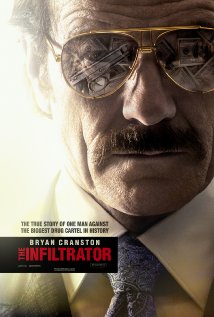
The Medellin drug cartel (helmed by notorious kingpin Pablo Escobar) at its pique flooded the U.S. with approximately half a billion dollars worth of cocaine per week in the mid 1980s, under the approving eye of the American government. This was all very clandestine at the time, but in recent years it has become accepted political history rather than mere fodder for conspiracy theorists. Television shows like Netflix’s Narcos and films like last year’s Kill the Messenger have pulled back the curtain on Escobar’s notorious exploits and the subsequent fallout, respectively. The Infiltrator, starring Bryan Cranston (Breaking Bad), offers a unique glimpse into the American effort to bring down Escobar’s empire.

If you’ve seen The Wire, you will recall that Detective Lester Freamon made a breakthrough in his drug case against Stringer Bell and Avon Barksdale after he stopped following the drugs and started following the money. U.S. Customs Agent Robert Mazur (Cranston) applies the same logic to bringing down Escobar. After his undercover efforts yield middling results, he switches his strategy, making inroads with perimeter players in Escobar’s network, particularly those who launder the ill-gotten proceeds of his trade. He goes undercover using the alias Bob Musella, operating as money launderer between Escobar’s associates and foreign financial institutions.

Fellow agent Amir Abreu (John Leguizamo, Ice Age: Collision Course) makes the appropriate introductions, and soon “Musella” is in. Their circle includes informants, criminals, and assorted lowlifes, and the stakes for Mazur could not be higher. He could’ve opted for retirement, but instead he dives even deeper into the underworld. A devoted family man, he maintains his integrity at the expense of his operation, while his marriage becomes increasingly strained. Slowly, methodically Mazur works his way up the food chain, with each new player getting him closer and closer to Escobar’s principal launderers. Cranston and director Brad Furman (Runner Runner, The Lincoln Lawyer) perfectly capture the tortuous duality of the undercover agent’s double life and its attendant betrayal.

Cranston does an outstanding job, infusing Mazur with dogged tenacity masking an omnipresent air of frustration and guilt. However, the most subtly revelatory performance might have come from John Leguizamo in his supporting role as the cocksure Abreu. I always appreciate the little non-verbal nuances actors bring to their roles, and Leguizamo did not disappoint. Whether a slight flicker in the eyes or a nearly imperceptible shudder, his performance bubbled with realism. Both he and Cranston shone brightest when their humanity conflicted with the tasks at hand, whether it was complicity in a murder or the need to befriend and then betray. I appreciated the film for its excellent performances and original perspective on a familiar story. The Infiltrator does not disappoint. Grade: A-

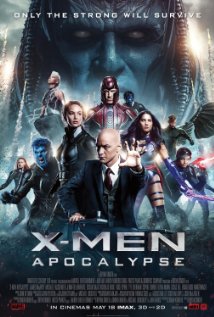
X-Men: Apocalypse

X-Men are among my favorite movie superheroes and always have been. I’ve loved every edition in the series, with the exception of X-Men 2. Director Bryan Singer (The Usual Suspects, X-Men: Days of Future Past) has infused the franchise with fresh energy by adopting a sort of prequel format established in the last two or three movies. By introducing us to a younger Magneto, Mystique, Xavier, and company, Singer cleverly extends the life of the franchise. The only constant character is the perennial Wolverine (Hugh Jackman, Eddie the Eagle). Boasting additional new young iterations of our favorite characters, X-Men: Apocalypse did not disappoint.

The movie begins in ancient times, as the Egyptians engage in religious ritual. Their apparent ruler is a strange behemoth with purplish, leathery skin called En Sabah Nur (Oscar Isaac, Ex Machina). He will eventually come to be known as Apocalypse, and his existence proves mutants were around long before Professor X (James McAvoy, X:Men: Days of Future Past) became aware of them. Apocalypse and his followers attempt a supernatural energy exchange with another person, which is disrupted by dissidents seeking to overthrow his regime. Apocalypse is buried alive, left undisturbed until the Egyptian ground shifts and he is awakened thousands of years later in 1983.

After his epic snooze, Apocalypse awakens to a world dominated by humans. He doesn’t like mutants’ stature and seeks to upset the proverbial apple cart by encouraging them to take their rightful place atop the food chain. He quickly assembles a team, including (a much younger) Storm (Alexandra Shipp, Straight Outta Compton), Magneto (Michael Fassbender, Steve Jobs), and newcomers Angel and Psylocke (Olivia Munn, Zoolander 2). Religious themes ran throughout the movie, with Apocalypse displaying god-like abilities as he actually makes his team of mutants better. He enhances their powers and shows them how to maximize their gifts. For example, we know Magneto controls metal objects. If there’s no metal readily available, one might think he’d be powerless in that moment. However, there are metals and minerals in the ground. Magneto can literally move mountains if he wanted.

Professor X learns of Apocalypse, whose powers are nearly insurmountable. Meanwhile, enrollment at Xavier’s School For Gifted Youngsters increases as Scott Summers/Cyclops (Tye Sheridan, Mud) joins the fray. It was fascinating to see younger versions of the familiar characters we’ve come to know and love. It was particularly cool to see the first meeting between Cyclops and Jean (Sophie Turner, Game of Thrones), who will go on to have quite a love affair, albeit an intermittently one-sided one. I also enjoyed the barrage of 80’s pop culture references, from Thriller jackets to Tab soda. The film establishes the clear ideological dichotomy between mutants that runs throughout (chronologically) later films. Xavier is a pacifist almost to a fault, recognizing the importance of educating his students in a classroom, but leaving them woefully unprepared for battle and unequipped for self-defense. Apocalypse forces him to open his mind to a new approach, turning the tables on the benevolent professor and setting the stage for a showdown between good and evil.

A summer day at the movies should be entertaining, action-packed, and fun. With spot-on casting and a strong yet simple plot, X-Men: Apocalypse was all that and much more. I can’t wait to see what Marvel Studios has in store for us next. Grade: A-


Miles Ahead

Sometimes it seems like an actor was just destined for a role. Think about how inextricably linked Angela Bassett and Tina Turner are after the 1993 classic What’s Love Got to Do With It. Over the last decade or so we’ve seen a host of biopics centering on everyone from James Brown to Steve Jobs. When a biopic covers a musician it must be particularly hard for filmmakers to nail the depiction, because they have the added task of accurately capturing the subject’s artistry and creative process in addition to just an impersonation or exercise in mimicry. Don Cheadle (Captain America: Civil War) looks perfect in the role of Miles Davis, and his involvement with the film on a cellular level reflects the passion and commitment he brought to portraying this legend and musical genius.

The film opens in the ‘present’ year of 1979, as Miles is being interviewed. His record label is hounding him to hand over tapes from a recent recording session, while Miles demands to be compensated first. He lives reclusively, his large brownstone a lonely, haphazard jumble of papers and clutter. Enter Rolling Stone reporter Dave Brill (Ewan McGregor, Star Wars: Episode VII: – The Force Awakens), an intrepid nuisance determined to pen the Miles Davis comeback story. Through Miles’ conversations with Dave we are taken via flashback to the 1950s, when Davis first rose to prominence on a national stage. He is particularly haunted by memories of his first wife Frances (Emayatzy Corinealdi, The Invitation), a vibrant and lovely woman whom Miles stifles in his demand that she give up her love of dancing to be his doting wife.

Cheadle was the uncanny embodiment of Miles Davis, from his signature rasp to his seemingly affable, accessible demeanor. He captured an interesting duality, showing that Miles was very aware of his own greatness, yet he had an approachable, selfless air about him. The epitome of cool. Most importantly, he provided a glimpse into Miles’ creative process, as we see him work on studio arrangements with other composers and delightfully improvise at home with Frances, during some of their more tender, intimate moments. Not that he needed it, but Cheadle humanized Davis, even in some of his darker moments. The film never demonized Davis, even as it exposed drug abuse and womanizing infidelity.

What an interesting, artful film. I don’t have any real criticism, only a few observations. Cheadle obviously selected a very narrow slice of Davis’ life to explore, rather than an extensive chronology of his childhood, musical beginnings, or other lovers (I had no idea he dated Cicely Tyson – she’s not referenced at all). I felt that the film presupposes a basic familiarity with Davis, and I guess that’s ok. I applaud Cheadle for his unique approach. Not every biopic is going to read like a step-by-step biography. The film was filled with musicality and warmth, yet left an air of mystery around the legendary jazzman. Cheadle did a masterful job on and off screen, and I hope he is rewarded for his performance. This was an emotionally gratifying portrayal and I recommend it to anyone looking for something a bit different at the theater. Grade: A


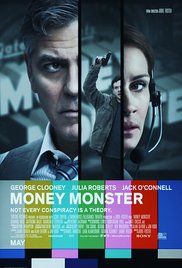
Money Monster

There are many ways to tell a story, and one of the great things about film is that it offers the freedom to explore a range of narratives. A sweeping epic may unfold at a leisurely place over the course of two hours. A movie that takes place in a single day will be presumably action-packed and fast-paced, as there is little time for character or plot development. Money Monster promised a glimpse into a day in the life of two men on a particularly harrowing day for both.

George Clooney (Hail, Caesar!) stars as Lee Gates, a Jim Cramer type of character who mixes buffoonery with financial advice on his own cable show. I was amused to see the typically suave Clooney bounce around like a ham-handed carnival barker, flanked by two ‘dancers’ in costume like a bad rap video. Julia Roberts (Secret in Their Eyes) is Patty, his calm and cool producer who helms the ship, making it hum like a well-oiled machine. Gates has a duplicitous, opportunistic aura, sort of like a cross between a car salesman and a stockbroker, with more style than substance. When one of his tips to invest in a company called IBIS proves disastrous, disgruntled viewer Kyle Budwell (Jack O’Connell, Unbroken) exacts his own brand of justice by taking over the television studio during a live broadcast.

An unhinged protagonist is familiar cinematic territory, whether our anti-hero is robbing a bank or holding hostages. Common themes are desperation and a nearly suicidal level of commitment. Kyle is armed with a detonator and makes Lee wear a vest rigged with explosives. He blames the loss of his life savings on the TV host, whose offhand prediction cost him dearly. Dominic West (Genius, The Affair, The Wire) is featured as Walt Camby, IBIS’ shady CEO who claims an unforeseen glitch in his company’s financial algorithm caused the stock to take a hit. At first Kyle’s ire is directed solely at Lee, but Gates is able to pass the buck on to Camby, whose explanation for the massive loss is questionable at best.

Jodie Foster (Elysium) marks her return to directing here, and quite naturally I had high expectations for such an acclaimed collection of Hollywood’s elite. I won’t use the word disappointed, but Money Monster was more decent than memorable. I enjoyed the subplot involving supporting characters as they worked to uncover the truth behind Camby’s questionable geo-political business dealings, but for the most part the tension and tautness wasn’t there. Perhaps the fault lies in the script, as I thought Foster’s direction within the tight confines of the television studio was effective. The small space added to the air of desperation, but overall the film wasn’t something that stayed with me. Sometimes a day at the movies is just a passable one, and while that’s enough for some – others may want a little more. Grade: B

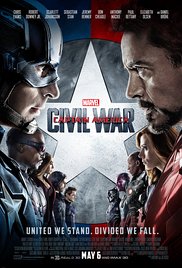
Captain America: Civil War

Marvel is only competing with itself at this point. A favorite at the box office and in fans’ hearts – the comic titan sits alone atop the superhero landscape, and it’s not even close. I personally don’t care for each installment (Thor 2, Avengers: Age of Ultron were rather lackluster), but overall Marvel boasts the most compelling, cool superheroes – both on the small screen (Daredevil, co-starring Punisher and Elektra) and big screen alike. Captain America: Civil War assembles an assortment of our favorite superheroes in a unique way, and for once the plot was not bogged down with confusing, unnecessary details.

The film opens with the Winter Soldier (Sebastian Stan, The Martian), Captain America’s (Chris Evans, Avengers: Age of Ultron) familiar bestie/nemesis from his last solo film. The Winter Soldier’s brainwashing was neutralized when we last saw him, but he is easily triggered, or ‘activated’ into becoming a killing machine once again after hearing a sequence of certain code words. The movie flashes back to 1991, where we see him executing a mission involving the theft of what appears to be a chemical agent. We also see a brief scene involving a young Tony Stark (Robert Downey, Jr., Avengers: Age of Ultron) and his parents before their untimely demise, also in 1991.

In the present day, half of the Avengers thwart a plot to steal biological weaponry in Nigeria, resulting in significant but inevitable collateral damage. This has become a disturbing recurring theme with the Avengers and other superheroes, and the U.S. government and other global nations are fed up. The Secretary of State (William Hurt, Race) proposes to Stark that the Avengers and other individuals with special abilities submit to the control and discretion of a United Nations panel which would govern when and where they could execute any life-saving missions, surrendering their autonomy in an effort to avoid unnecessary casualties. Stark particularly feels guilty about his role in the inadvertent killing of a promising young student in Sokovia, so he’s primed to be on board with the Secretary’s demands. Captain America, however, doesn’t want to be hampered in his efforts to execute his patriotic duty and save whomever he can, whenever he can.

The stage is set for a civil war, as Iron Man, Black Widow, War Machine, Spider-Man, and Black Panther agree that the UN should hold sway over them and other superheroes. Diametrically opposed are Captain America, Falcon, Winter Soldier, Hawkeye, Scarlet Witch, and Ant-Man. I mentioned Black Panther, who makes his debut here. When the African nation of Wakanda is threatened by an act of war in response to their efforts to curtail the Avengers’ deadly global overreaching, a new superhero is thrown in the mix. Chadwick Boseman (Get on Up) emerges as T’Challa, also known as Black Panther. He swears vengeance on whoever is responsible, aligning himself with Iron Man in pursuit of the Winter Soldier.

The common themes running through Civil War were vengeance, loyalty, and guilt. It was guilt that drove Iron Man to vehemently advocate for what Captain America believed to be a dangerous chilling effect on their collective autonomy and his own very raison d’etre. It was vengeance that fueled Black Panther and Iron Man, in an explosive final act. Finally, it was loyalty that was either doggedly adhered to (Captain America and War Machine) or painfully questioned as new allegiances were formed. We don’t often see this plethora of ‘supes’ in one film, and of course there is just an initial WOW factor as this bomb ass hodgepodge occupies the same space. The humor injected into the dialogue was well timed and not forced. The introduction of new characters like Black Panther and Spider-Man (I’m referring to new actor Tom Holloway as our friendly neighborhood arachnid) was seamless. The storytelling was simple, yet strong. In short, Captain America: Civil War lived up to the hype – and what more could we ask for? Grade: A.

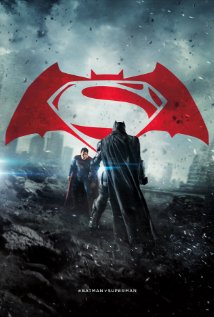
Batman v. Superman: Dawn of Justice

Ever since Ben Affleck (Gone Girl) was announced as the next iteration of the Caped Crusader, movie buffs and fan boys alike have been waiting with baited breath to behold this epic clash of titans in Batman v. Superman. Most fans have maligned Affleck’s selection, but I reserved judgment. Affleck’s career experienced a brief downturn during the J-Lo era, but I thought he rebounded nicely as early as 2006 with Hollywoodland. I like Ben Affleck and if anyone tells you he’s what’s wrong with this film – they are mistaken.

I looked forward to this, cautiously optimistic about what director Zac Snyder (300, Sucker Punch) would do with the franchise after taking the helm over from Christopher and Jon Nolan (The Dark Knight Rises). Batman v. Superman begins with the familiar exposition of the murder of Bruce’s parents, Thomas and Martha Wayne. We then move forward to the recent past, and the inception of Batman and Superman’s mutual disdain. When one of Superman’s epic battles leaves an avalanche of destruction in its wake, including the decimation of one of Wayne Enterprises’ properties, Bruce is furious. Meanwhile, Clark Kent (Henry Cavill, The Man From UNCLE) is none too fond of Batman, bristling at the cavalier vigilante who has won Gotham’s heart by taking the law into his own hands. To be clear, Batman doesn’t trust an alien with god-like abilities; conversely Superman thinks the billionaire is reckless and should be contained.

The stage is set for battle, after a young Lex Luthor (played by a terribly miscast Jesse Eisenberg, Now You See Me) pits the two against one another. Luthor and LexCorp have weaponized kryptonite, in the event that Superman ever needs to be neutralized. After Congress denies his request for government approval, he moves forward with another plan, hoping that the two heroes will take each other out. The plot was a little thin, and I was never emotionally invested in any outcome for either hero. When Batman and Superman finally square off, it is laughably apparent just how overmatched Batman (a mere mortal) is when facing a real superhero with powers beyond a utility belt. Only with the tried and true trick of kryptonite can he keep pace with Superman. Affleck clearly bulked up for the part, which makes sense – but why was he a slow, lumbering oaf with little agility and quickness? It looked as if even the likes of Daredevil could handily dispatch Batman.

I thought the movie was just ok. It wasn’t as horrible as the blogosphere is making it out to be, but it was rather underwhelming, plagued by poor casting and an underdeveloped, nonsensical plot. Eisenberg was miscast as Luthor. Instead of a criminal mastermind, Lex Luthor seemed like a bratty, petulant teen – hardly a worthy foe to a much more mature Batman or Superman. Batman seemed slow, and the fight sequence wasn’t as jaw dropping as I expected. One scene involves Superman 1) retrieving some kryptonite and 2) using it to kill something; how is this even possible?! There were some cool, entertaining moments, but they were few and far between. Moreover, I don’t really like the way Wonder Woman (Gal Gadot, Triple 9) was incorporated. The character wasn’t properly integrated in the storyline. Perhaps she was supposed to be mysterious, but I never felt like I understood her motivations or history.

Lastly, I just can’t get the Nolan’s interpretation of Batman out of my head. It was just a superior trilogy, and I don’t particularly care for what Snyder has done thus far. I’m still curious to see what Ben Affleck can do in the role, whenever he gets a solo Batman film. I thought he looked the part, but I would like to see more in the future. Superman is just a boring character to me, and Henry Cavill didn’t do much to change that opinion. Superman has all the power and none of the personality, easily distracted like a simp when Lois Lane (Amy Adams, American Hustle) is in danger. Corny! The cinematic edge still goes to Marvel, and all this movie did was make me anticipate Captain America: Civil War even more. Grade: C

Triple 9

I like to remain open-minded about my film experiences, and sometimes I take a more cerebral approach to my cinematic choices by occasionally venturing beyond my comfort zone. But when all else fails, stick with what you know. When I saw the trailer for Triple 9, I knew this was my type of movie. Reminiscent of movies such as Training Day and Street Kings, Triple 9 promised a gritty look into the seedy world of corrupt law enforcement and the criminals to whom they are indebted. Featuring a talented cast including the likes of Chiwetel Ejiofor (Secret in Their Eyes, The Martian) and Kate Winslet (Steve Jobs), my curiosity was sufficiently piqued. It looked like the type of movie to fly under the radar, and sure enough my theater was sparsely populated.

I often say that movies are won and lost in their opening and closing sequences, and Triple 9 started with a literal bang and never let up. It begins in the back of a van, without about six men gearing up for what appears to be some type of tactical mission. Are they cops? A swat team? Bank robbers, or all of the above? They expertly execute a bank heist with precision, targeting only a singular safe deposit box. As they flee the scene of the crime and peel off their masks, we see that most of them are actually cops. They are lead by Michael Atwood (Ejiofor), ex-military private security, police officers Marcus Belmont (Anthony Mackie, The Night Before), Franco Rodriguez (Clifton Collins Jr., Transcendence), ex-cop Gabe Welch (Aaron Paul, Breaking Bad) and his brother Russell (Norman Reedus, The Walking Dead). The crooked bunch are working at the behest of the Russian mob, controlled by a very sinister Kate Winslet (Steve Jobs) as Irina Visalov, wife of an incarcerated Russian mobster.

Irina and Atwood’s relationship grows increasingly volatile after she ups the ante and insists they pull off another heist, this time from a Homeland Security facility – a nearly impossible feat. In a cruel stroke of genius, Rodriguez has a plan to divert local law enforcement’s attention while they pull of the job. When an officer goes down in the line of duty, his fellow brothers in blue respond immediately, citywide. Just as 187 is the police code for murder, 999 (triple 9) is the code for officer down, or in distress. If they can pull off a Triple 9, they can square things with Irina and walk away with a big payday. Stuck between the law and the mob, these crooked cops have their work cut out for them, leveraged to the hilt.

I enjoyed this movie for the simple reason that it was entertaining. There were some issues with pacing, as the movie wore on in its final act, but overall I enjoyed it because several scenes were nothing short of an adrenaline rush. The performances were mostly good, with Mackie and Ejiofor particularly bringing a convincing and conflicting emotionality to their roles. Winslet was as I’d never seen her, unnerving and vicious. The script faltered a bit here and there in terms of realism, but I mostly thought it was solid. You could say this was a poor man’s Training Day, and it won’t be remembered, but hey, I liked it! I give it a solid grade of: B

The Revenant

Leonardo DiCaprio (The Wolf of Wall Street) is at an interesting stage of his career. He’s been turning in critically acclaimed performances since 1993’s What’s Eating Gilbert Grape, with no obvious missteps in his impressive catalogue. He has been nominated for an Academy Award for acting four times, though he has never taken home a golden statue. It’s becoming somewhat of a running joke that he hasn’t won; and it shouldn’t be. After viewing The Revenant, I can say that he’s turned in arguably the performance of his career, and hopefully that elusive award is within his grasp.

DiCaprio stars as Hugh Glass, a weather-beaten trapper traversing the brutal frontier of 1820’s Midwestern America. We meet Glass and his fellow men as they fend off an attack from Native Americans, their party whittled down to just over a dozen men. This early scene sets the tone, as the men are equally vulnerable to both the harsh landscape and its native inhabitants. Glass faces an early challenge from fellow trapper John Fitzgerald (Tom Hardy, Mad Max: Fury Road), who doubts his navigational abilities and questions his leadership quite disrespectfully. He insults Glass and his teenaged son Hawk (newcomer Forrest Goodluck), whose Pawnee mother was murdered when he was just a boy. Captain Andrew Henry (Domhnall Gleeson, Ex Machina) acts as peacemaker, leading the decimated outfit while deferring to Glass as the more seasoned frontiersman.

While exploring the dense forest, Glass spies a pair of bear cubs. The mother isn’t far behind, and before he can fire a musket, she pounces viciously, instinctively protecting her young. The relentless grizzly slings a helpless Glass to and fro, mauling him mercilessly. This is the scene you’ve probably heard about, and it was incredible. Director Alejandro Inarritu (Birdman, 21 Grams) had me riveted, effectively employing creative camera angles and use of sound to transport the viewer alongside DiCaprio. We see, hear and feel what he does. As the beast heaves in and out the camera lens fogs with condensation, the fear primal and palpable.

After surviving the brutal attack, Glass’ men stitch him up as best they can. Realizing it’s impossible to carry him on a makeshift stretcher while climbing a steep, snowy mountain ridge, they agree that Hawk, Fitzgerald and a young trapper named Bridger (Will Poulter, The Maze Runner) will stay behind with the ailing Glass.  I don’t want to reveal too many spoilers, but if you simply consult the definition of revenant, you can deduce what happens when Fitzgerald is left to care for Glass. According to Merriam Webster, a revenant is one that returns after death or a long absence.

Inarritu has crafted a stunning film.  He extracted every ounce of ability from DiCaprio, down to the bone marrow. I’ve never seen an actor give so much of his body to a performance. Much in the way a prizefighter gives his body to his craft, DiCaprio completely immersed himself in the role of Hugh Glass. He was tender, vulnerable, physically and emotionally spent under the sheer weight of what he was called to do. He caught the flu several times while filming, consumed raw bison liver, and slept in an animal carcass. We’re accustomed to seeing actors transform themselves physically for roles, but this was different. DiCaprio didn’t alter his physique, but he endured tremendous physical hardship, and his performance was a revelation.

The landscape was ironically beautiful yet brutal, a brilliant juxtaposition Inarritu depicted masterfully. In one scene the snow swirled like interplanetary dust, one breathtaking scene of many. Moreover, I don’t usually pay attention to sound in film, but here it added to an overall feeling of visceral authenticity. Glass faced deadly internal and external conflict, battling the elements, animals and indigenous people alike. Inarritu harkened back to a period in American history influenced by the transcendentalism espoused by the likes of Thoreau and Emerson, capturing an aesthetic that belied the occasionally spiritual relationship between man and nature.  I could blather indefinitely about this film, a work of art. The Revenant is the first must-see film of 2016. Grade: A